Be Kind To Dragons

adventures at higher altitudes

Menu
  • Home
  • Nepal Treks
    • Langtang
    • Annapurna Circuit
    • Tsum Valley
    • Gokyo and Everest Base Camp
  • Out and About
  • Ceaseless Melody
  • The Daily Proverb
  • Classic Texts
Menu

Category: Nepal Treks

Nepal trekking lists

Mardi Himal Ridge and Annapurna Base Camp

Posted on August 13, 2025 by ianraitt
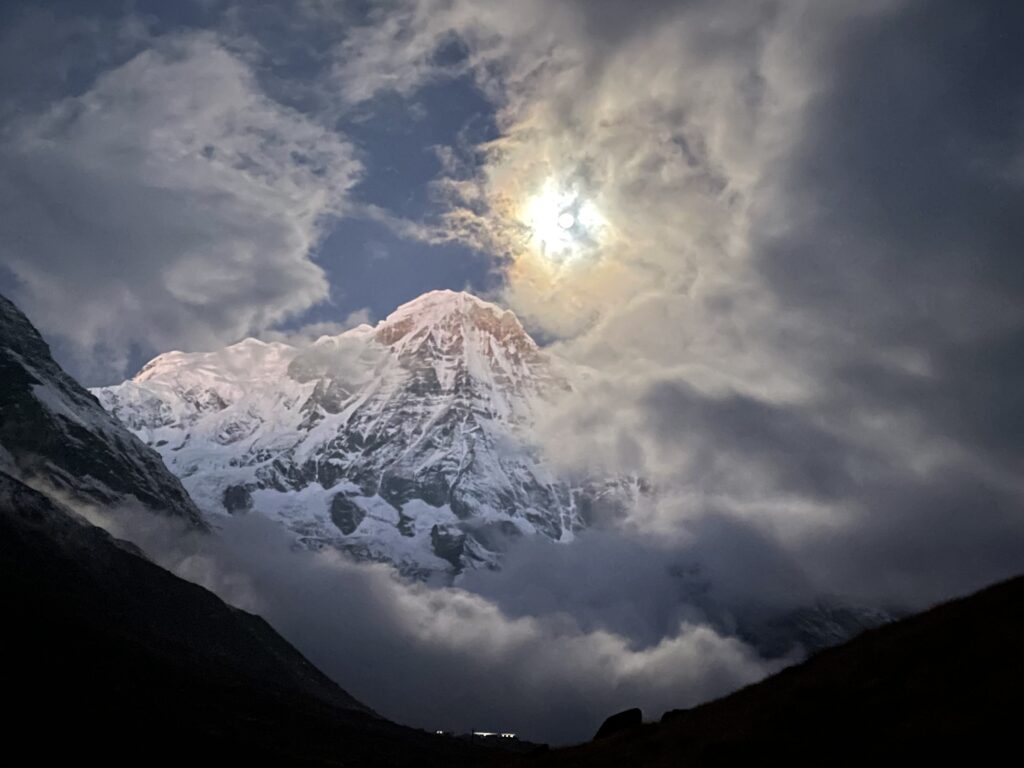
moonlight illuminates Annapurna I, lights of Base Camp visible

In late September 2025, a lingering low-pressure system over the Bay of Bengal and northern India caused a tremendous amount of rain to fall in Kathmandu and eastern Nepal. On Saturday 28th and Sunday 29th September from 240mm to 322mm of rain fell and parts of Kathmandu itself were flooded. It rained heavily for 40 hours, a continuous and dispiriting downpour. Since October is the start of the trekking season, tourism would be affected. Bridges, houses, highways were swept away, people displaced.
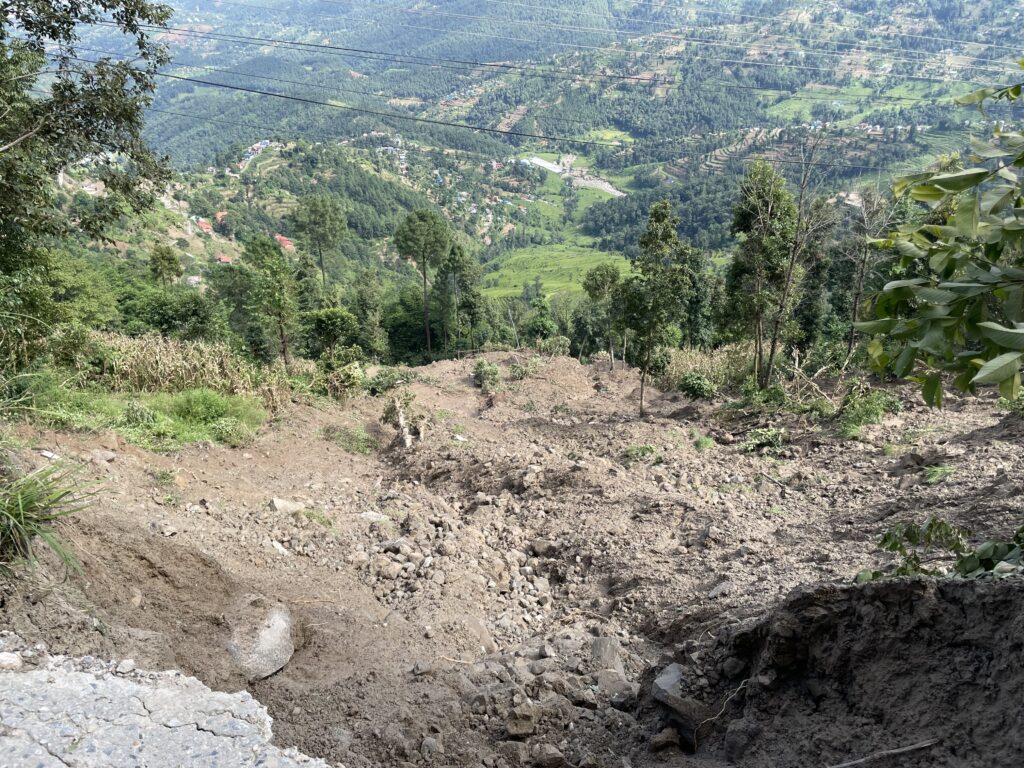
side roads are not built with proper drainage to cope with storms

In the aftermath, we walked a little way out of Dhulikhel towards Namo Buddha, and parts of the road below the Kali Temple, near where I used to live, had been swept away by the surging floods. I had been intending to go to the Everest region, but road transport had been severely affected, and flights were all booked up. The only possibility would be trying to go by helicopter, but these flights were full, and the price kept going up, so we switched to the Annapurna area, as the road to Pokhara was open. It did occur to me that I was acting like a selfish Western tourist, only devoted to getting into the trek, while all this devastation was hitting Nepal, almost like another earthquake. But somehow Nepal is very resilient and just keeps going.

Day 1: Kande to Deurali
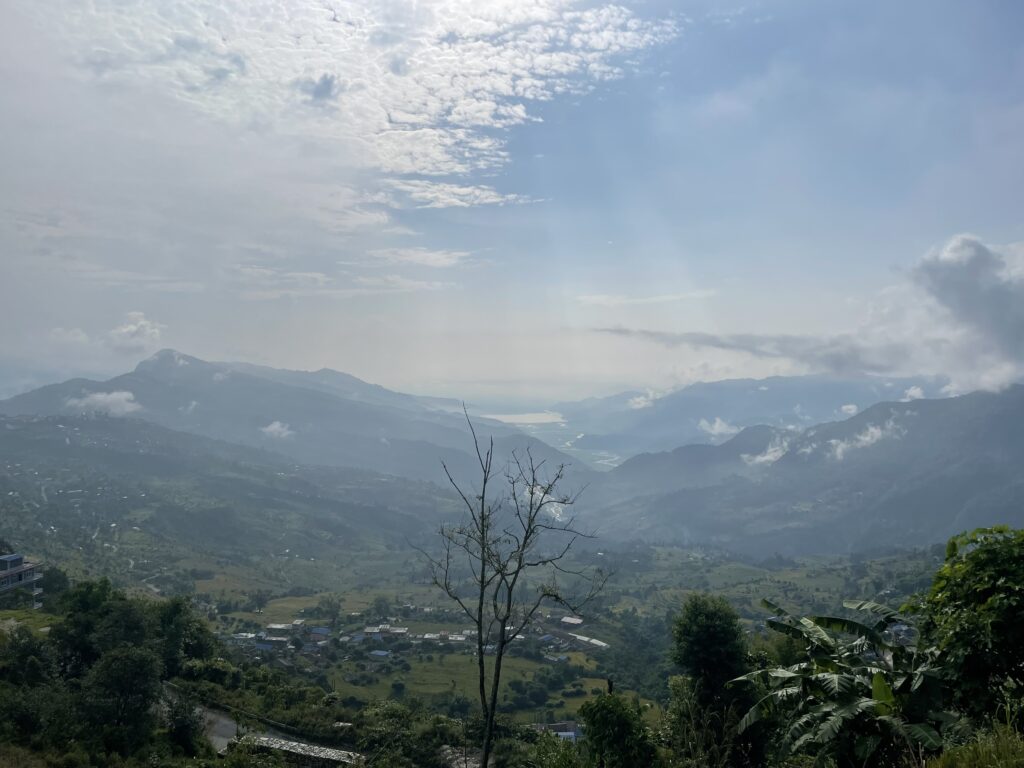
As we looked back towards Pokhara, everything was bathed in milky light; all that rain was still evaporating into a new cycle. Rain started again at 5:00 pm. No visibility, and not a very good outlook for clear views, with the forecast for rain continuing on and off for a week.

Day 2: Deurali to Low Camp
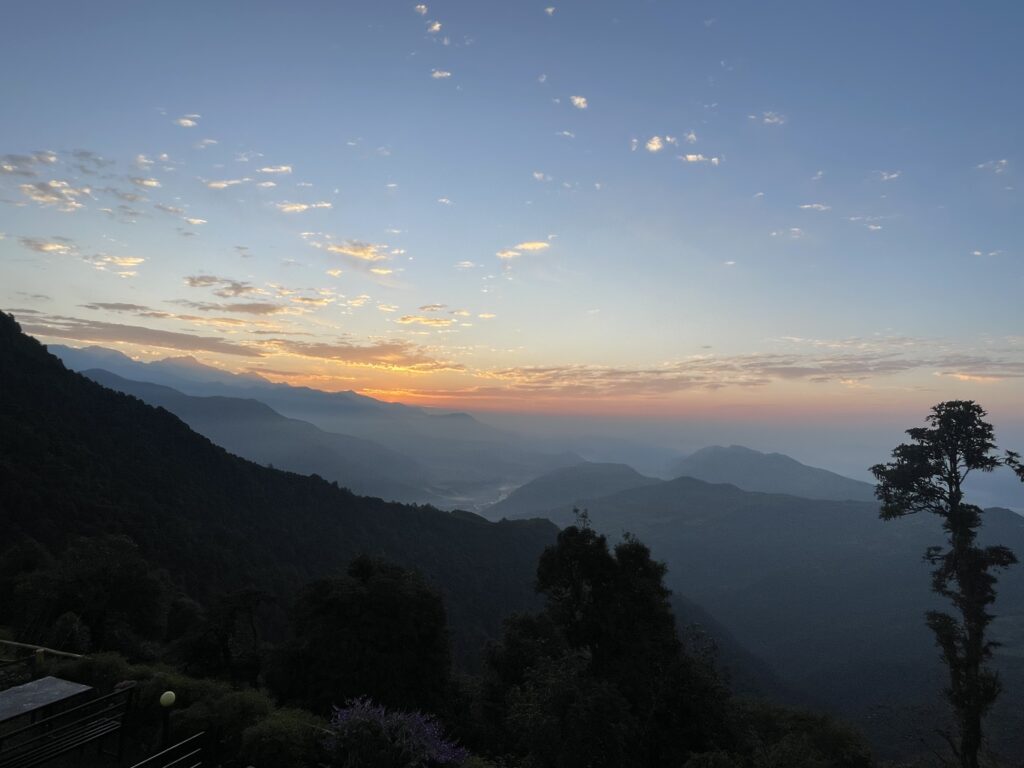
at least the early mornings were clear

A clear view at 05:30. Cloud billowed up the valleys at about 10:00. Despite all the rain, the path was in good condition, everything held in place by the trees, for example the hardy Himalayan Oak, Rhododendrons, all trunks mossy. It was still and silent, though with the buzz of cicadas.
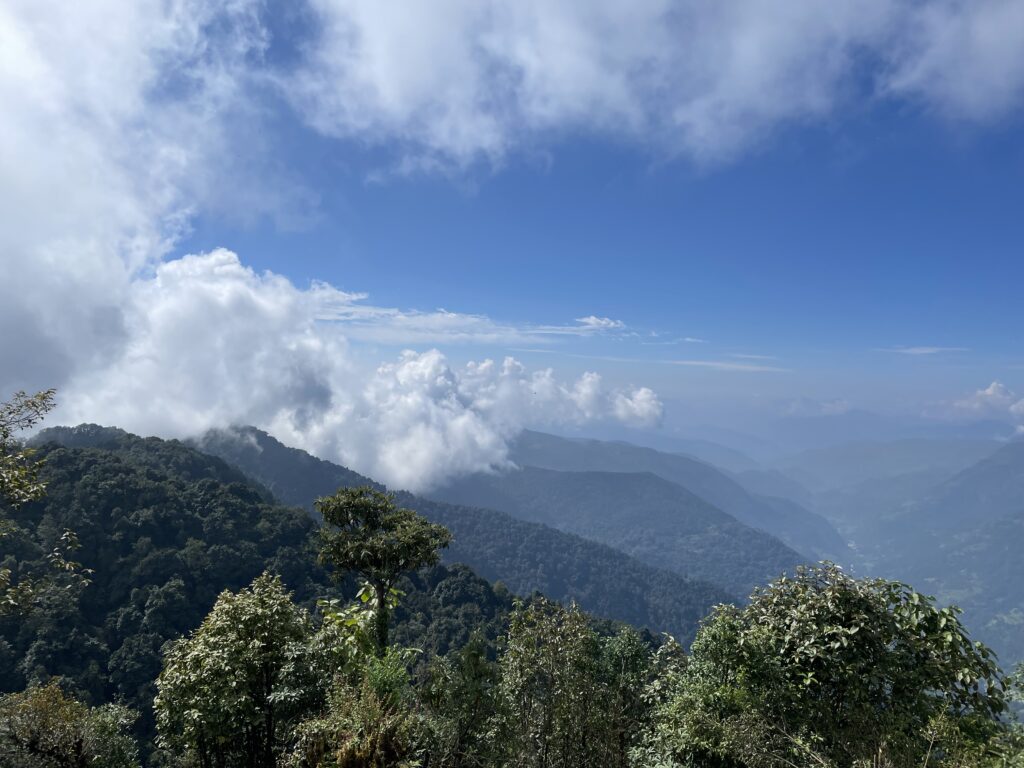
clouds quickly formed below as the hot and humid air starts to rise

Leeches evident. Blood soaked hand. Left pinkie kept bleeding, thanks to the anti-coagulant they inject. A spectacular thunderhead was visible at 18:00
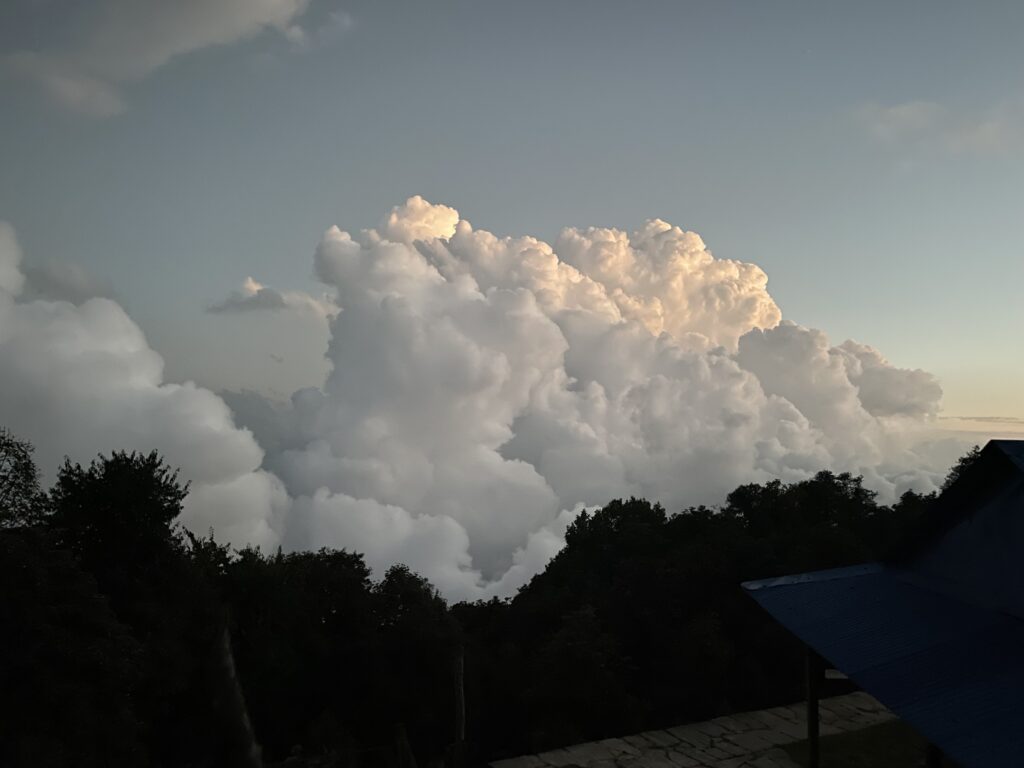
someone down there is getting a soaking

Day 3: Low Camp to High Camp

Bishnu, Pashupati and Purna, the ridge stretching ahead

The late monsoon was still producing a lot of moisture, and clouds formed from below through condensation, so clear views were only available early on. As we climbed up the trees started to thin out and became shorter. Suddenly we could see all the way to High Camp with a well-defined ridge. It was quite windy and cool when we approached the lodges at High Camp. Cloud battalions were advancing up the valley towards the Annapurna range. We could see the sheer walls on the Annapurna Base Camp trek, and all the villages beyond Chomrung. It was reassuring to see this quotation from John Muir:
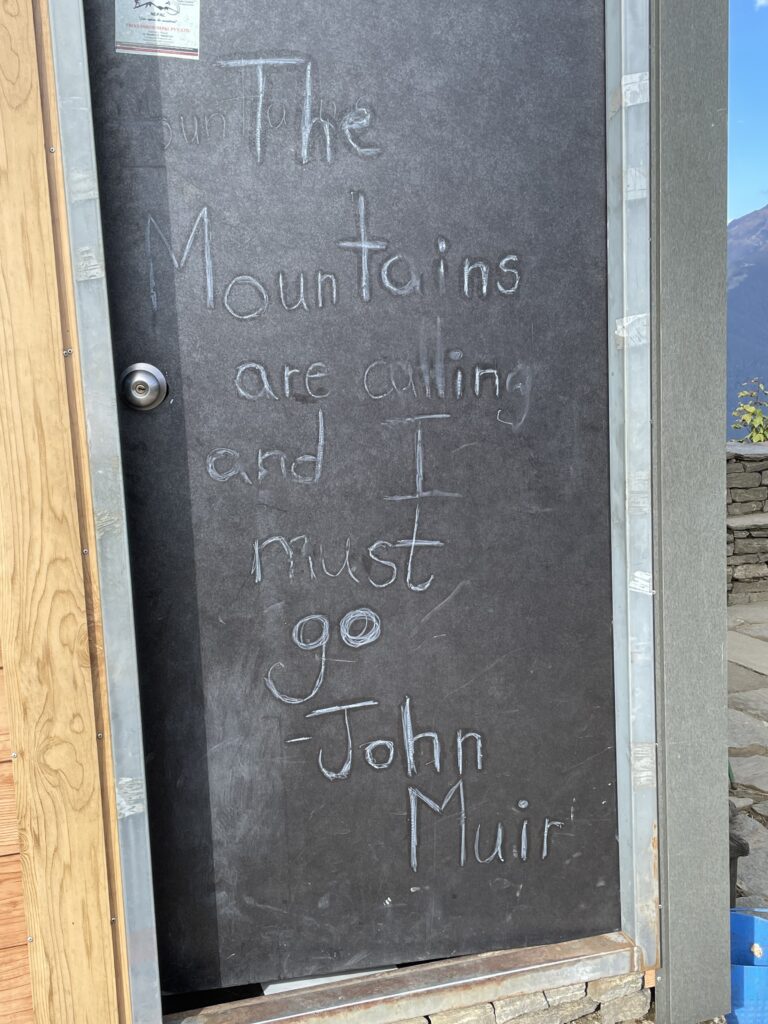
John Muir – Scottish born American naturalist and philosopher of nature (1838-1914)

Day 4: High Camp to Upper Viewpoint, and descent to Forest Camp

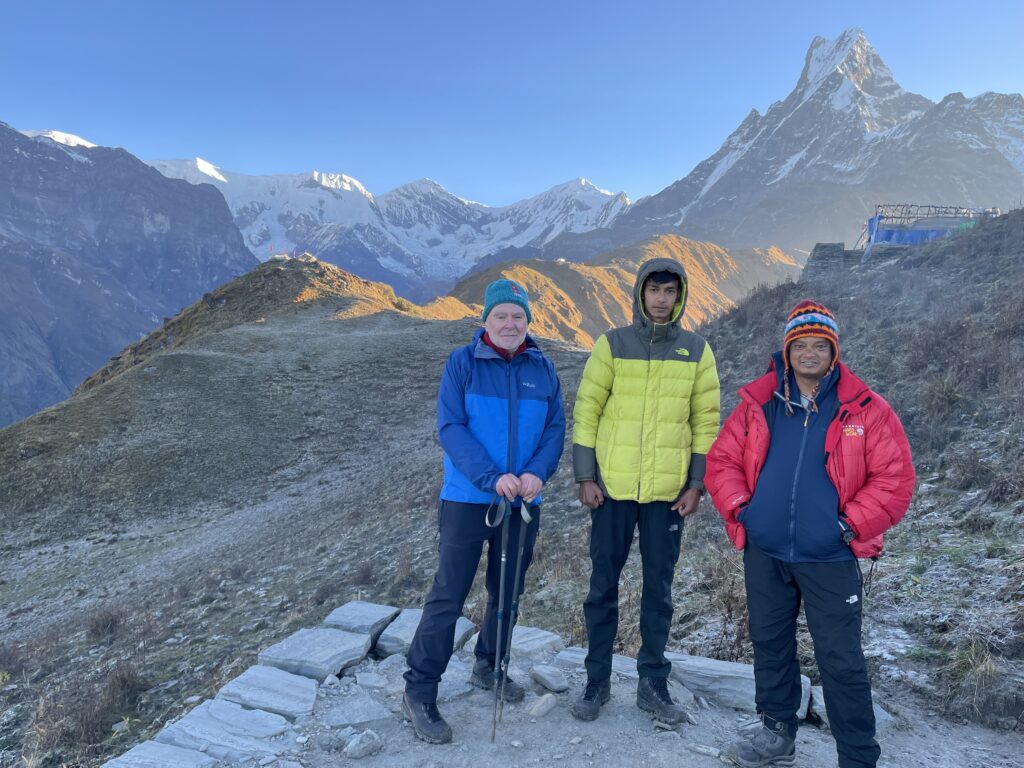
We left at 04:00 to catch the sunrise. Many people were going up, a visible flow of head torches. Sheep were sleeping on the path. We arrived after a two hour ascent, and in time for the sunrise, with about 70 people milling around. It was a little tempting to go on and escape the crowds at the viewpoint, but the ridge does get quite narrow, and there have been reports of people slipping.
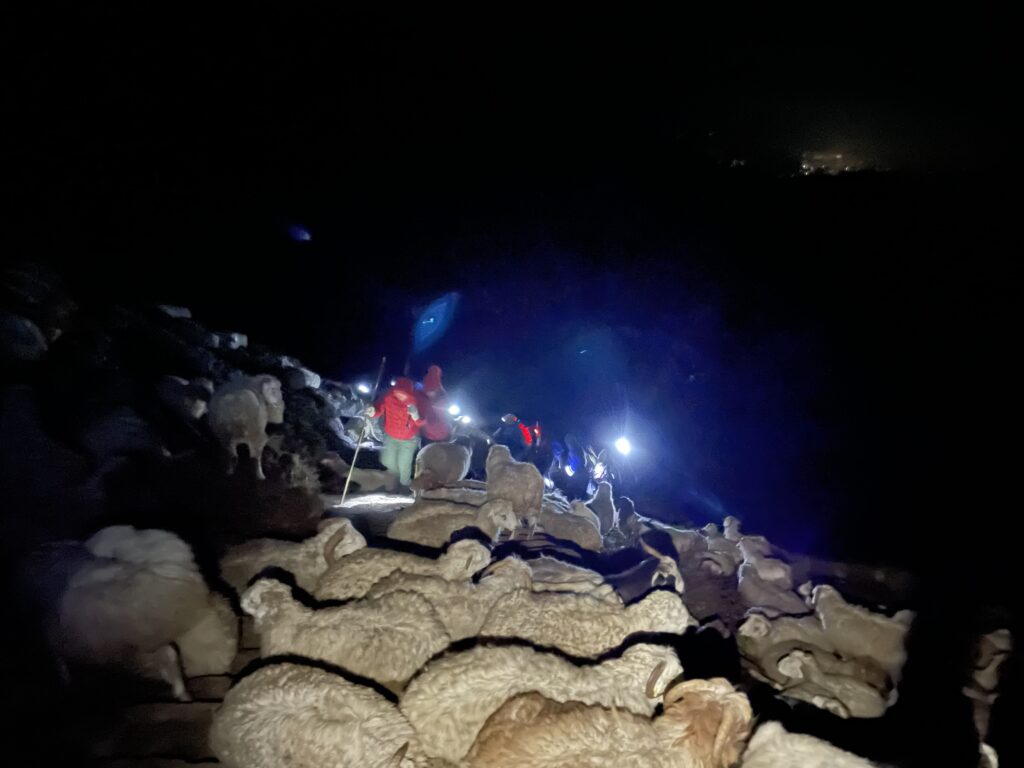
sheep rest impassively, blocking the path
discretion is the better part of valour

After breakfast at the lodge we continued down, a longish descent of 1600m and 20 km. The highest the rhododendrons will grow is about 4000m and all concentrated on one side of the ridge, either due to the soil or to get some shelter from the prevailing winds. They are stunted but just as beautiful.
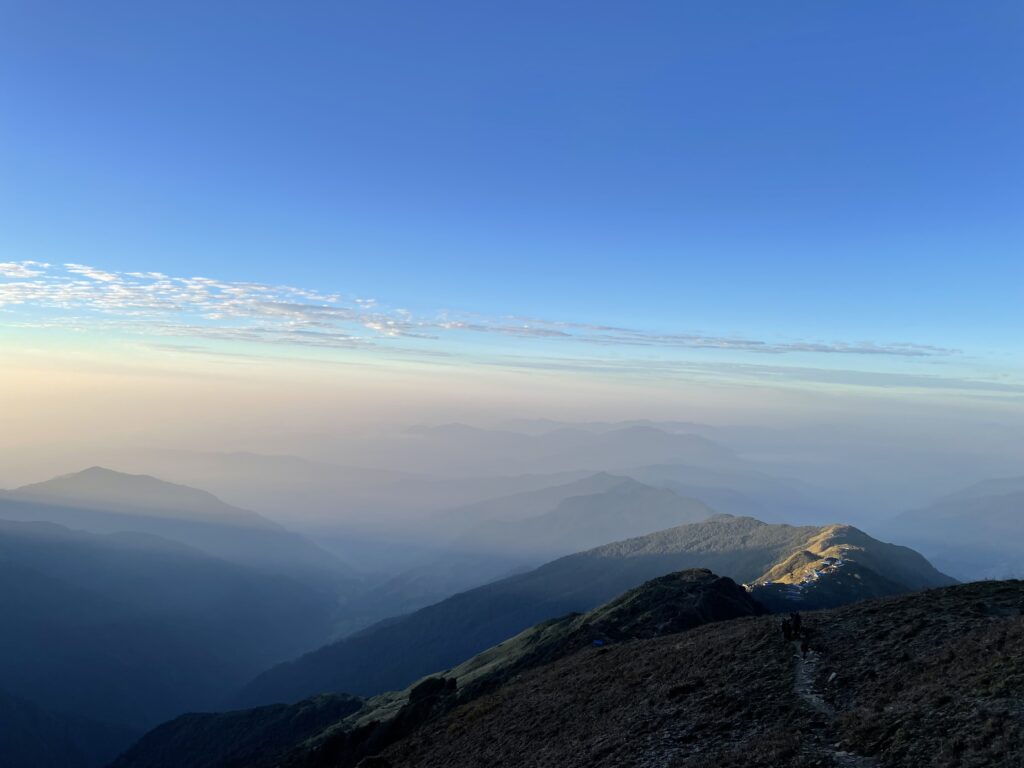
going down is always easier

Day 5: Forest Camp to Landruk

It was a drop of 1045m to Landruk. The weather was humid, windless and cloudy. There were many steep staircases on the way down, all wet and quite slippy. Handrails were in place for safety. We have met the following nationalities on the trek: Belgian, French, Australian, Swiss, Indian, German, Israeli, Japanese.
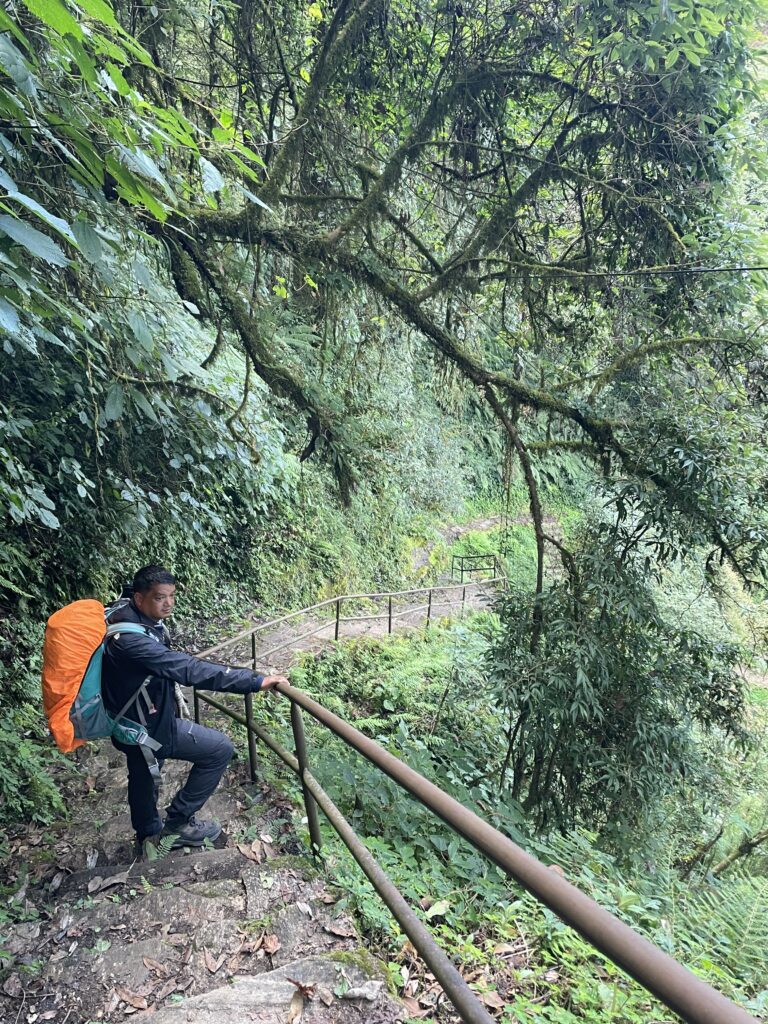
Bishnu in contemplative mood

Day 6: Landruk to Chhomrong

We still had to descend to the river this morning. We met a French guy aged 72, walking alone with a minimal pack. Plucky. Now the trail is much busier. After lunch there was a gruelling rise up to Chhomrong. The second longest suspension bridge in Nepal is impressive, and removes the very steep descent previously necessary.
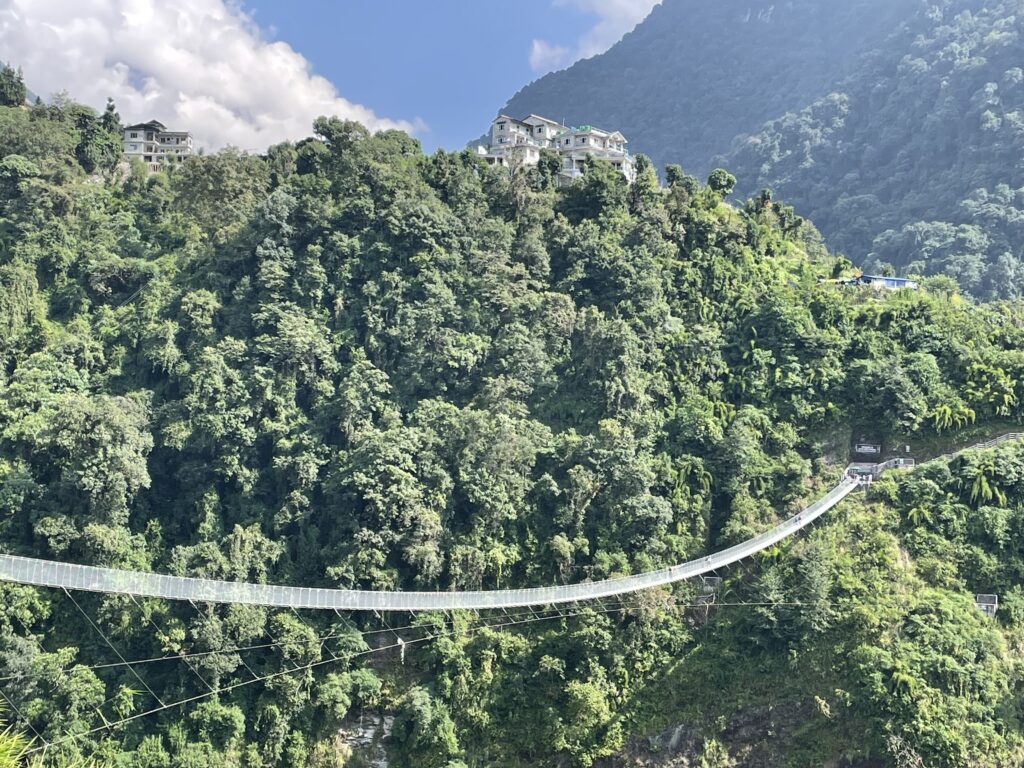
Day 7: Chhomrong to Bamboo
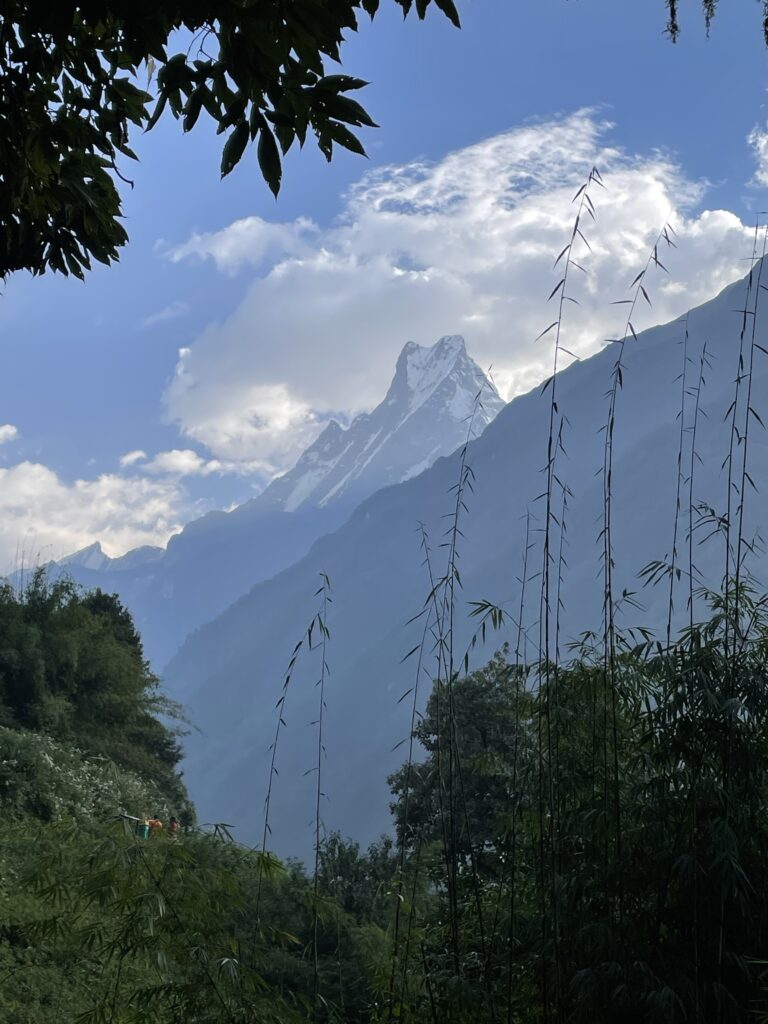
A strong stream ran by rice fields. A short day, but going up was still quite challenging, through the humid air. A large group had descended from the Base Camp, but there was no room at Bamboo, so they had to keep going to Chhomrong. It is apparent that this trek has become a ‘must do’ for young Nepalis, particularly during the Dasain festival, as I had never seen the trail as busy as this.

Day 8: Bamboo to Himalaya
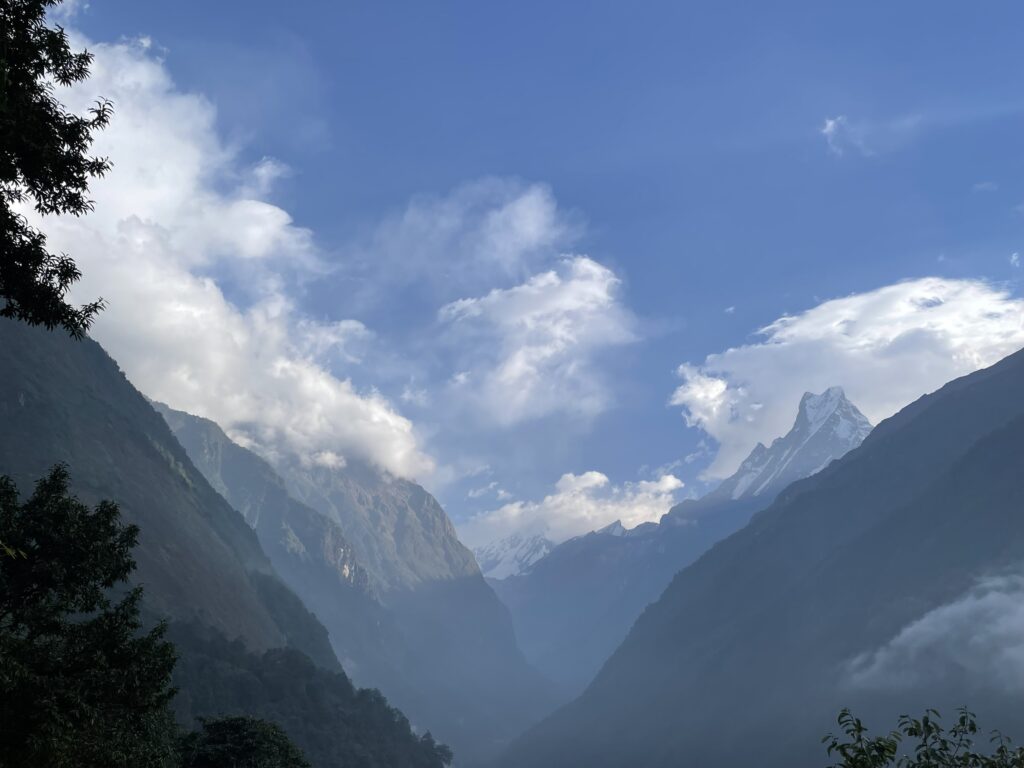
the valley narrows towards the Annapurna Sanctuary

Cloudier weather. Lunch in Doban then a steep rise to Himalaya, where the three lodges were packed. Rain fell shortly after arriving. Many dogs on the path, who seem to shuttle between the lodges.

Day 9: Himalaya to Machhapuchhre Base Camp
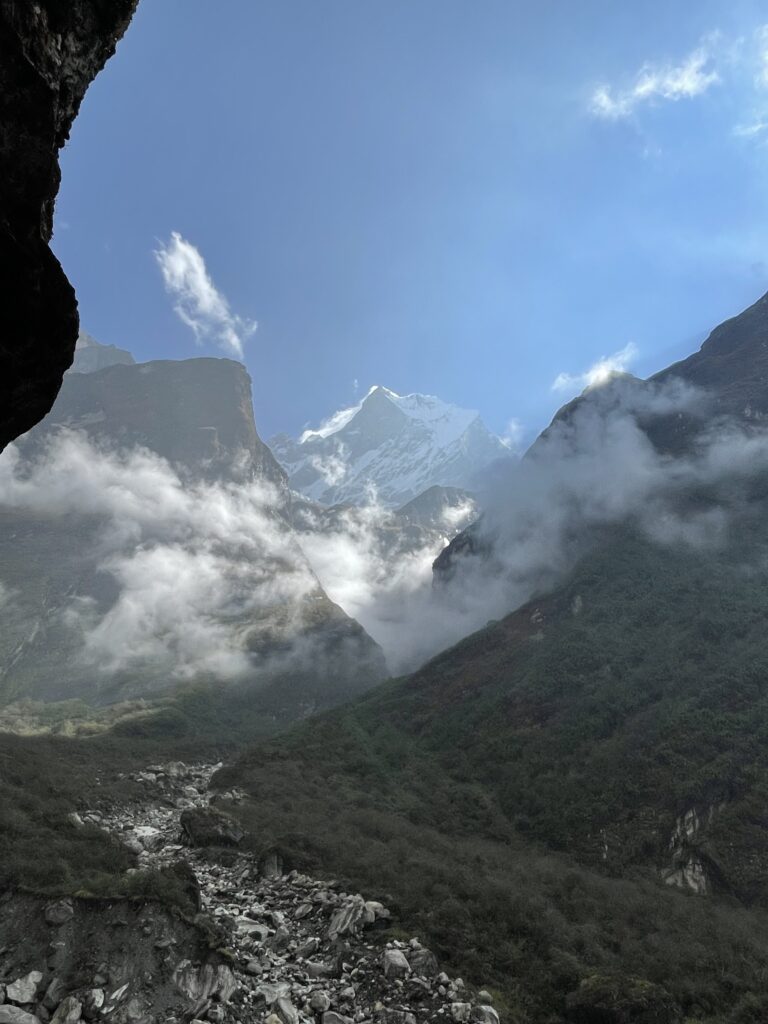
The trail is rockier and rather worn. We passed the avalanche zone, Himalayan birch trees by the path. If there is an avalanche, there is no warning and everything shoots off the heights and thunders down below. Anecdotally, someone saved themselves by going towards the river. A long slow climb up to MBC, where the lodges are impressively built stone structures. About 350 people an hour going up or down, certainly an impressive volume, if not tranquil.

Day 10: Machhapuchhre Base Camp to Annapurna Base Camp – down to Himalaya.
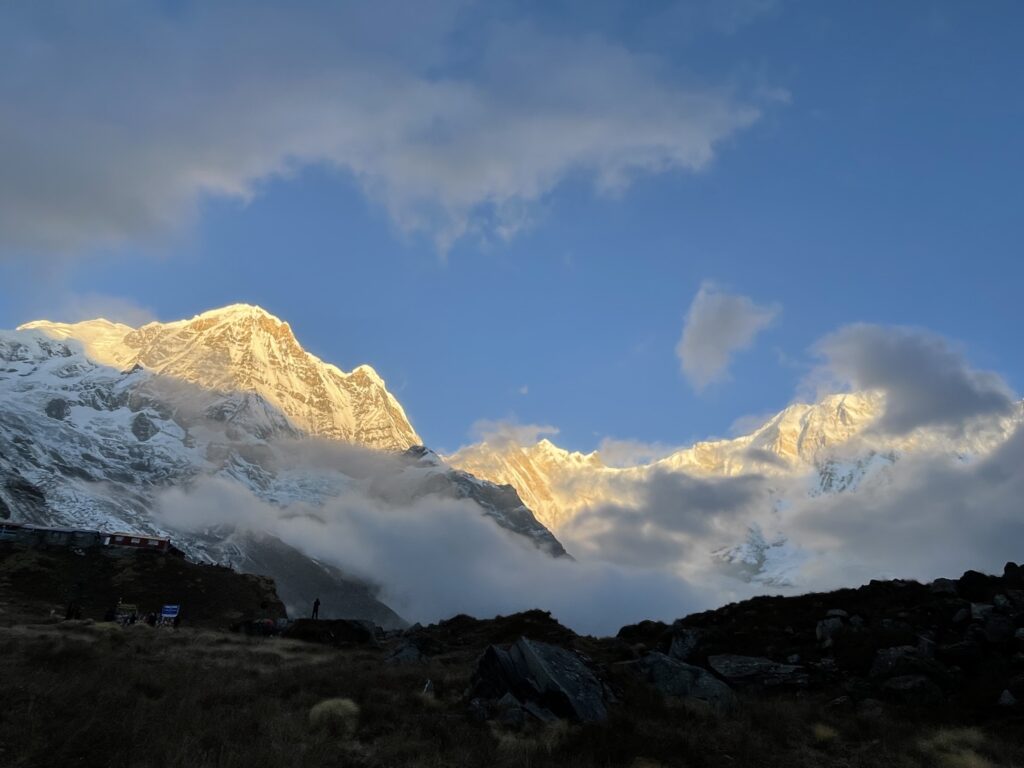
A sleepless night. Started off at 04:00. Some hot water to drink, and two Hobnobs on the way. Very much lacked energy, but kept going, and no other altitude effects evident. There were hordes of people out for the sunrise, many perched on the abyss above the glaciated valley which is crumbling away. Some new snow lay just above the base camp at 4130m.
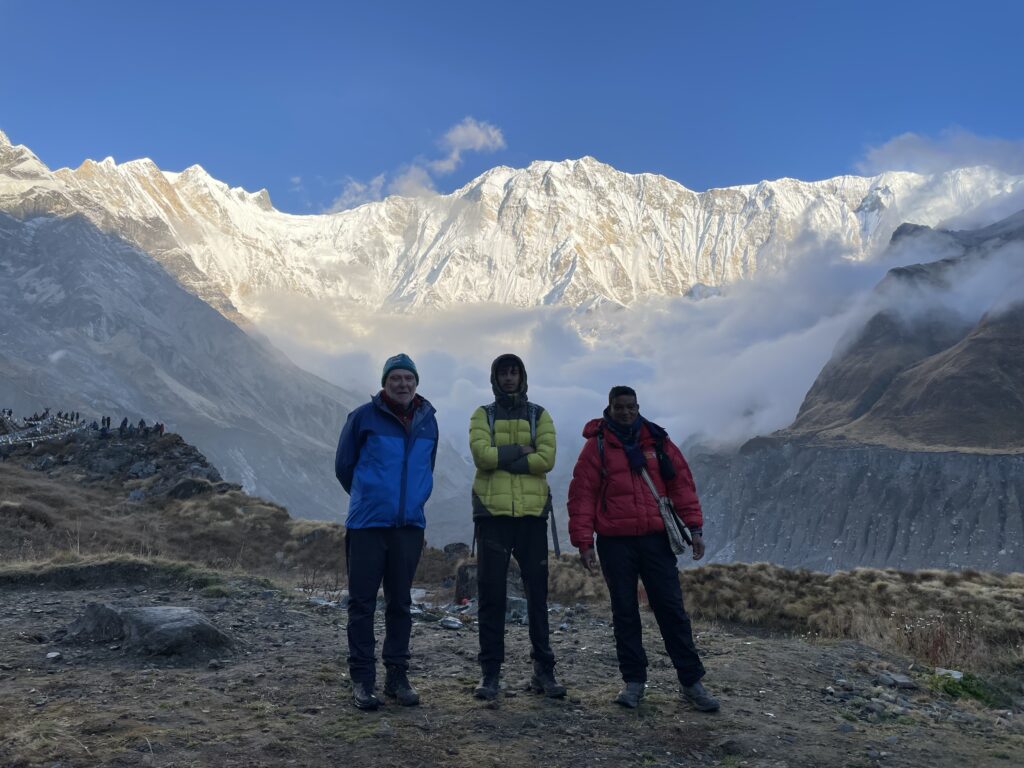
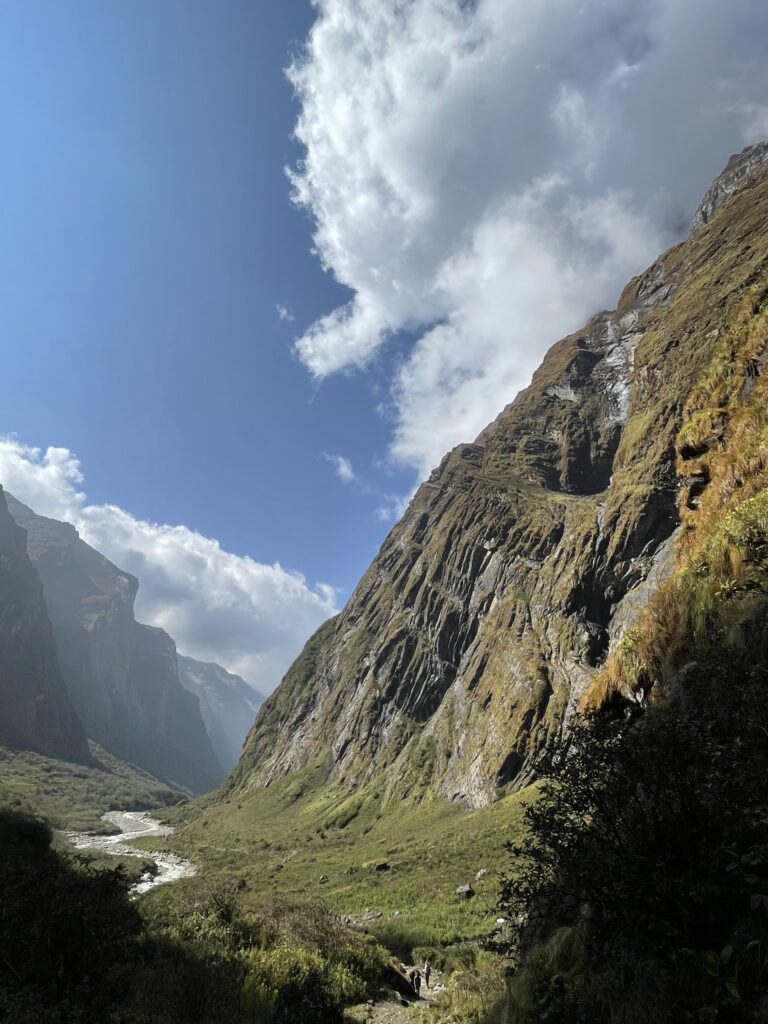
crumbling walls of the ancient glacier basin seen on the right

We had a clear view of the avalanche zone on the way down. The classic U-shaped glaciated valley appeared, though hard to imagine the whole place completely filled up with ice slowly eroding the edges under the law of gravity.

Day 11: Himalaya to Chhomrong
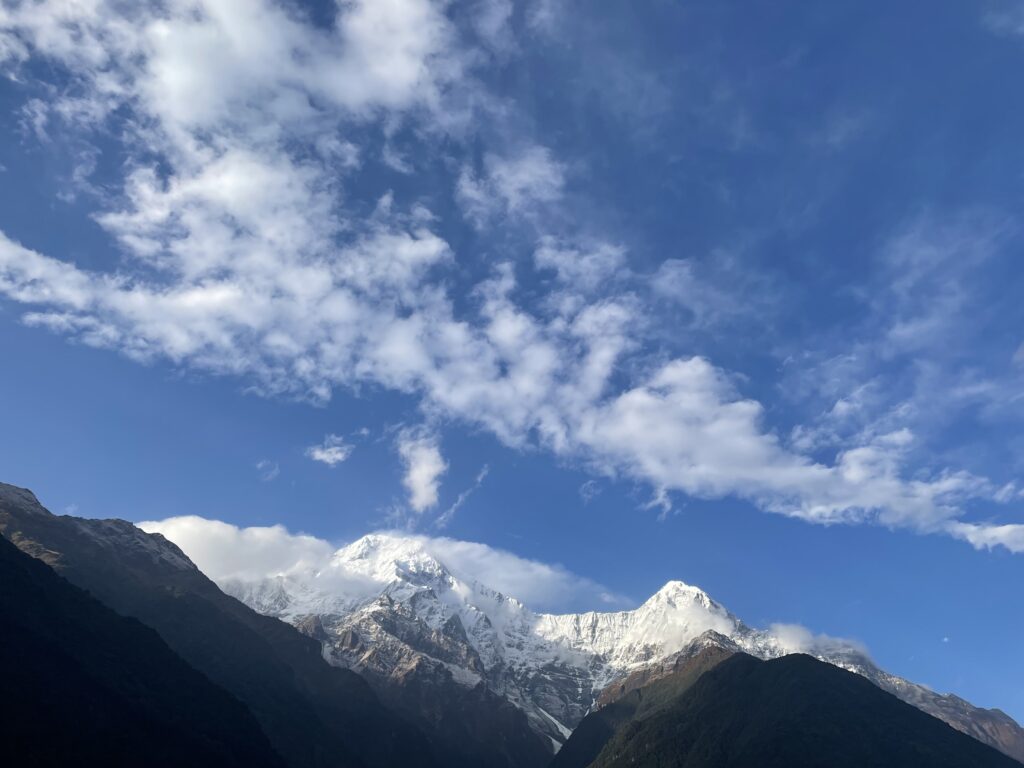
A long descent to Chhomrong, and it was not all down, with some impressive rises on the way as well. A thunderstorm started as we left Sinuwa, with quite heavy rain. But afterwards the air was very clear with impressive views, and new snow could be seen on the rocks of the heights. The following day a jeep took us to Pokhara.
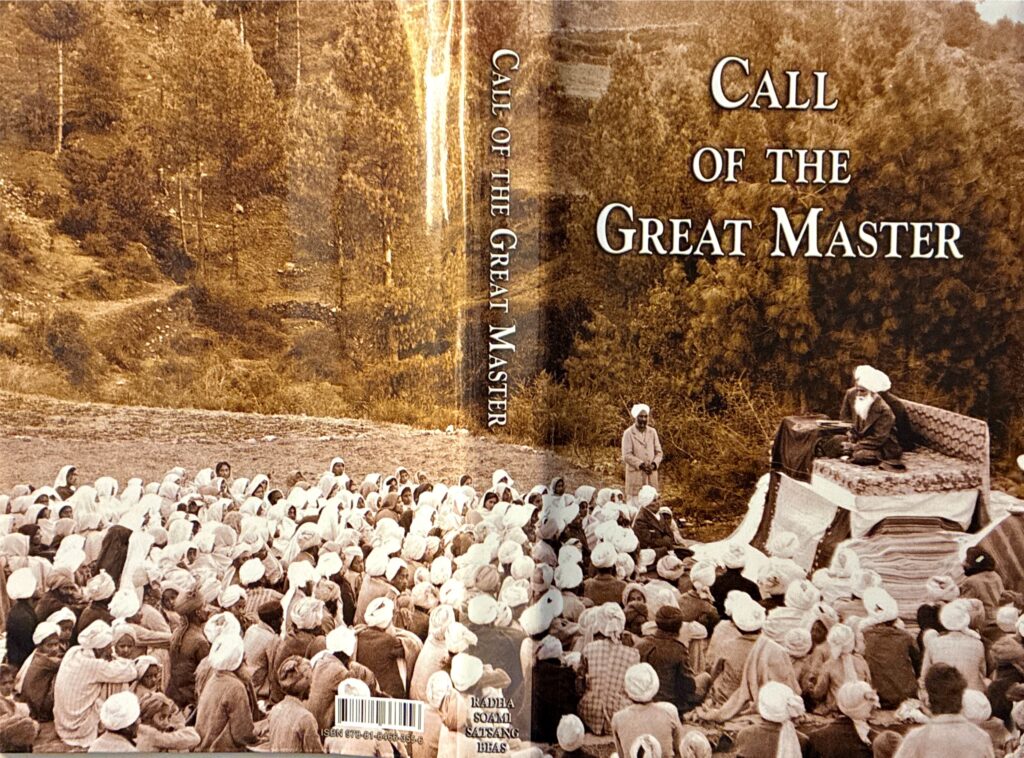
Call of the Great Master- another spiritual classic

Posted on August 11, 2025August 11, 2025 by ianraitt

This book was written by Daryai Lal Kapur, and it is an account of the teachings of Sant Mat, or Surat Shabd Yoga, as presented by Maharaj Sawan Singh (1858-1948), who was known as ‘the Great Master’ by his disciples, and who consolidated the teachings in a line of Masters founded by Shiv Dayal Singh (Soami Ji) in 1861 in Agra, India, also known as the Radha Soami tradition, which continues to this day. The book is in the form of answers to questions posed by visitors to the Radha Soami headquarters in Beas, in the Indian state of the Punjab. Some of these were European Christian teachers at a nearby college, and the responses frequently refer to aspects of the Christian Bible, as well as discussion on how Surat Shabd Yoga differs from the six schools of Indian philosophy and spiritual practice. (Please consult https://www.bookfinder.com/ or https://scienceofthesoul.org/books-english.html for availability of this title).

One chapter is entitled Miracles, and gives a clear account of why a true spiritual Master will pay little attention to any of those supposed demonstrations of mental powers that can effect a change in this physical world, and if there are any exceptions, he will keep quiet about them. Now, the writer was present at the discussions between Sawan Singh Ji and visiting enquirers, and always keeps a low profile in his account, but he starts this chapter by explaining that the Master delegated to him the task of explaining how miracles are approached in the true Sant Mat tradition. The author says he was : “overwhelmed with a sense of my incompetence to deal with the subject” but did not protest after receiving a piercing glance … “oh, that glance! It was not a glance; it was a flash of light that, passing through my eyes, entered my brain.”

The fundamental position is as follows: “Saints never perform miracles for public exhibition. Sometimes these things just happen, but in every case it is kept a secret.” There are two contrasting examples given in this chapter that I would like to discuss. The first one is a story about how a Master reacted when his son performed a miracle. This is a very well-documented story from the Sikh tradition, and concerns Baba Atal Rai, known as Tal, the son of Guru Har Govind, the 6th Guru in the line of Masters founded by Guru Nanak. Tal was precocious in the sense of already being noted for insight, wisdom and saintliness beyond his tender age.

Tal was only nine years old, when his friend Mohan died from a snake bite. Tal went to his friend’s house and found the deceased boy’s family deeply distressed by the death of the child. He claimed that Mohan was just feigning death as he did not want to lose at a game the two boys were playing from day to day. He circled the body, prayed, and called on Mohan: “Why do you sleep so soundly?” Mohan stirred, and got up. The revival of the boy, a reversal of death, was reported to his father, the Guru, who sent for Tal and said: “My son, you have not done well. Now, either you must leave this world, or I shall have to go.” The boy perfectly understood the implication of his action, and the following day performed ritual prayers and ablutions, went into meditation, and left his body.

The narrator of this book now gives another example, just to make us wonder. The Great Master, that is Sawan Singh Ji, was travelling on horseback from Sikanderpur to Sirsa, with a small group of devotees walking on foot. A Muslim disciple of the Master called Mian Shadi was bitten by a viper. There are various poisonous snakes in that area and the Russell’s Viper is one of the most potent, a bite being fatal unless an antidote is given. Shadi changed colour and could not walk, but he implored his companions not to bother the Master with his stricken condition, even though this was their natural reaction. He fell down senseless. However, the Master looked back and returned to the group. They tried to put Shadi on the horse, but he could not support himself. The Master stated that the leaves of a Neem tree had healing properties, but in this open space there were no trees. Finally, the Master asked for a branch from a shrub to be brought saying: “I have heard that passes of a green branch like this remove the poison.” The author then comments: “But we all knew what was removing the poison.” After ten minutes the stricken man revived, but still complained that he did not deserve to live, though the initiative had been taken by the Master alone.

Neither of these examples will impress a rationalist, who would state: “You see, these examples are contradictory. The whole business in incoherent!” You can imagine how easy it is to construct a sceptical position in both cases. In the first case, apart from the doubt that such a resurrection is ever possible, there would be outrage that a father could say to the child, repeating a religious belief, in this case the inviolability of the law of karma: “Either you or I shall have to die.” The implication is that the child is able to accept the unlawfulness of harnessing spiritual energy for a mundane resurrection, and a payment in balance is due, and that it should be the child who pays, as the father is in the middle of his spiritual mission as the 6th Guru, with a huge community dependent on his leadership, in temporal and spiritual matters.

The other example is also poignant, since the devotee begs the others to do nothing to inform the Master. Persisting in this attitude, on revival he is disappointed, believing himself to be unworthy of life, showing an immense detachment from this earthly sphere. It is clear that he thinks he deserves to die. Nevertheless, in this case, the intervention was judged permissible, in terms of the law of karma. We know nothing about the karmic debts from former lives of Tal’s friend Mohan, except that according to this belief, the snake bite was a necessary event in karmic balance. But in the case of Mian Shadi, despite his self-deprecating lamentation, he was an initiate, therefore his fate karma is now under the administration of the Master, who judges that his development is best served through continuation of life in the physical sphere. The contradiction can be resolved.

The theme of ‘a miracle is a changed consciousness’ is also embraced in this chapter, with a notable example, that I will leave to the reader’s curiosity to discover. Perhaps all of us can think of some event that changed the course of our lives for the better, that event most powerfully being a change of attitude or a realisation. That is the real miracle.

Langtang _ Day 1: Thursday 13th February, 2020 -Dunche to U Kyang

Posted on March 2, 2025March 14, 2025 by ianraitt

Madhu said there was no point in trying to get transport to Syabrubesi from Dunche, as it is infrequent and already full, but this was just as well as it provided the opportunity to make a new approach into the Langtang Valley, and we had the time.

The road ahead: this time on foot, but earlier times on a bus

As we left the town, we could see the road ahead hugging the mountain, and how it had been carved out of the rock. Some sections had buttressing and support below. Simple but impressive engineering, but how secure was it? There were no safety rails anywhere to be seen. This view was instantly recalled from earlier visits, how alarming it looked, and how you had to trust; not only the road itself, but the driver of the bus, full as it was of talkative, unmindful fourteen year olds, the grade nine students from our school.

Winter is a time when the vast northern Indian plain sends its terrible air quality seeping up onto Nepal. It joins with Kathmandu’s local pollution and continues on into the Himalayas. While the air in the early hour after sunrise appears clear enough, as soon as the sun’s rays start to slice the atmosphere the refraction of the light shows up the myriad small particles that have come all this way from the cars and factories. Nepal, which has supposedly the highest and purest mountain air in the world, is not being spared the planetary curse of polluted air.

So maybe the air is not so clear after all: PM2.5?

The extent of the pollution could be seen on the weather app windy.com, which has layers showing air quality and the various pollutants – take your pick from nitrogen dioxide, PM2.5 and aerosol; then you can check the ozone reading too. So the information from satellites had been distilled into this amazing app, and allowed us to compare what we saw with our eyes with the online map confirming the air quality. Yes, there was air pollution, and it stretched all the way to the Tibetan plateau. The question was: at which point would we come out into pristine clarity on this trek?

Langtang in Winter _ Day 2: Friday 14th February 2020 – U Kyang to Lama Hotel

Posted on March 2, 2025March 14, 2025 by ianraitt

A bittersweet experience on a trek is the knowledge that height gained is often sacrificed in height lost. Thus today we could see the long descent to the floor of the Langtang valley where the path would join the main trail. Finally in the valley was a lodge where we could have a hot cup of ginger tea, though the morning was chilly as the narrow valley was still in shade.

All day a helicopter flew up the valley and back, carrying long baskets of steel for concrete pillar construction; a disruptive, angry noise in this natural area, as many as fifteen trips. We met a group returning which had climbed Yala Peak (5500m), one of the easier trekking peaks, as they are called. They mentioned that there was plenty of snow at the top.

Lunch was at Bamboo lodge, finally in warming sunshine. It’s an area where the very rare red panda lives, eating the bamboo shoots, of course. It is threatened by loss of habitat. More prevalent were the red monkeys, who were chased off by a stone-throwing girl at the lodge. Half-grown chickens scrabbled in the dirt.

The winding route up Langtang reveals constantly changing vistas beside the rushing waters

Conversation turned to the cow family in Nepal. We would see Dzo on the trail, a hybrid between yak and domestic cattle. The Dzo is male and infertile, but the female, called Dzomo is fertile. Yaks are in the cow family, but buffaloes are not, in Nepali eyes. Thus the large Hindu Newari community, may eat buffalo meat, because they don’t define the buffalo as being of the cow family. Brahmins and Chhetris may eat goat or mutton as well as chicken. Madhu recognised that the universal dal bhat (lentils and rice) lacks protein, but he mentioned that goat meat is fatty, so not so healthy.

One of the saddest animal sights in Nepal is the dumping of young bulls at roundabouts where they try to forage some sort of provender, but may end up swallowing plastic refuse. They have no economic value. They cannot be eaten, but to look after them involves the expense of providing fodder. So only the cow is venerated and protected, the bull is marginalised and excluded.

We passed the cliffs where wild bees have their honeycombs and where bee collectors make a perilous descent to extract the highly valued and reputedly psychotropic melliferous product. It was not long before we arrived in Lama Hotel, the usual first day stop on the Langtang trail. Earlier in the winter there had been a fair bit of snow, particularly in the Gosaikunda area, but it was relatively mild now, in mid-February. My experience in Nepal in earlier years, is that the weather often became warmer in the last week in February, a rush of sap and springtime. So we were on the cusp of that.

Honeycombs of wild bees on riverside cliffs in lower Langtang

Langtang in Winter _ Day 3: Saturday 15th February – Lama Hotel to Langtang Village

Posted on March 2, 2025March 22, 2025 by ianraitt

We were invited to sit in the kitchen while waiting for breakfast. Cooking was done on a semi-open fire, and surprisingly there seemed to be little smoke from the wood used. It was a cheery sight, and though a bit wasteful of wood the blaze got the breakfast ready fast.

Waiting for breakfast in the cheery kitchen

The path crossed landslides triggered by the 2015 earthquake, but the terrain appeared well-trodden and stable.

Landslides are evidence of the earthquake, but now stable to cross.

No disturbing whine came from the helicopter, its entrance deterred by mist patches coalescing in bright air. We climbed out of the narrow valley and stopped for another ginger tea in brilliant sunshine.

Looking back down the valley with mist coming and going

The setting of the old Langtang village came into view with Tsergo Ri in the distance. The earthquake had funnelled a mass of rock, silt and ice from above, submerging all dwellings. A single untouched house remained, hedged from the descending projectiles by proximity to the mountain. Huge slabs of rock had fallen off, creating a sharp pressure wave. The explosive force severed the tops of trees on the other side of the valley: their stubs remained.

Sea of rock debris covering the original site of Langtang village

New houses had been built on higher ground further up and away from the cliffs. They beckoned across a bleak sea of rocky debris. The buildings encroached on yak pasture, but no one could construct on that movable morass of stone and silt, under threatening cliffs. An expression of trust, a bold rejuvenation – would the new village remain safe?

New building and signs of hope. Tsergo Ri beyond, objective of this trek.

Now that Tsergo Ri was visible and closer, the determination to have a go at climbing it became stronger. We could see the long sloping shoulder that we would have to go up, free of snow and leading onto the rocky approach to the summit. It looked possible.

A half-grown kitten accepted a tea-dipped ginger biscuit, returning enthusiastic for a dry crumbled one. It had an attractive coat, though the beastie was gaunt. Bishnu complained that village cats became too lazy to hunt mice these days, being fed liberally enough, though not kept as pets. Such a creature as this would probably be hungry all the time, in the austere boondocks of upper Langtang. I could only be its friend for a moment, before the tide drew us apart.

I am quite partial to a ginger biscuit, myself. A friend appears.

Langtang in Winter_ Day 4: Sunday 16th February 2020

Posted on March 2, 2025March 14, 2025 by ianraitt

A high wind in the night, then stillness. Sleep came with difficulty in the mountain air. Then a bright morning with no wind; warm in the sun. The valley opened out to a Scottish highland glen, with its boulders, its rushing river, its small hydroelectric scheme with insulated pipe. A majestic stupa crowned a rise.

The highland valley, with stupa just visible in the middle distance.

Kyanjin Gompa had undergone a building boom of new lodges for the trekkers, with some having three levels, many in the bright colours Nepalis like, all jumbled together and overshadowing their neighbours. But the crowding was due to a prohibition on building on the grazing land, so it had logic. The trekkers congregated at the one lodge that was open. Sunlight warmed the common area.

Jumble of new buildings at Kyanjin Gompa, crushed together to preserve grazing land

In the afternoon we climbed up on the approach to Tsergo Ri, a time-honoured ritual of acclimatisation: go high, sleep low. Even another 300m up from Kyanjin Gompa would help the lungs manage the real climb the following day. The path was clear. Bishnu kept going up just a bit more, to make sure the effort didn’t stop short of the required pain. From this vantage point, you could see the familiar peaks and glaciers from a different perspective, including the twice-ascended Kyanjin Ri.

Looking down to Kyanjin Gompa, a layer of pollution visible below. Look how far we had to come to escape it!

We met a well-muffled Greek trekker who had reached the summit. He reported that after 2.00 pm the wind got up. He congratulated me on the mere presence of such an aged spirit at this height. We eschewed a handshake for the protocol of elbow bumps. We fed the local crows biscuits. The one which pecked aggressively also had the biggest head … the male of the species?

Bishnu and the crows

Two high passes cross from Helambu to Langtang, the Ganja La and Tilman’s pass. We thought we could see two entrances to the Ganja La on the opposite slopes of the valley. These passes with their steep snowfields at the top are only for autumn, perhaps springtime. It is a bit late in life for more adventurous trekking, so these peaks and passes have to be considered carefully, but for the embodied spirit a dream still beckons.

The frozen slopes of the upper valley in brilliant sunshine

Langtang in Winter _ Day 5-7: Monday 17th February to Wednesday 19th 2020 – Tsergo Ri and return

Posted on March 2, 2025March 14, 2025 by ianraitt

This was the climax of the trip. Would I get up without any altitude symptoms, weakness, headache? Pepe, a young Catalan from Barcelona, joined us at the start. We gave him some suncream. Then he streaked ahead.

It was just a long, long ascent. The only tricky part was when you reached an intermediate saddle adjoining a corrie. There were large snow-covered rocks, and as the snow was not firm and frozen you could have dropped through and twisted an ankle. Bishnu was good at spotting the most secure way. Now we met Pepe leaping his way down. We could see the ridge to the summit, with its boulders and lip of snow.

Looking back down to the valley as we approach the summit ridge

A surge of optimism and energy arrived, with the delight of knowing you would make it in fine weather, and still no altitude problems. Tremendous 360 degree views. The unassuming Yala Peak (5500m), just a rocky bump on a ridge that continued higher, remained for a camping trek in the future.

Looking west from the top

The whole ascent had been 1000m. Care was needed on the descent, with rocks more reliable than snow, and the path proving slippery. Looking down there was a sense of achievement. Had we really come all this way up? Eight hours, including thirty minutes at the top, at my slowish pace. But slow and steady won the race.

Looking north to Yala Peak, the small bump at the right side

You always leave something else that you may do, to give a reason to come back. It may be Yala Peak, Gosaikunda pass, or Kanja La pass and peak. Or all three together, perhaps. Langtang is a great place for a short trek in winter, and also offers those additional variations when the weather is warmer in the main trekking seasons.

Descending

The following day: a last look back at Tsergo Ri, then the descent to Lama Hotel. Then sitting again in that kitchen, where the smoke mysteriously disappeared, invisible, through a space in the roof. Then the next day, down into the damper and hazier air at Syabrubesi, and to enjoy the usual luxuries of a softer bed, a warmer room, and richer food, before getting in to our jeep and the journey back to Kathmandu.

New lodge: fine stone work in a concrete frame

In search of the Ganesh Himal base camp

Posted on February 7, 2024March 14, 2025 by ianraitt

To approach the inner sanctum of the mountains, we first had to descend quite steeply through the forest and cross a couple of rivers. The total ascent for these two days could therefore have been about 2200m, though without any altitude effects, since we were not staying at the top elevation of 4000m, but returning to Lungang Gumpa at 3200m.

What was apparent was that we were not taking the trail on the left hand side of the glacier, that led to the base camp, but the alternative trail on the right hand side. Ani Ri San indicated that there were three yak kharkas that would signal that we were on the right path. A long section went through moss-covered trees, with many fallen trunks. Madhu questioned why there were so many of these. It could be that the competition for sustenance means that some trees submit to self-sacrifice so that the larger forest entity may thrive. Research shows that trees communicate and assist each other. Also, this damp area obviously got much less sun, which may have affected the overall condition of the trees. The trail was quite indistinct, but we found the first kharka, and on we went through thinner, more open forest, where the snow still lay unmelted in shadow.

Madhu, with a stone resembling an image of Ganesh, in the last of the three kharkas

The map is quite misleading in that there is no glacier, or only the shrunken remnants of a glacier. The area of vast historical glacial erosion, perhaps from 10,000 years ago, was not visible to us, and when we finally ascended the innocent looking slope, seen in the above photograph, the hill with stunted trees on the left, it was with a shock that we realised that suddenly the land plummeted vertically down into the eroded valley, and was still crumbling away, so that the earth we stood upon might collapse at any moment!

the clouds are a narrative all of their own – looking towards the sanctuary

Madhu went on a little further to get a better view. He reported rockfalls and small avalanches from the cirque of icy slopes. Then down we retreated, through the snow meadows, with numberless steps, through the mossy green primeval woods and their rushing icy brooks, on a path more imagined than perceived. We came to the tree trunk bridge. It was a different proposition in the dark. I eschewed the challenge, and went towards a shoal of large rocks. ‘Jump!’ I urged Madhu, but I was glad to be pulled upward with Bishnu’s steady hand. Now there was only a shimmer of light in the west. I turned on the head torch, and we covered the last stretch in the thickening darkness, tired but elated, and pleased that we had truly trod a path less travelled.

dawn, at Gumba Lungdang, the following day
the descent towards Lokpa at sunset that same day

Further into the unknown region: The Ganesh Himal base camp.

Posted on February 7, 2024March 14, 2025 by ianraitt

Nile to Domje: While many of the most famous treks in Nepal are circuits, for example Annapurna, Manaslu, Kanchenjunga, there is also interest in going down the way that you came up, for example in the Everest base camp trek and the Langtang trek, due to the surprising new viewpoints you may have missed on the way up, as you see the landscape from a new perspective. This was a long day, all the way down to Domje, but no stress on the lungs. Leaving Nile, it was worth noting that these weather-beaten welcome gates, hide a rich set of Buddhist illustrations if you look up when passing through the gate.

weather-beaten welcome gate just outside Nile
look up to the heavens inside the welcome-gate

There must be a Tsum Valley diaspora, since on descending we took the path ‘less traveled by’ and came upon this magnificent, and freshly-constructed stupa, which Madhu discovered had cost some $270,000. Contributions must have come from far and wide.

magnificent stupa, with dramatic backdrop

Our descent took us to a pleasant, though seasonally parched, pasture above Chhokang Paro, where the north Indian plain smog could clearly be seen in a layer below, and which did not bother to delay before surging upwards and turning the pristine air murky.

smog layer, about 2400m

Now we had to negotiate the exposed path that descends from Chhokang Paro to Domje. Wild mountain goats above looked down disdainfully. The path was stable, but some nerve was still needed in places, with steps submerged in fine dust.

in the smog again … narrow exposed trail

But we established that the Gompa on the way to the Ganesh Himal base camp is open! Now I only had to rally the troops, reminding them of what we would miss out on if we neglected this adventure. Meanwhile, approaching Domje, I was reminded of the parable of the sower: ‘ … and other seed fell upon rocky ground …’

young wheat shoots amid the boulders

Domje to Gumba Lungdang: The following day we went up through the forest, a magnificent walk. A winding path, not so steep at the start, but later it became quite tough as we went over 3000m, and also the full ascent was about 800m. Madhu said that we were travelling through an oak forest, but the leaves were evergreen. Many species must exist, and there certainly is a Himalayan oak. Meanwhile, views across the valley showed deep gorges and a thick covering of pines. The mountains were closer, with high extensive snowfields.

Hidden Himalaya, in all its untouched glory

We arrived, gratefully, at the Gompa, but only three nuns were in residence; the other ten or so sent, compassionately, for winter leave to warmer climes in India for study courses. Three nuns, and two hungry dogs. Some biscuits made friends of the dogs.

in bright sunshine outside one of the prayer halls at Gumba Lungdang, 3200m

There is not much flat land at the Gompa. Our rooms are perched above a steep drop. The kitchen is organised and warm. It is the universal habit to lop some branches from growing trees, and these long sticks are fed into the stove. A large kettle sits directly above the flames, and the stove door is kept open. But this often leads to rather smoky rooms, though in this case it was mostly smoke free.

Ani Ri San in her kitchen

We asked Ani Ri San why she had become a nun. She said it was of her own volition. She told us that her father had deserted her mother, and life became very difficult. She did not have a very positive image of marriage. Another issue in Nepal is child marriage, often due to poverty, though mainly experienced by marginalised social groups. Nevertheless, some nuns do not maintain their vows and leave the Gompas to seek a marriage partner. I asked if the practice of meditation may have a positive effect not only on the practitioner, but also on the world at large, and she agreed to that.

dusk is early at 16.45 … looking towards the amphitheatre of the Ganesh Himal – small meditation cell seen in the distance on the left

My room is constructed of wood, with many little shelves that could be bookcases. The pillow is even filled with sawdust; nothing is wasted here! There is very little flat land. around the Gompa, except for a few terraces where potatoes may be grown. An apple tree renders tiny fruit. This is a peaceful place. I could imagine spending a longer time here, especially in the winter, looking out longingly for snowfall, and at the wonderful evanescent cirrus clouds.

Tsum Valley: The Upper Sanctuaries

Posted on February 7, 2024March 14, 2025 by ianraitt

Chhokang Paro to Nile: So now that we were in the upper valley, did the atmosphere provide subtle emanations linked to the remote, untouched nature of the place, and to the constant vibrations transmitted from the places of inner devotion, the gompas with their adherents always in solitary, meditative retreat from the maya and illusion of this impermanent world?

Yes. Maybe. Maybe it did.

We saw in the distance, amid a thick pine forest, one of the gompas of this upper valley, that reminded you of one of the fairy tale castles to be found in Bavaria. Remote, almost invisible, still in the shade, mysterious.

distant mysterious gompa in the woods

It was, mercifully, a more gentle day. The valley was wide and spread with fertile fields, many of them already planted with winter wheat. Mules, unladen, came down at a strong pace. We stopped for an early lunch in a small, sunny courtyard. The sun was warm, but the wind still cold. Looking up you could see continuous chutes of powder snow falling down, down the crags. The lodge owner told us that even now some yaks are are on high pastures. The people keep an eye on the weather, and will go up to bring them down if it threatens a storm. Then we saw the characteristic fluted snowfields of the Ganesh Himal, beneath a faint new moon.

fluted snowfields of the Ganesh Himal, with new moon
Gompa (inhabited by nuns) beneath the crags; haze of green on the fields, planted with winter wheat

We went up from the trail towards Milarepa’s cave. It cost an effort. Horses and mules grazed. The guardian came running, explaining that he had been at a cremation, and had seen us moving up. The site was well-maintained, with a new staircase leading up, and small retreat houses beneath the cliff. One room had a shrine with a footprint of the saint. Another was a prayer-room with a shrine to Buddhist gurus; it had a gigantic prayer wheel. The shrine of Milarepa himself had an image of the saint, looking a little wild.

The dining room at the tea house in Nile was warm. It’s a phenomenon in winter when the sun streams in. Enjoy it while you can! The night will be cold.

approaching Nile (3200m), still in the winter sunshine

Nile to Mu Gompa: At 3700m the monastery catches the morning sun early due to the opening out of the valley, compensation for the colder, thinner air. On the way we crossed a wide river bed, not a landslide, but tribute to a mighty flood, an impressive sea of stone. Yaks grazed. We could not stay at Mu Gompa, but the resident monks gave us a cup of tea. Many further yak kharkas (summer pastures) are indicated on the map, all closer to the Tibetan border. In that direction, the southern facing slopes are free of snow.

border lands: a path leads to two main crossing points – snow-free slopes, crumbling into fine gravel

The monks won’t return the hand gesture in prayer mode that is universal while saying ‘Namaste’ in Nepal. Probably they don’t want to participate in a specifically Hindu phase, ‘I recognise the sacred within you,’ as it can be rendered. One monk mentioned that he was going to take water to an injured yak, as an act of service. At last we are clearly out of all remaining remnants of the north Indian plain smog, reminding us that windy.com often has the impure air going almost up to the border. Now the thought of the Ganesh Himal base camp has arisen. Will the Gompa up there be open? Will there be too much snow? Will I have enough energy? The idea of going there is surprisingly resilient, though.

Tsum Valley Approaches: December 2023

Posted on February 7, 2024March 14, 2025 by ianraitt
Leaving Jagat, the Buddhi Gandaki, gushing down – a tributary is providing local hydro power

Jagat to Lokpa: we were still in the common area for trekking around Manaslu. Frequent mule trains descended, unladen, usually placidly, but at times there was jostling and kicking. We could see that this traditional means of transport will be replaced by the gradual extension of the road towards the villages in the Manaslu valley. But one issue is, should a road also come to the untouched Tsum Valley?

The only way to extend the road is to blast through sheer rock faces. This is being done by the engineers and workforce of the Nepal Army. We are cautioned by an infantryman with an automatic weapon to wait, as a routine explosion was imminent. For some reason, there was a ‘test explosion’, then the real one came with a cloud of dust.

Road making inch by inch
Classic Himalayan valley, our route on the right

This type of work may not be done with standard western risk management. There have been fatalities with similar road construction on the Annapurna circuit. But it is hard not to be impressed by the persistence that brings better communications.

Doing the Manaslu circuit in winter has an enhanced risk, even though the weather appeared very stable so far. We met a group of six trekkers who had turned back due to deep lying snow, wind and drifting snow. Later, though, we met two other groups going to attempt the Manaslu circuit: one from Germany and one from Australia, the second with an impressive 75 year old trekker, giving hope to others near that age!

Lopka to Chumling: A forest walk, winding up and down, with the river roaring below. First, a massive landslide that took 45 minutes to cross. It looked alarming, but in the dry season it was stable enough. We heard later that one trekker had taken fright and retreated!

There was only a glimpse of sunshine at the lunch stop. The owner of the tea house explained that they didn’t get sun for two months in the year. Suddenly a suspended walkway appeared in the cliff, but reassuringly ‘Swiss designed’. The metal holding plates had spaces for six bolts but only two were in use. We rationalised that the weight of the metal only required two bolts!

soaring cliffs show the sheer scale of things

Tiny settlements could be seen huddled beneath crags. One thing that has improved in Nepal is electricity provision, and even the remotest villages had their power lines, and the supply is stable, unlike fifteen years ago, when massive ‘load shedding’ was universal.

A rare hot shower was available at Chumling. The views became quite alpine. We ate in the cosy kitchen and later gathered round a small campfire.

Chumling to Chhokang Paro: Altitude started to kick in at 2500m. A group of women descended, asking, ‘Why are you taking this old man up? We are coming down to escape the cold!’ A couple of small children, aged 3 and 5 were walking 2km unaccompanied to school. Then two British chaps, but with Australian accents, as they had moved down under, jaunted down the trail in T-shirts and shorts.

the impressive lodge at Chumling

Our destination at Chhokang Paro was the Bio Hotel. We were grateful that something was open. Again we ate in the warmth of the kitchen. While begging for an internet connection, we elicited from the lodge owner that his father was truly fortunate, living in the present moment, without the distractions of technology. Now we were in the real upper valley, with grand vistas and extensive level agricultural land.

early morning, looking back at Chhokang Paro, as the valley opens out into cultivated fields

Toward the Unknown Region: the Tsum Valley in Nepal

Posted on February 7, 2024March 17, 2025 by ianraitt
Chortens announce the entry to the upper Tsum Valley

Yes … a touch melodramatic, because the Tsum Valley in Nepal is only unknown to those who have yet to explore it. But the idea of the ‘unknown region’ is a symbol for adventurous travel, and maybe for deeper exploration, since Toward the Unknown Region is the title of a poem by Walt Whitman, and also of a piece, with the same name, for chorus and orchestra, by Ralph Vaughan Williams (1906), who also used Whitman’s poetry from Leaves of Grass for his epic A Sea Symphony (1909). The poem has some wonderful phrases, and though I might demur that Time and Space in themselves are worthy of such exalted praise, there is no doubt that Whitman’s words carry us vibrantly along in a mystical, ecstatic trance. https://whitmanarchive.org/published/LG/1891/poems/245

The Tsum Valley is a Buddhist enclave. The inhabitants are of Tibetan origin and speak a dialect of the Tibetan language; there are a number of monasteries, called Gompas, whose inhabitants in this area are nuns. At the head of the valley are at least two entries by high passes into Tibet, still used for seasonal trade, and through which, no doubt, the valley had been populated in earlier times, by explorers from the high plateau beyond. There is also a famous cave where the great saint of Tibet, Milarepa, is said to have been in retreat. The valley is liberally supplied with chortens, stupas, and prayer walls, and omnipresent prayer flags. It is an independent branch of the Manaslu circuit, and those trekkers who come up to the top of the Tsum Valley, will be acclimatised for the higher regions ahead on the main circuit.

Gradually the idea formed of a winter trek in December, by poring over maps, and reading Trekking around Manaslu and the Tsum Valley (Pritchard-Jones and Gibbons – Himalayan Travel Guides). You could see that after quite a steep day of climbing at one point, the land broadened out into a high, level valley, before narrowing again in its ascent towards the border. And I began, also, to speculate about an approach to the Ganesh Himal base camp, which should allow a viewpoint of the high, massive snowfields of these mountains, as yet unthreatened by the climate-induced melting going on in other places, due to their aspect facing north. We would have to stay at Gumba Lundang at 3200m, one of the monasteries, if it were open at this time of year, when people come down to spend a couple of months in Kathmandu and escape the cold.

So while journeying deeper into the mountains, I started to consider how 
little I knew about Buddhism. Why was the religion so prominent and persistent in these remote valleys? Why were there so many nuns in the Tsum Valley? Even though Buddhism expresses some of my deepest beliefs, such as the ultimate illusion of our sensory life and our repetitive reappearance here on the earth planet, with only small incremental evidence of progress, I knew that my understanding of its traditions and current realities was superficial. As it happened, after the trek, I found some books in Kathmandu to add to those I had already read, that gave some further understanding, such as the following:
1. Thomas Shor: A Step Away from Paradise
https://www.thomasshor.com/a-step-away-from-paradise
https://www.bbc.com/travel/article/20220830-the-himalayas-hidden-paradise-valleys
2. Lama Yeshe Losal Rinpoche: From a Mountain in Tibet - A Monk's Journey
3. Alexandra David-Neel: Magic and Mystery in Tibet
4. Mick Brown: The Dance of the 17 Lives - the incredible true story of Tibet`s 17th Karmapa.
And I decided to re-read Lost Horizon, the 1933 novel by James Hilton, that immortalised the name, Shangri-La. Yes, fiction, but it also captured the public imagination, that somewhere on earth, there could be a rarefied place where the normal dissolutions that characterise human life, might at least be delayed, and where a conflict between temporal love and higher aspiration is brought keenly into contention.
The journey toward the unknown region would be both an inner and outer experience.
Weather-beaten welcome arch at Nile
The hidden reality inside the welcome gate, looking upward

Langtang in Winter. Conversations we had on the trek: the pot cannot call the kettle black.

Posted on February 9, 2021March 15, 2025 by ianraitt

A trek is not just a geographical displacement; it is always a change in consciousness. Here is where it started, in Dhulikhel, just outside the main urban area of Kathmandu, in the early morning haze.

Hazy early morning view of the Mahabharata mountain range from Dhulikhel

The discussion of this haze, as part of a massive bank of pollution from the North Indian plain and how it had invaded the air space all the way to the border with China, and how you had to climb to about 3800m to get completely out of the sea of particles, was part of the discovery.

Knowing that we would walk over the site of the destruction of Langtang village in the 2015 earthquake, we reminisced about another disaster in recent years, the October 2014 snowstorm on the Annapurna range. In the peak trekking season, when the monsoon is over and the weather is usually dry and sunny but not yet too cold, trekkers flock to the Annapurna circuit, with its high pass, the Thorung La (5415m). The snowstorm was caused by a tropical cyclone which formed in the Andaman Sea and progressed over the Bay of Bengal gaining in intensity. It moved in a north westerly direction towards Nepal. It was recognised and expected in India, but there does not seem to have been any early warning system in Nepal for trekkers in the way of the storm.

I used to check satellite photos of the Indian subcontinent published by the meteorological office in Britain. I distinctly remember observing the very pronounced depression (Cyclone Hudud) and seeing it track into India. It was clear that it would go on towards Nepal and only be drained of its energy on the sheer walls of the Himalayas, but at what cost?

Sitting in a comfortable room (at that moment I was working in Cajamarca, Peru) I could have sent a message to Nepal. I could see the storm making its unexpected journey to the mountains. I did recall that there can be very late storms in October or November. I remembered that the Arabian Sea or the Bay of Bengal can produce these spontaneous tempests at almost any time in the year, certainly outside the monsoon. Probably one assumed there could be a warning from the Nepali authorities.

Unlike an earthquake, you can predict the weather at least three days in advance with some certainty, but there was no awareness nor communication with the Annapurna area, and the trekkers became trapped in conditions which saw almost two metres of snow arrive suddenly at a time of year when this is not at all expected. At least 43 people died.

Madhu and Bishnu have a nephew, Anish, who was a porter on the Annapurna trek during the storm. Somehow he got over the Thorung La, arriving at Muktinath with his group very late at 9.00 pm. But one of the porters did not survive. The intensity of the storm was local. Canadian friends of Madhu and Bishnu were in Langtang at the time, where the only signs of the storm were snow flurries and wind.

Another area that has seen avalanches after unseasonal snow is the upper part of the Annapurna Base Camp trek. On an earlier trek here, we came across a former trekking guide sitting on a wall, crutches beside him, with a tin for donations. Both his legs had been amputated below the knee after he had been trapped in such an avalanche. The cause was an unseasonal November snowfall resulting from one of those sudden storms funnelling up from the Bay of Bengal. Madhu mentioned that in the last month there had again been fatalities on the ABC trek, again due to the unforeseen instantaneous avalanches from above the sheer enclosing cliffs on the trail.

Risk management is a concept used to control the effects of unfortunate events. In the context of these disasters, some measures can certainly be applied to mitigate earthquakes, and the sudden onslaught of bad weather. But a more insidious danger is breathing polluted air, especially for the developing brains of young children, and for the accumulated effect on adult lungs.

Brick kiln emissions near Bhaktapur, Kathmandu valley

We started the trek in Dhulikhel, where a series of hotels has been built on a ridge facing the long mountain chain of the Himalayas, to celebrate one of the greatest views in the world. But now, in the viewing season after the monsoon, the air is never as clear as it used to be, the local Kathmandu valley pollution being amplified by the North Indian pollution. The mountains often remain obscured. Nepal is at the mercy of its larger neighbour in this respect, and this is now being recognised and documented.

https://www.nepalitimes.com/here-now/how-transboundary-haze-affects-nepal/

At present the pot cannot call the kettle black, unless Kathmandu becomes irreproachable and stainless in the matter of its air purity.

Dhulikhel: delicate clouds float in gentle afternoon light, the air a bit clearer now
Prayer flag in clear air: Tsergo Ri

Langtang in Winter

Posted on February 8, 2021March 15, 2025 by ianraitt

Day 0: Wednesday 12 February 2020
There was a window of opportunity in February, before work obligations in the spring. Covid was just starting its march across the world. Could there be a quick trip to Nepal, as the recorded cases of coronavirus were so far tiny? A convenient short winter trek would be Langtang.

Memory is unreliable. Had I done this trek in January two or three times? I recalled twice ascending Kyanjin Ri (4774m), an outlying peak above the Kyanjin Gompa, the last settlement on the trail. The second of those ascents had been accompanied by chest pains, warning signs of altitude stress on the lungs. The ascent from Langtang Village to Kyanjin Ri is 1344m, which can be too much in a single day, especially as the overall ascent in the Langtang trek is rapid.

I had inflated to three the number of previous visits, a common ego problem: exaggeration! The third unconfirmed occasion was a trip for grade nine students which I had organised but not accompanied. The chest pains on Kyanjin Gompa were during another later school trip. So: this new trek would be the third one up the Langtang Valley.

The trek would be familiar, but could it reveal something? What new vistas would open up after a successful climb of Tsergo Ri (4984m), the peak that dominates the views on the upper part of the valley trek? The students on the earlier trek had been willing to try the peak, but it had been safer not to go up: in January it was snow-covered, not all had suitable boots, and the icy nature of the ascent and descent could be risky. Now, it would be feasible.

No journeys in Nepal can be made without commenting on the state of the roads. Every village wants a new motorable road. But often these are bulldozed in without thought of the likelihood of landslides in the monsoon. I remembered some massive landslides on this road, and the vertiginous mountain-hugging path the road would take. It caused some nervous moments when taking the students up to the start of the trek at Syabrubesi.

Road blocked by overloaded truck with broken axle: after waiting three hours – let’s walk!

Now this road was being improved with the aid of Chinese grants, as it connected with the border and could be used to enhance trade, so we made quite good progress on the widened stretches. But after lunch we came to a long queue of vehicles: a truck heavily laden with cement had got stuck in mud and no one could pass in either direction. After some three hours waiting, I said to Madhu and Bishnu, “Come on, let’s just walk to Dunche. We don’t need to get in to Syabrubesi. And the following day we can go over to U Kyang, the Tamang village.”

It was a gentle walk of about 10 km, and we even got a short lift on the school bus, though we had to get out in order to register at the entrance of the National Park, where rucksacks had to be unpacked. The soldiers were particularly interested in whether we were secreting drones, which are prohibited. The bus had the rules of transport written on a whiteboard at the front, with such recommendations as: Remember, you are on School Bus. Take your seat and do not talk loudly. And finally: The harder you work, the luckier you get. On the path we could see a hardy goat devouring aggressive looking nettles, its leathery tongue lashing the leaves, relishing every bite.

It was a cold, damp evening when we approached Dunche in the last light of day. This town is the starting point for the ascent to the sacred lakes of Gosaikunda, and sees a massive influx of pilgrims trekking up to the abode of Shiva during the festival season in August. But now it was relatively quiet. I think we were the only guests at one of the roadside hotels on the main stretch of the town.

Approaching Dunche village – hazy air showing winter pollution from north India and the Kathmandu valley

Gokyo to Everest Base Camp: returning to Salleri

Posted on October 18, 2019March 15, 2025 by ianraitt

Sunday January 13th, 2019.

Amazingly this is Day 18. Coming down is all part of the experience, and allows a retrospective contemplation, but while most trekkers stop at Lukla, and then take a plane ride back to Kathmandu, with more time on our hands we have elected to walk out to Salleri, the way we had come in. Today is quite a long day and we only reach a village beyond Phakding, and  close to Lukla, by dusk.

A4AB2C4F-5809-4FF2-A70E-F0372A04F4A6
Evening scene near Lukla

Somehow Madhu has found a homestay, rather than a trekking lodge, so it is very pleasant to stay in an actual house, which has a great deal of good quality wood on the first floor as partitioning walls, and the base of the house is in handsome stone blocks. However, this is a rebuilt house, as the area was affected by the recent earthquake.

While we wait with anticipation for the evening Dhal Bhat, I notice that in addition to a gas ring in the kitchen, there is a wood burning stove-cooker, but that the lady of the house is operating it with the door open, feeding logs into the glowing interior. I comment that it would use less wood and probably be hotter if they just closed the door, but there is attachment to old ways, maybe she feels she has more control over how fast the wood will burn by delaying the push of the log in further. Well, I have said my piece; whether it changes anything, as often, I won’t be here to see.

Monday 14th January, 2019: Lukla to Bupsa

Certainly, if you don’t fly out from Lukla, there is no alternative but to keep walking! And today we are reminded that the way in was very much up and down, and the reason for this is that the north-south watercourse of the Dudh Khosi is intersected at right angles by many deep valleys whose east-west tributaries flush down from the heights and cut deeply into the landscape, making the trail an equal challenge of ascent and descent in either direction. But now, at the end of the trek, anticipation of some rest is in conflict with the continuing effort, and familiarity certainly does not breed acceptance!

6039D3A7-77D3-4AA5-B3C4-26654BEE5FBF
Transverse valleys cut into the Dudh Khosi river

Many mule trains meet us. They are bred in India, and the going price is $1300. A hard life, being a mule. One section of the trail is very slippy with mud and droppings. A slip here and you could go over, so mules must be given right of way. They may be unassertive, but they are heavily loaded, and take the route their feet dictate, so could swing against you in unexpected ways.

We spend a very long time waiting for lunch, during which the lady of the lodge upbraids her teenage son, presumably for being idle and spiritless both at home and at school.  On the trail a mother asks if her daughter can walk with us, as even in this region an unaccompanied female might run a risk of assault apparently, though at the top of the pass before Bupsa, on familiar territory, she sprints off energetically on her own. The light fades and then we approach Bupsa in the dark, and I can’t help complaining a bit to Madhu, pointlessly, which he gracefully ignores, and when we reach the same lodge we stayed at on the way up, there is no one else there, so they have not put on the heating. Cold, so quick to the sleeping bag.

Tuesday 15th January, 2019    Bupsa to Nunthala

Madhu has had a shower this morning, whether hot or cold I don’t know, as today is a festival day when the people eat yams producing heat in the body, as well as taking this ritual purification by water. But at least it feels warmer now in the sun at this lower altitude.

Another very long day, and the trail is in shocking condition in places, clearly the result of the incessant mule trains on the go. The carefully constructed stone steps have broken up, and there are huge sections of dust and decay. And a new road is being bulldozed down near the bottom of the valley, and the idea is to take this to Sirte, below Lukla. It seems that the one urgent undeniable request of all the isolated hill communities is that they should have a road, so that these roads criss cross the ridges of Nepal, and are clearly visible from the skies, lacerating the green spaces. But in this case, it might have some logic due also to the very heavy expedition traffic, but heaven forbid that any road should go on further from Lukla.

The lodge in Nunthala is again unheated, and we are the only visitors. However, I’ve decided that this is the end of the trail, and that we can get a jeep to Salleri, avoiding a tough climb up. However, there is no booking system, so we have to wait until tomorrow to see how this will work out.

The next day there is a long and uncertain wait in the morning but finally a jeep will be going. I speak with other trekkers who have also decided that this is the end. The road is packed earth in mostly good condition. Once over the top of the hill, the landscape again looks familiar. This is now day 21, so we have done almost three weeks on the trek. Once in Phaplo, near Salleri, Madhu directs us to a small lodge on the main street whose owner he knows, and we are soon enjoying hot samosa and noodle soup.

7B666A51-E1EA-412A-84A7-0B9CA5111691
Wintry scene: looking back at the mountains of the Solukhumbu

Winter: inwardness, preparation, recuperation. Looking back at a mountain kingdom, a fastness, with that blur of mysterious precipitation, be it snow, hail or rain. Winter: a very good time for a trek in the Solukhumbu.


Gokyo to Everest Base Camp (part 2)

Posted on October 16, 2019March 15, 2025 by ianraitt
5508FB11-2D49-4811-A12B-5CC8CE27E61D
Temba on the trail returning from Lobuche

Lower altitude permitted some sleep last night. It is snowing, and all views have disappeared, only the sense of the gulf down to the river. Quiet, with that sense of mystery and stillness. After a steep rise, the path is contouring round. A yak follows us. There are footprints in the snow, but surely not made by a snow leopard? Madhu thinks Temba has made them with his trekking pole. It was fun though, the thought, while it lasted.

D3409141-581B-4670-A978-3BB71558A0E5
The fake snow leopard prints

A yak follows us. We come across a group of sheep, scampering on the edge of a cliff. Madhu says that they gather in such areas for defence, against a leopard, for example.

785DB299-6B0F-4D3C-931D-F8460ED0C01C

F714D710-6E84-4CFE-86DB-FBC0139E285F

Lunch is at Somare, and the wait feels very cold when you are not moving. On to Pheriche,  the lodges mostly empty and deserted. At night, there is no electric light as the dull day has not allowed the batteries to charge up, so candles illuminate the long corridor, clearly a fire hazard in the wooden building. A bleak place in this weather, like being stuck in a Scottish glen in winter. 

Tuesday 8th January 2019 Pheriche to Lobuche

The morning, however, is radiant again, all the more welcome after the mist, with the mountains jagged and striking, and a fairly gentle ascent to Dughla, gingerly crossing a frozen river before enjoying a hot drink in the sunshine.

F7C9FDDE-29F9-4237-9490-62112826AA94


86980BF8-6DEE-4668-AFA9-921C92C9DF5F

We speak to someone who had suffered from altitude sickness the day before, and is now waiting for the others in his group to come down from their attempt at Kala Pattar (5546m). He is Australian, his father is ethnic Egyptian, his mother ethnic Greek. There are quite a few groups of Australians here, as January is the summer holiday. But despite the implied warning about AMC, after resting I announce to Madhu that we can go on to Lobuche. Maybe it turns out to be not such a good idea, as we shall see later on, but I thought that Lobuche was in the plan for today. In fact, we have gone faster than planned, on the whole trek, but it seems without rushing, and surely we are already acclimatised?

But there is pure exhilaration on reaching the top of the pass with the sense of openness, light and joy, and being a very high place, in a circle of mountains, and far away from the human world. We are going to stay the night in the Pyramid, the Italian research station lodge. It is a bit warmer, as there are two layers of glass on the windows.

071DF2CE-66B9-4A2D-A596-5EDC6BA01CC1
Breaking through into the Everest area at last

Wednesday 9th January 2019 Lobuche to Base Camp

A slow climb to Gorakshep. It is misty but the mountains are visible.

39C00284-114F-44C3-9124-03E2CA0AA320
Gorakshep at the edge of the shrinking glacier

We soon see down below the lodges of Gorakshep, clustered together for mutual support in the high desert. And onwards to the base camp after lunch, quite a scramble as the rough path is often through boulders.  Up and down, and certainly still up! No activity at this time of year, and at least it has been cleaned up, though the spring onslaught is not far away.

2C942FDF-A363-4B68-9331-4EBBA79E8FDE
The icefall from Everest Base Camp

The glacier below has vast ice auditoriums, but all covered in grit and stones. You can see earlier marks where the glacier has been much higher on the hillside. The icefall is clear of debris, all white. We hear the explosive sounds of an avalanche while returning.

Sun warms the lodge a little. A breeze startles the wind chimes into melody.


Thursday 10th January, 2019. Kala Patthar

This is the day. Another cold night and not much sleep. It looks straightforward, but a slog. Very few people out on the hill.

A9B35C1A-E1E7-4F4F-B4D6-3C4E8C41D63E_1_201_a
Going up Kala Patthar

No energy, but at least no headache. Stopped a couple of hundred metres below the summit.

It was probably the correct thing to do, as it took an hour to recover in Gorakshep, with complete weakness but still no headache.  A bit dizzy on the return to the Pyramid in Lobuche that afternoon.

Friday 11th January, 2019  Lobuche to Pangboche

Another splendid morning, and the comforting thought of descent. At the top of the pass there is an elegiac atmosphere, as there many memorial cairns for deceased sherpas.

4A24EAC4-9523-4605-8BF1-42B59A96A5D1
Sherpa memorial cairns

After tea at Dughla, we take the high trail to Dengboche, a wide trail, with many variations.

AFF3ED6B-4056-46CB-A29B-6653C41AA746

You can see the village below finally, and there is a sense of the very modest amount of flat land having been consumed by the building of the lodges, a reminder of the question of how to balance the economy of tourism with the fragile environment. One trekker we met suggested that there were too many yaks for the landscape, but maintained due to the need for yak dung as fuel,  but now denuding the soil and pasture.

D4E224FC-FA5E-4674-BC00-BB77D8A61E58
Looking down at Dengboche

Saturday 12th January, 2019   Pangboche to Namche

There are dogs on the way, who sometimes will accompany you to the next village. They respond to friendly words, but are not used to overt affection. Himalayan Hounds … looking quite well-prepared for the cold.

633CA054-DAEA-40F4-98AF-DF2A896B6E95_1_201_a

We can see on the other side of the valley the way we had come from Phortse, in the snow, but now the snow has rapidly evanesced in the January sunshine.

2E36C93D-0C27-4BA5-B937-42F6C61AB6DD

The familiar amphitheater of Namche comes into view again.

4F285D95-E9F6-4A3E-B3CC-3B9838A3387C


Gokyo to Everest Base Camp (Part 1)

Posted on October 15, 2019March 15, 2025 by ianraitt

5th January 2019
A gentle sense of achievement flushes the veins, as in the bright air we start to descend: there will be scalding soup at Gokyo, and in gradually waning afternoon light, views will open up besides frozen brooks. Colder air, wisps of mist condensing, calm silence; only busy ducks will forage in the waters of a still unfrozen first Gokyo Lake, as the icy fluid sluices away underground, gravity-led, to the surging river below.

A4ACECE3-3A83-4C80-863A-C87752FF1C03
Leaving the unknown region

There’s a memory of Scottish winter afternoons, light fading at 4.00 pm, walking in the gloaming, cheeks glowing in cooling air, anticipating pleasure in the warmth that returns once inside. Now mist wells up in thickening waves and all perspective is lost as we negotiate a narrow staircase in the descent. Then the rays of the sun illuminate the peaks above the mist just before it drops below the mountain chain for the day.

In the lodge at Machhermo, the lady of the house has a baby that she fondles constantly, showing the importance of touch, and she uses sound and chants to captivate, soothe and reassure the swaddled entity.

Another difficult night as it is still hard to sleep, and the ten hour period from 8.00 pm to 6.00 am is rather like being in a cell,  and the sleeping bag can feel like a straight-jacket. In the morning it is impressive to see the yaks who live outside in the cold of night stirring gently in the morning air, breathing.

6th January
A beautiful walk down, with a glorious perspective, and the knowledge that we came up this way, so patiently.

29440FBE-AE8C-481D-8BB0-F36F56B07CB4
Clear morning air on the descent

Once again in the forest: rhododendron, pine, juniper, birch.

317092F3-CC9C-4C08-BD15-DA5022E88046
Entering the forest. Pheriche on the hill in the middle distance

Pheriche is a working village perched on flatter land whose edges are eroding. We arrive after a steep climb up from the river, to thickening clouds and the chance of snow the next day. Potatoes are huddled under earth mounds awaiting the spring planting. Nothing is open, but finally we find Thamserku View that will take us. You realise that if you are going to build a house here, you might as well build extra accommodation for trekkers. Now we are the only guests, grateful again for the stove.

A1E6849C-F03A-4045-8F21-CF48C36F471D
Tea around the stove

Toward the Unknown Region

Posted on January 28, 2019March 17, 2025 by ianraitt

This eloquent title belongs to a poem in Walt Whitman´s Leaves of Grass. It begins:

Darest thou now, O Soul,
Walk out with me toward the unknown region,
Where neither ground is for the feet, nor any path to follow?

The epithet ´unknown region´resonates, challenges. This is how we may feel at the end of the trail up the Ngazumba Glacier, three hours up from Gokyo village, as we look out at the wilderness and realize the difficulty of going any further, toward the unknown region.

img_5734

How jagged and proud the mountains stand, in the midst of dissolution, constantly crumbling. Here, cloud-shrouded, is another perspective on Everest, dark shape in the centre, the glacier in the foreground smothered in rubble and gravel.

img_5743

According to Wikipedia (https://en.wikipedia.org/wiki/Gokyo_Lakes):

Gokyo Lakes are oligotrophic lakes in Nepal‘s Sagarmatha National Park, located at an altitude of 4,700–5,000 m (15,400–16,400 ft) above sea level. These lakes are the world’s highest freshwater lake system comprising six main lakes, of which Thonak Lake is the largest.

dsc00328

They are also a focus of Hindu devotion especially during the festival of Janai Purnima, usually falling in the month of August, when about 7000 devotes visit Gokyo.

After a hard climb the day before, we reached the summit of Gokyo Ri, 5483m, which affords clear views of the Everest massif.

img_5721

A dust storm raced along the glacier. Can´t blame Delhi´s air this time.

img_5724

Then we´re on the way out, light fading as we move down towards Machermo, cheeks glowing in the cold, just as you remember them from cold winter childhood days.

dsc00381

And the unknown region? Walt has dared us, dared Soul. This poem was set to music by Vaughan Williams, his first choral work for massed choir. You can see a performance here:

While it may seem slow at first, it builds momentum to a fine climax in the last four minutes, as does the poem itself. If you like that, then try Vaughan Williams A Sea Symphony, on a much larger scale, also with words by Whitman.

Here is the poem. I think it is clear he is talking about the translation from the earth plane at the time of death. I may demur at his acclamation of Time and Space though – isn´t our final destiny above? –  but there is no denying his examination of our reluctance and fear and ultimately our exultation.

Toward the Unknown Region (from Leaves of Grass)

Darest thou now, O soul,
Walk with me toward the unknown region,
Where neither ground is for the feet, nor any path to follow?

No map there, nor guide,
Nor voice sounding, nor touch of human hand,
Nor face with blooming flesh, nor lips, nor eyes, are in that land.

I know it not O soul,
Nor dost thou, all is a blank before us,
All waits undream´d of in that region, that inaccessible land.

Till when the ties loosen,
All but the ties eternal, Time and Space,
Nor darkness, gravitation, sense, nor any bounds bounding us.

Then we burst forth, we float,
In Time and Space O soul, prepared for them
Equal, equipt at last, (O joy! O fruit of all!) them to fulfil O soul.

Altibajos …. or the ups and downs of the trek – and its exigencies

Posted on January 28, 2019March 15, 2025 by ianraitt

We have to accept ups and downs, so nicely captured in the Spanish word altibajos. But it is difficult not to resent losing the height one has gained. A particular example occurs up from Namche. After patiently climbing to the pass at Mong, the path descends all the way down to the river, yes the same Dudh Kosi … that now I see actually flows from the famous Gokyo Lakes where we are headed.

But first the trail is looking straight north-east, right up to the peak of Everest. And what is that village so perilously perched beneath the crags? Is it really secure or might  landslides open up on either side where the land falls steeply to the rivers below? It is Phortse, where will we stay on the return from Gokyo. Defiant, stoical people must live on that bleak ledge.

img_5675

But this is real walking, with some narrow corners, some exposed ledges.

img_5680

Do man´s visions last, Do man´s illusions? My illusion was that the trail would just continue nicely contouring up into the Gokyo valley, instead of plunging 400 metres down to the river. Here, approaching the village of Mong, the illusion was still intact. Take things as they come!

img_5681

But we can enact our daily homage to spontaneity, surely? Although we had planned to stay in Phortse Thanka, by the river, we found the lodge we anticipated staying in was closed. Nothing for it, but to continue up to Dhole then, a rise of some 500 metres. Any altitude risk?  … probably not. We passed through magical forests of pine and rhododendrons, skirting the frozen rivers, conscious of passing into a more hallowed land and rarer air, to the sacred lakes.

img_5686

And what about the ¨exigencies¨hinted at, and why the obscure vocabulary? Dear reader, I promise it is not to baffle nor to impress; these words simply pop up from the subconscious river of lexis. I check them for their suitability. Exigencies are the demands of the trek, what it requires, what is urgent and unavoidable.

It´s the cold that is unavoidable, now intensifying each night as we go above 4000m. Yes, yak dung is pressed into service in the stoves, and effective it is too, but there is nothing for it but to return to one´s frosty room at about 8.00 pm, and it´s a long night to 6.00 am. A long, sleepless night, since it is increasingly hard to conk out: one of the effects of altitude.

On top of this, in the small hours I begin to feel claustrophobic in the sleeping bag and fumble to release its constricting chords. Then reassess the irrationality, tighten up again. Repeat. All the time drifting in a half sleep, conscious, checking the watch. If one is lucky, one may have vivid, alarming, surreal dreams, but I have not been blessed so far. All symptoms a result of the thinner air and its effect on the vigilant brain.

Despite the cold, movement on the trail warms you, radiance of the sun splashes you benignly, and you have to take off an anorak and thus walk comfortably with three layers: thermal vest, shirt, fleece.

img_5689

Onward, upward, inward to the heart of the mountains and the lakes, the landscape becoming more extraordinary, wild. How satisfying to see the trail leaping ahead, with the Dudh Kosi river bed stretching into Gokyo, some water still flowing.

IMG_5694.JPG


Take things as they come

Posted on January 25, 2019March 15, 2025 by ianraitt

Should we embrace a teleological view of the trek, that it only has meaning based on its purpose to complete its objective and arrive at the final point, or should we follow that impressive advice of Robert Louis Stevenson, ¨to travel hopefully is a better thing than to arrive¨? Dear reader, you will probably feel that with his Zen advice on trekking, the writer must accept the latter dictum. Already the readers are bristling into armed camps of liberals and conservatives, the conservatives insisting on completing the trek as planned, and the liberals favouring Lao Tse´s flexibility in the face of perpetual change: take things as they come.

Having an objective to be reached in planned stages on the trek gives order, a sense of progression and control, defines proper effort and expenditure of energy, and gives blessed form to the immediate future in the turbulent seas of this uncertain world! But still, the mind will ¨What if …?¨  us, so travelling hopefully is tempting. Altitude might intervene, a snowstorm might confine us to immobility in a lodge, or even on a ledge, some injury might occur.

Early morning cold, brilliant sky, the valley narrowing, and a promise of the new heights and views once we reach Namche. Here we look towards the mountain sacred to the Sherpa people, and thus unclimbable, Khumbi Yul Lha, which towers above the villages of Khumjung and Khunde, above Namche. There is an example in the foreground of two of the many boulders engraved with mantras in Tibetan, chiseled letters then highlighted with paint.

img_5636

And on the trail, quite busy with trekkers, mules and yaks descending, half way up, a first glimpse of Everest through the pines.

img_5637

Namche, commercial capital, calling  trekkers for a two-night stay, with rest day, on the way up, and perhaps for a celebration on the way down in its mini-Thamel section (reminiscent of the famous tourist quarter in Kathmandu), now seems over-built in its elegant nest and horse shoe crescent shape, with some tall tea house residences, where potatoes used to grow in the short summer growing season. Higher up there are fairly newly planted pines to bring stability to the steep hillside. An underground stream gushes out, turning massive prayer wheels, providing a public washing place for clothes, our last opportunity for the laundry.

img_5640

dsc00202

The constant struggle between ascetic and sybarite is resolved in favour of good coffee and apple pie in one of the cafés open, even in this low season. Take things as they come!

The following day is the ´rest´day, as even though we climb up to the villages of Khumjung and Khunde, some 400m, we will descend to sleep again in Namche. There is a sense of peace in these quiet, deserted villages, not only as views on the way open up gloriously in the clear air to the Everest massif, but also because they are homes to two Buddhist monasteries, and in Khumjung the school inspired and built by the efforts of Sir Edmund Hillary and other donors. We walked around the deserted school compound of small-scale and well-built stone buildings, students being on the January break. The monastery at Khunde blends perfectly into the hillside, with a quiet and discrete power. This area is the higher spiritual plane of the area, with Namche, or to give it its full title, Namche Bazaar, the material world below!

img_5667

The landscape is serene, empty and sun-bleached, with a Zen garden feel, each rock a presence.

img_5671

With the cheerful certainty of the dogmatic, I led Madhu and Temba through interconnected and flowing yak enclosures, to seek the way down to Namche, despite their mild, polite protests that the path was much further over. My confident road to nowhere was just an aesthetic preference.

img_5669

But, to travel hopefully is a better thing than to arrive!

Still, it was quite quick to get back to the proper trail down to Namche, very steep; then we were rewarded with a perspective of the blessed, sheltered balcony that cradles the town.

img_5672

Now we are truly on the upland route, one week into the trek. Here with quiet, stoical and steady Sherpa Temba, as Everest looks down with its distinctive plume drawing us upward and inward.

img_5654

Here is that beautiful, thoughtful contemplation from Lao Tzu:

All Things Pass – Lao-Tzu

All things pass
A sunrise does not last all morning
All things pass
A cloudburst does not last all day
All things pass
Nor a sunset all night
All things pass
What always changes?

Earth…sky…thunder…
mountain…water…
wind…fire…lake…

These change
And if these do not last

Do man’s visions last?
Do man’s illusions?

Take things as they come

All things pass

  • 1
  • 2
  • Next
Ian, the Scot

Ian, the Scot

A Scot who lived in five continents, now using some free time to attempt some of the classic treks in Nepal, where he lived before. As well as contemplating why we like to move through majestic three dimensional geometry, there could be some reflections on life´s higher altitude.

Subscribe to Receive Updates

Check your inbox or spam folder to confirm your subscription.

Recent Posts

  • Nepal Notes: Demonic trumpets and vivid necklaces
  • Nepal Notes: day hike to Namobuddha
  • Nepal Notes: Animal Welfare
  • Nepal Notes: a wondrous sound
  • Nepal Notes: Christmas
©2026 Be Kind To Dragons