One thing has not changed since the first time I arrived in Nepal, in January 2008, and that is the dramatic and over-loud power horns attached to buses and trucks. 18 years ago, I was at first accommodated quite close to the highway, and the passing traffic certainly made itself known. And now I am staying quite close to the road again, but on the opposite side, still in audible distance of the torrent of discord.
Some of the horns play what sounds like a minor interval, such as C and E flat, exactly like the melancholy note traditionally heard on North American railroads. But the North American train horns are not designed to produce a minor triad, for example, nor any specific musical interval, but merely to be as resonant as possible, simply to be heard as a warning signal. The idea that the sound is melancholy may simply be due to context: the emptiness, the night-time, the loneliness of a long train journey.
Another common type of demanding horn sound here is a chromatic run, brutal and jarring, simply done to demand attention. On my very first visit there was a rhythmic staccato phrase reminiscent of some of the overtures to early Verdi operas, a brassy but more musical riff; but this is rarer now. The road emits sounds late into the night: a moaning of brakes, a rattling of metal bodies of trucks, a constant low rumble punctuated by squeaks, knocks, and jangles. These continue to lap against the windows, echoing as the vehicles recede on their bumpy path to Kathmandu.
The road works from Bhaktapur to Dhulikhel are still going on, and the only way to handle the topography is to have the two opposing traffic streams at different levels, and this has resulted in huge amounts of earth being gouged out, and massive walls of concrete put in place. I suspect that even when it is all finished, the road will mostly be choked with traffic.
As you approach Kathmandu, the massive ranks of motorbikes dominate the whole road, weaving in and out, or simply forming an impassible knot. Whatever happens, those raucous horns are sure to continue. Such jarring noises have been declared illegal, but like many of the well-intentioned laws in Nepal, this prescription has been ignored.
Last week we returned late from Kathmandu, and hurtling through the torrent of darkness were those trucks, which in addition to their strident voices, were bedecked in vivid necklaces of garish lights, insisting that in addition to being heard, they would certainly be seen.
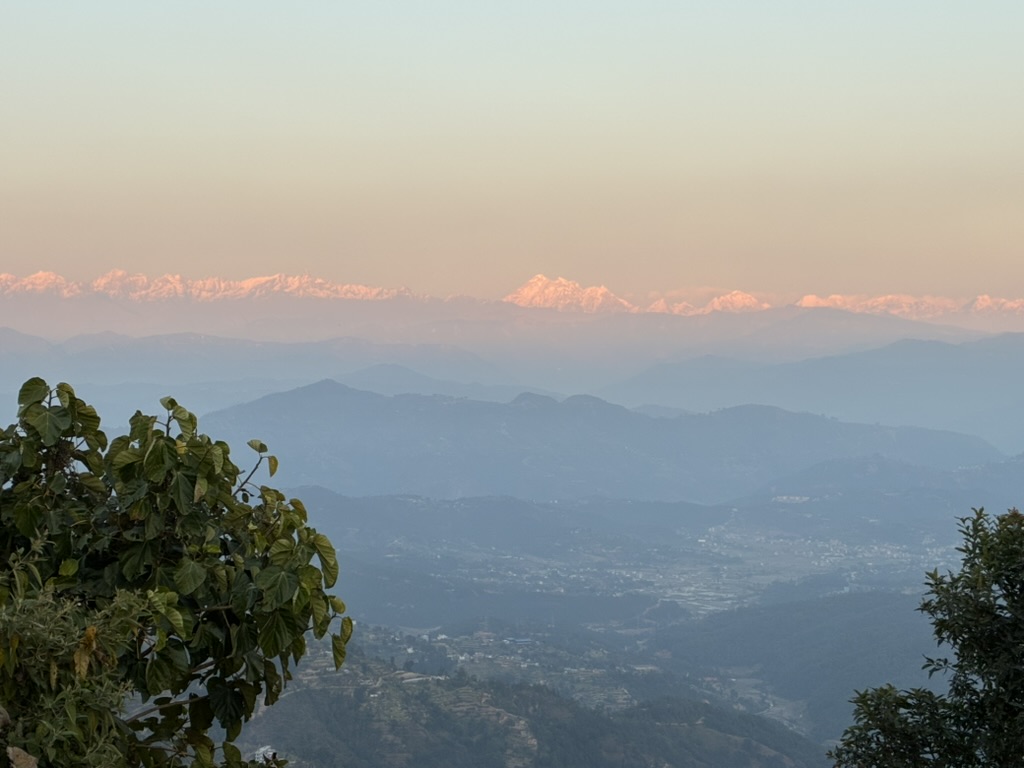
I have done this walk many times, but this time I noted some of the gradients. After passing through Dhulikhel, there is the steady ascent on ‘the thousand steps’ to the Kali temple, then the path goes down quite a way to the main highway that goes to the Terai, then gradually rising and winding round, with good views of the mountains, if only the humidity and smog were less these days. The road was being levelled and graded probably prior to being resurfaced, and it was quiet too. Above we could see a new building, that looks like a hotel, but incomplete, then another much more elaborate construction of a hotel underway, and finally the rather large and imposing new hotel, Dusit Thani Himalayan Resort. All of these new places have been constructed with the view in mind, though it is a bit further away than Dhulikhel, but it might allow a perspective on the further western ramparts of the Himalayas.
Finally, we go round the corner and descend slightly. Suddenly, another new hotel, though smaller, comes into view, the construction still going on. But beside it, there was a copy of an old style farmhouse. I wanted to go and see it close up, and Madhu said, yes, we could. So went down and a friendly lady showed us around both the large building, and this smaller, typical house. They had done the small house nicely, but to get to the second floor you had to up a metal spiral staircase on the outside. Both the upper level and the lower level consisted of two rooms, with a bathroom in the middle. The total cost of this house seemed modest from a western price model. I imagined doing something similar, but with slightly expanded dimensions, and an open plan area downstairs with kitchen, dining area and sitting area. Also, there was a third level with lower windows, and gable windows, but this is only accessible via a hatch. This is where they would keep the corn and other crops to store and dry in the traditional houses. Now this is just for the water tank.
So, finally, the stupa of Namobuddha comes into view, with the golden roofs gleaming. A descent, and another climb up. The views of the Mahabharata Hills are superb, though the air is still misty. The most interesting part for Madhu, is the shrine that celebrates the idea that in his previous incarnation, the Buddha sacrificed his body to a starving tigress, whose cubs were about to die as well. This legend attracts Hindu visitors to this place as well. We also went to the main prayer hall. Here, I think there are seven Buddhas in golden statues of various sizes, which represent different aspects of Buddhahood, such as The Buddha of Compassion. Otherwise, I still wonder why the prayer halls are so crammed with illustration, pillars, roofs, all sporting mandalas. Maybe all this represents samsara, or moreover something similar to the Hindu concept of maya, so all of this quite gaudy display of colour is meant simply to be ignored in the meditational practice. However, every time I go into a Buddhist redoubt, I feel very detached and it doesn’t set the pulse racing. But I always recognise the place Buddhism has in the religious experience.
The walk back could have been via another route, towards Panauti, which would be a descent, but I opted just to return the same way. I wanted to do the complete walk, which would be at least 25km. And, in fact, this was a good idea, since once you have gone up a short way, there was a long, gradual descent on that road which is being resurfaced, and was still quiet. The final section back to Dhulikhel features quite a long rise up from the road to the Terai, then you reach the Kali temple again, where we bought some drinks, then back down the steps. The whole journey was 27.5km. This was certainly enough for today!
On animal welfare, Madhu told me that his cow was due to give birth a few days ago, but that the birth was a little late. He explained that the calf often has to be taught how to suckle, an anxiety shared by mother, calf, and human attendants right at the start. Today he stated that the cow is giving about 12 litres of milk a day, but that calf only needs 4 litres, so that he can sell the majority of the milk. I then started to talk about the dairy industry, since it is only recently that I became aware of the exploitation of dairy cows. This is why people argue for veganism. The most cruel element is separating the calf very early after birth, and of course the routine slaughter of bullocks. The cow will continue to produce milk. The process also involves repeated pregnancies, another form of exploitation.
But what about letting the calves grow to maturity while taking off the surplus milk, as Madhu is doing? So, briefly, the vegan position is quite absolute. Animals should never be used in any way that may indicate exploitation; they have rights. However, many people, while acknowledging the wrongs of the industrial dairy industry, believe that the surplus produced by lactating cows can ethically be used. Of course, this does not deal with the premature slaughter of bullocks. A writer that we may look at is Peter Singer, an Australian philosopher, who has written on animal rights. He has produced a lot of material. I used to use his book Practical Ethics when I was teaching IB Theory of Knowledge. His approach is utilitarian, that is based on the contentment or suffering of animals, so a practice is wrong if the animal is degraded in any way. But also, other writers have taken a different approach to stand up for animals, arguing that they have inherent rights, so that their defence does not just depend on suffering in itself.
The question of how chickens are treated, and also sheep for their wool, is related. I am sure that we should do more for chickens. I think the EU has regulated this. A campaigning organisation is Compassion in World Farming. Maybe the tide will turn. Animals are sentient. And they are part of the long experience as souls in this world. It is ironic that cows are given huge respect in India and Nepal, but the bullocks are neglected as they have no commercial value. I would often see them abandoned by the side of roads, woefully looking for scraps of grass, even ingesting plastic.
After some debate, we have confirmed we will do the Mustang trek. I got a book from a bookshop in Kathmandu about the lesser known walks in Mustang. There is a lot there to do for many years. The landscape is extremely interesting. It is mostly treeless, and there are some amazing geometries out there, and also startling colours. Some summits are so gradual that you could easily ascend the 6000m in a carefree way, though still slowly in the thin air. The yellows that you can see apparently indicate uranium ore which the Chinese are interested in (that would be a disaster). At the top of the trek there is Lo Manthang, the walled town, at 3800m. The whole trek has become very popular with Nepalis in October, their festive season. But we have to walk on the road part of the way, so in the busy season, motorbikes would ply the route, not so good. Foreigners have to pay $50 a day, but it’s all a bit crazy since Nepalis don’t, and the idea of restricting access should apply to them as well, since it is a Buddhist culture, thriving in isolation.
I looked up the weather up there for the next fifteen days on windy.com and it indicates some snow from 7th January, so I urged Bishnu to start the trek two days earlier since I would love to be in falling snow up there. But looking at the website later on the same day, then the snow forecast had just vanished! It will be about minus 20 though!
Madhu suggested a stroll up towards the well known viewpoint above the house, where there is a tower that you can climb up, to see the hills. Today was a particularly misty day, with all the usual pollutants, but I think the mistiness was due to higher humidity, so visibility was even more reduced. I have been checking the weather forecast in the hope that there might be some snow in the mountains. Nothing is really on the way. But I did note that the pollutants are not reaching up into the Mustang area.
I suggested that finally we could go down to the Shiva Temple. It is in a grove, a peaceful place. Sounds of the city recede, though the penetrating horns of the buses and trucks still rend the air. We sat for a while with the Sadhu, who was warming himself in front of wood fire. Madhu asked him some questions. In a small receptacle, reposed some marijuana. These Sadhus are known to use it as way of getting into what they think is a more receptive state towards the god. However, he also explained that he added hemlock, which sounded dangerous. I looked this up, and there is a ‘hemlock’ tree which is used in incense, as opposed to the plant which is the neurotoxin of Socrates fame, causing gradual paralysis, and death. The consumption of poisons by such Sadhus emulates the great acts of Shiva who saved the universe by consuming poison. The idea is that the holy man will demonstrate his immunity to the poison due to the level of spirituality he has reached. But it remains in doubt if the gentleman was referring to the real plant hemlock.
He mentioned that he suffered from thieves in the night raiding his supplies of rice, for example. This is quite a symptom of societal breakdown. Madhu and he discussed the problem of refugees in Nepal. It turns out that such countries as Bangladesh and Myanmar are expelling immigrants of Nepali origin. He has a small plot for growing vegetables. Ginger was drying in the sun. He depends on donations. He left his home at the age of 25. A Brahmin, he would be celibate to take on this role. I asked Madhu if he could not do service in this temple for some time, then move on to something else, but this is not so in Nepal, but would be practiced in India where there are more priests to circulate. The previous post holder was reverenced by a statue within an enclosure.
As we were walking up from the sacred grove, I stopped below the Sanskrit School, entranced by the sound of the boys chanting. Madhu said we could go in, so we walked up into the precinct. Boys were sitting in small groups in the sun, receiving instruction. We were invited to enter a prayer hall, shoes off first. On a raised dais, sat a rotund teacher in the same maroon robes as the boys. While Buddhist monks in Nepal, Bhutan and Tibet all use the maroon coloured robes, here the Brahmin boys were all using the same colour. Chairs were brought for us to sit on. Madhu made a brief introduction. I suggested that they continue the lesson. There were thirteen boys seated in front of the teacher, and all chanting in the most melodious fashion. The scripture had been learned by heart and was beautifully rendered in unison, but somehow there seemed to be a subtle and gentle harmony, as if a few were forming a major triad. As they continued, I surrendered to the beautiful sound, which brought tears to the eyes.
When they stopped, the teacher suddenly produced an infant, much like a conjuror. This was the first time I had seen someone teaching while harbouring a small child. The child was quiet and biddable. The teacher, who was the Principal of the school, said that the chanting pacified the little girl and could put her to sleep! He motioned to us to join him in the adjoining room, where we conversed in general terms about the school. There are 55 students from age 10 to 18. I mentioned that Sanskrit is taught in the St James group of schools in the south of England, and he knew of these schools. He mentioned that the school enters the boys for IGCSE Sanskrit, taken at the British Council. I mentioned A level Sanskrit, but they did not seem to have thought of that.
The students do quite an extensive early morning meditation practice, and it must be Transcendental Meditation, as he mentioned the Maharishi. It may be a total meditation period of about two hours.
So, now I found out that a Brahmin priest does not need to be celibate, this is a choice in others for their form of devotion as a sadhu. Madhu thought that the boys can pursue a normal career in engineering for example, or go on further in Sanskrit studies. Of course, as well as being such a precise and elegant language, it harbours the whole range of profound religious texts. They do the normal SEE exam (aged 16) and then the +2 examination at age 18, focused on social studies, so with three languages. But what a wondrous sound, this grade 9 group made, and it is not always easy to find boys willing to vocalise in this way in Europe.
I am mildly curious if I will find some way to celebrate Christmas this year. Probably hotels will put on a Christmas meal for those interested. When working at the school, I recall a couple of Christmas Days when I would work as usual and not take the day off, but a doctor from the Bath area in the UK was out working as a volunteer for a few months in Dhulikhel Hospital, and he would invite a few British people to his flat, quite near where I lived in Dhulikhel, for a Christmas meal in the evenings, which was certainly welcome. So, although I don’t miss the Christmas and New Year atmosphere, there is a lingering attachment to some kind of recognition of that special day.
The incredible smog continues here, but the Nepalis appear to be oblivious of it, just accepting it as normal. At least it is not so far an irritant to eyes and throat. Rajiv, who works in the health sphere, is on a contract for WHO in the Terai, the border area with India, which being warmer has a greater amount of infectious diseases and plenty of parasites. He is working with vaccination programmes. He mentioned that it was getting colder down there, but still it can’t be as cold as Kathmandu which is about 1500m up. He was surprised when I said most of the air pollution was coming from India. It can be quite warm from about 11.00 am to 4.00 pm, but noticeably cooler when out of the sun. And after 4:00 pm you really notice how damp it is. windy.com reports presents humidity of 55%, but on the Indian border it rises to 83%. It is windless. windy.com also shows all the layers of the pollution, which is even worse in the north Indian plain, that is sulphur dioxide, carbon dioxide, nitrogen dioxide, and PM 2.5, the fine particulate matter which can enter into the lungs and is just not a good thing for us to be breathing, being linked to all kinds of health conditions. The air quality here is one reason I would be reluctant to live anywhere in this region. Generally, in the south of Spain, the air quality is good. Today almost no PM 2.5 is reported.
The Nepalis are very stoical as the houses are unheated, so this means a cold December and even colder January, when schools close for three weeks. It’s important, as in Spain, to try to have a least one room which will get winter sunshine, but often that is not so, as the house in which I used to live in here proved each winter. The sun barely gave any warmth through the forest above, and now some organisation has erected a building above which blocks the sun even better! But suddenly, in the last week of February, there can be a surge up to 23 degrees, as it warms up much faster than southern Spain, being on the same latitude as Mauritania. So, the upcoming trek to Upper Mustang will feature cold temperatures at night, but not as low as on the Everest trek, which goes up to 5500m, whereas the destination of Lo Manthang, the ancient town, is at 3800m.
But this is also the picnic season, probably to avoid the hot sun at other times of the year. There are numerous picnic grounds, usually on the tops of hills with a view, where organisations or families meet to enjoy the brief hours of sunshine. Today we passed quite a few groups out for a picnic. There were a couple of extended family groups, and one group of youngsters with girlfriends in a circle, gambling with cards, while a pot of rice bubbled on a wood fire. I hoped they would extinguish the fire properly before they left. Visitors to Nepal often deplore the litter problem, and indeed we could see piles of plastic and other discarded refuse in various locations.
So I managed a 13 km walk today and yesterday, but of course this is a much lower altitudes, though today there was a bit of climbing. Probably the Mustang trek will be the most appropriate, since it will be cold, but not extreme. But oh, would that the mountain wall of the Himalaya were clear and bright in the still air! Clouds appeared today, like stately galleons. There was a slight breeze at times, useful to disperse the smog maybe.
On Sunday I went for a short walk with Ram. The mountains were clear, though the smog haze can be seen here.
I asked him about the erosion of arranged marriage by caste in Kathmandu. Seven years ago I had a conversation with some young Nepalis when going up to Tilicho Lake in the Annapurna Circuit trek. They said that love marriage was on the increase. Ram confirmed this. He got married last year in the traditional way. Young couples make contact on social media, and present the families with a fait accompli. This is underway with his two cousins. They want to marry their girlfriends which are of the Newari social group, thought of as a merchant class, whereas he is a Chhetri, being the warrior class traditionally, just one below the priestly caste, the Brahmins. The father said, well what can I do, they are in love. However, the marriages have been delayed, so we do not know what is really going on.
It is thought that arranged marriage in caste is being maintained much more on traditional lines in India. It is also much more complicated than we can imagine, as there are many sub-castes. The arranged marriage system has advantages, for example divorce rates are lower. It is a different concept of union based on compatibility with an emphasis on support from the community. So, the arranged marriage system is not going to disappear, but it is undergoing a challenge. It is paradoxical, since arranged marriage does have a different concept of what a union should be, with some advantages of stability in the community and in the union itself, and though the caste system itself can be thought of as outmoded, it is likely to be very resistant and resilient. But it’s an example of how the noble and profound idea of rebirth has been changed by human convention, because it is believed that you journey through the castes and arrive at the ‘top’ caste.
As were talking and admiring the view, a group of boys aged about 13 or 14 in orange robes came up from a nearby temple to return to a small boarding school situated above on a knoll. This is a school where Sanskrit is taught, since these boys are Brahmins, and they are training to be priests. The script used for Sanskrit is the same as that for Nepali and Hindi. Sanskrit is the parent of these languages, but completely different, and a dormant language in that it is not used for everyday communication, though it is used for all the important religious ceremonies, so the priests have a guaranteed role. I felt a certain disquieting sympathy for the boys, going as they were to an unheated dormitory.
I have had a certain fascination with Sanskrit as a language, since some of the terms that I am familiar with from my spiritual studies, are Sanskrit ones, and are not translated since there is no easy English alternative. I also am fascinated by those people who are very multilingual, such as Sir William Jones, whose day job was as a lawyer, but who knew 12 languages very well, and another 10 quite well. He was very well paid for the time, in the mid 18th Century in Calcutta. He is famous for coming up with the theory that Latin, Greek and Sanskrit shared many grammatical points, so he speculated they are all born from a now disappeared parent language. Subsequent studies confirmed his analysis that there is a common ancestor, but that the idea that Sanskrit is the most perfect of the three languages is now deprecated, though it does have a very admirable and precise grammar. And Sanskrit is valued for its actual sound, said to have originated from a ‘higher plane’ and thus calming and inspirational. This must be one reason why it is insisted on by Hindu believers.
When I was in the school in Nepal, we were visited by a certain Yogi who also had a boarding school for boys in Kathmandu for the teaching of Sanskrit, and a gentleman from England accompanied him. The Yogi declared, a little ruefully, that he thought the students of the English gentleman had attained a higher level of Sanskrit for their age, taking GCSE Sanskrit. They were students in a group of schools in London and Surrey that had been founded by a British philosopher who was a follower of an Eastern teacher, who obviously also thought that to learn Sanskrit was good for the integrated being of the child. In these schools, Sanskrit is taught from 4-11 with options to continue to GCSE and A Level. The grammar of Sanskrit is so logical and pure that it would be a strong foundation for the learning of other languages, so this is another echo of what William Jones thought. The other point is that Sanskrit has 2000 years of literature to be encountered. The proof would be in the pudding. I have a theory that Sanskrit did originate in the previous world age, ie the Bronze Age. The Kali Yuga (Iron Age) is said to have begun about 3100 BCE. If Sanskrit is older than this date, then it would belong to an age that had a higher vibration that the current one.
Scotland: a while since I’d been here, some sixteen years. Aberfeldy was familiar territory from the first eighteen years of life spent in Perth, and thus a remembered spot, associated with youthful ascents of Ben Lawyers and Schiehallion. How damp it felt after the much drier air of Andalucia.
‘You must go up the Birks,’ my friend said, so off I went in the right direction, though still managing a detour up a lane with very elegant detached houses, before finding the car park at the start. The Birks (Scots for Birches) is listed in a Times article, Five of the Best Woodland Walks in Scotland (25.01.23) and by coincidence there was another article in the Times series Walk of the Week (09.11.23), just after I had been there.
The Birks of Aberfeldy is the name of a song by Robert Burns, written in 1787. https://allpoetry.com/The-Birks-Of-Aberfeldy It uses a simple rhyme scheme, repetition, and a catchy chorus to persuade his lady friend to accompany him up the Birks. Here he is at the start of the walk; he wrote the poem in situ, and it is sung to a traditional ballad. Someone has placed a small bunch of roses, naturally reminiscent of another of his famous songs, A Red, Red Rose.
Now, by all accounts, one is meant to go on this circular route anti-clockwise, but I had forgotten and did the opposite; if you go the recommended route, the best views of the Tay valley appear while descending. It is quite a steep climb up the banks of the Moness burn, and here one must explain, that ‘burn’ in Scots is a small stream. Some of the feeder burns flow in narrow disciplined channels over tough underlying rock. Others are cascades. The perfect contrast of tree trunks, mosses and autumn colours, had attracted a number of photographers, with elaborate equipment being balanced on tripods.
So, although I had gone round the glen in the opposite direction to the established one, I was able to contemplate the people who came into view descending the walk as we came face to face, and to speculate which of the family groups was the possessor of the Lamborghini parked in the carpark, amongst other large, ostentatious 4×4 vehicles. Then, by simply turning round, I could look down on the quiet, patient landscape, where some fields were notably thick with almost static sheep.
A perfect Autumn walk, though the colours will be more resplendent if the light is brighter: but November is November, not the summery time that Burns took up pen to record his impressions and longings. The air is calm, heavy and moist; mist hangs in the valleys; clouds form, wander and vanish over the summits; leaves drift down. And the burns, for a’ that, and ‘a that, rush and gurgle.
Now Simmer blinks on flowery  braes, And o'er the chrystal streamlets plays; Come let us spend the lightsome days
In the birks of Aberfeldy.
Once a year, the local hill-walking club in Archidona climbs the mountain known as La Maroma, the highest in the province of Málaga at 2069m; I am keeping up this tradition as well, as it’s a way to test stamina with each year over the age of 70. It is a majestic creature, and can be traversed up one side and down the other if you have the right transport.
The overall massif and summit plateau reminds me just a little of that between Cairngorm and Ben Macdui, which I crossed many times in late adolescence: bare, stony mounds, austere and wind-scoured, Also, this outing is one that is more typical of hill-walking in Scotland, which always has a summit or chain of summits in mind, whereas in Spain, the walks are usually more meandering, partly to avoid a long tiring ascent, but also to take advantage of the vast system of existing paths. One thing memory had preserved from the two previous ascents, was that the descent was the really tiring part of the day: going down for 1350m in contrast to going up for 1000m.
near the summit: a rocky outcrop and chasm – views down to the Mediterranean
The autumn sunshine was warm and brilliant. A couple of groups of sturdy pine trees survived near the summit, surrounded by a bedraggled and discontinuous stockade of metal fencing. The noble conifers had merited sanctuary, perhaps from deer; but they were surviving in the waterless mesa, outlasting their protector, shoulder to shoulder, in the cleansing winds, a hardy band of Macedonians. All the pines that we met on this walk had my goodwill and commendation during the extended stress of the drought we are living through.
Looking back up towards the summit: did we really come down all that way?
The next walk was in one of those summer-hot and winter-warm south-facing valleys up from the Mediterranean coast, this time in the province of Granada, one of the areas dedicated to the growing of avocados. Three villages hug the steep slopes: Guájar Fondón, Guájar Faragüit and Guájar Alto. As avocados require a continuous supply of water, there must be sufficient in the river Toba all year round. Circular, raised water-holding concrete drums were dotted about near the leafy avocados. One side of the valley presented the unmistakeable signs of a fairly recent forest fire, though the highest widely spaced pines looked instead desiccated rather than burnt out, as it was difficult to see how fire could have spread between them. The history of deforestation in Spain for firewood has been balanced by the planting of pines in the last hundred years or so, one reason for this being to limit erosion, and the dry side of the valley here clearly showed erosion, while the other gentler side had ample pine cover with some secretive avocado groves.
the fertile side:forest scene with avocado grove amidst the pines – radiant late October day
Many people have used the following quotation from T. S. Eliot’s Four Quartets, and I can’t resist doing the same, even though its use here is hardly justified by the threadbare realisation that the village I could see below me, was really the same one that we had started out from, the highest of the three villages, Guájar Alto; such are the joys of circumambulation in unfamiliar territory.
We shall not cease from exploration And the end of all our exploring Will be to arrive where we started And know the place for the first time.
But in the photograph here, you can see the opposite side of the valley with the margin of burnt forest, the erosion, the parched land, a real contrast to the place we were trekking.
Guájar Alto: thirsty land above
Descending finally to the middle village, we passed through mature avocados, pomegranates, apple trees, and this quite ancient and massive olive tree, still bearing fruit.
a Merlin among trees
Gratitude and appreciation are in order after rambling and roaming in the folds of the secretive glens of Granada.
It was the first outing of the Senderistas after a break in August. Thirty people turned out to go on a walk along the water channels above Lanjarón, a village of some 3200 souls, which is now famous for its brand of mineral water. Lanjarón is a town of hotels and it looked as if it had been spruced up, and recovering from the pandemic slump in visitors. From above, it appears very neat and ordered. Disciplined in its land use, it nestles at the foot of the Sierra Nevada, but below the town there is a sharp drop and then a mountain bluff cuts the foreground with a sharp edge.
There had been some rain the previous week, so the atmosphere was humid in the morning and very hazy. Mist drifted around. Soon we were on the hill, and the water was gushing along one of the acequias, historic water channels, that contour the hill, always remarkable to see after the dry summer days; the water never dries up, being fed by snow melt, and then still filtering down in August and September, after all the snow has disappeared.
Having been rather inactive lately, I found that the climb was quite demanding. There are three of us aged 69, and all were attending. Luckily the group is always very disciplined and no one goes ahead, and there are frequent pauses, as well as the stop for breakfast, and tentempié de media mañana. Before long the gradient began a gradual descent to a shady river, where lunch was taken at the official Spanish time of 2:30 pm.
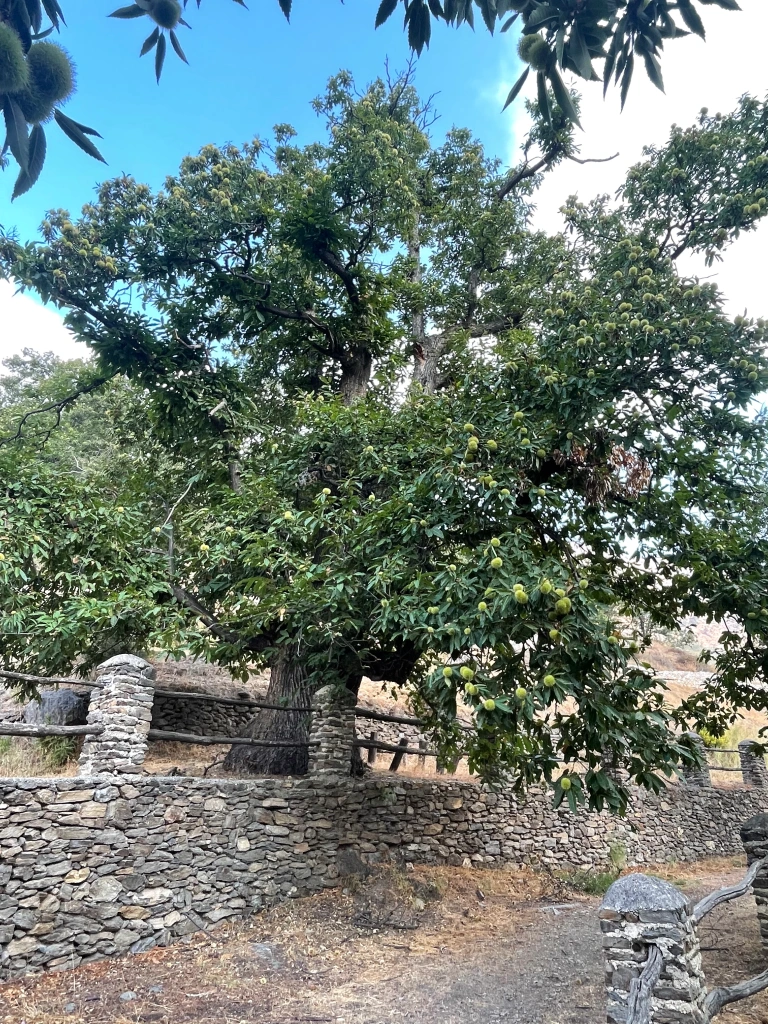
After that, just a long contour on the opposite side of the valley, always along the acequias. These valleys are famous for the chestnut trees, but quite a few of them had died, whether from old age, or ironically from lack of direct rainfall in such a well-watered area, no one knew. Below, a herd of a hundred goats was resting in an enclosure.
Proceeding along a dry acequia
Descending towards Lanjarón we passed quite a few mountain houses with splendid views to the south. Near one of these a couple of kittens ventured out as we passed by. They were probably in cat adolescence, not fully grown, but not so tiny. But the remarkable thing was that when the group paused in the shade a bit further down, someone noticed that the kittens were pursuing us. Completely unfazed by the size of the group they came tumbling down the mountain path, about 300m from the house. Someone produced slices of ham which they devoured quicker than a robber’s dog. We had some difficulty in shooing them away when we continued.
There is no doubt that kittens at this age are very entertaining. Recently I have only had the street cats which my neighbour feeds to contend with, leading me to describe cats as ‘soulless beasts’, which a friend found very amusing, but is based not only on the experience of these very suspicious and untrusting street cats, but also on a lifetime of keeping cats. But these ones were most amiable, exploring, tails in the air, not minding being picked up, but wriggling free; the best word I can find is sparky! That is for me ironic, as the first cat I ever had was called Sparky, so maybe this is an ancient neuron sparking alive again!
Well, the definition of a good walk with the Senderistas of Archidona is that it will be about 20km long and involve some thousand metres of ascent, and that at the end you will have bruised toes, some blisters on the heels, aches of various kinds in the legs, a light sunburn, eyes smarting from the bright light, and a limping gait. Most of all you will deserve a hot bath, and the following day you will only be able to hobble about. On these criteria, this one was a success!
Finally we were on the outskirts of Lanjarón and instead of the usual visit to a café for refreshment, we sat on a ledge and filled our bottles with cold water gushing out of a pipe into a stone trough. It tasted good, and any doubts about whether it was potable disappeared when a succession of locals came with five litre bottles to fill up.
At last some of the ladies decided to take off socks and shoes and bathe aching feet. This provoked a terrific critique from a stout elderly lady who had arrived to fill her bottle. The essence of this was that it was vulgar to wash ones feet at a source of drinking water, even though no contamination was taking place. It became endless and over-heated until Mario, our leader, told the lady concerned that her vituperation was being directed at his mother, and that it would have to stop. It did.
It is interesting how memories from walks in the past can suddenly well up. I remembered how once in the summer holidays in my first school in Lancashire, the deputy head and myself took a group to the Glen Shiel area in western Scotland. At the end of a hot and tiring day, one of the boys complained: “My feet are knackered, my legs are knackered, my back is knackered, my shoulders are knackered, my eyes are knackered ….”
My reply:”I wish your tongue was knackered!”
I have come to enjoy these outings. All the walks are pre-tested by the monitors. It is safety first, and a good first aid kit is carried. My socialisation has been gradual, but a step along the way, a staging post in unfoldment, a grand complement to a hermitic existence. And like the acequias, so beautifully designed to take advantage of geometry and gravity, life-giving.