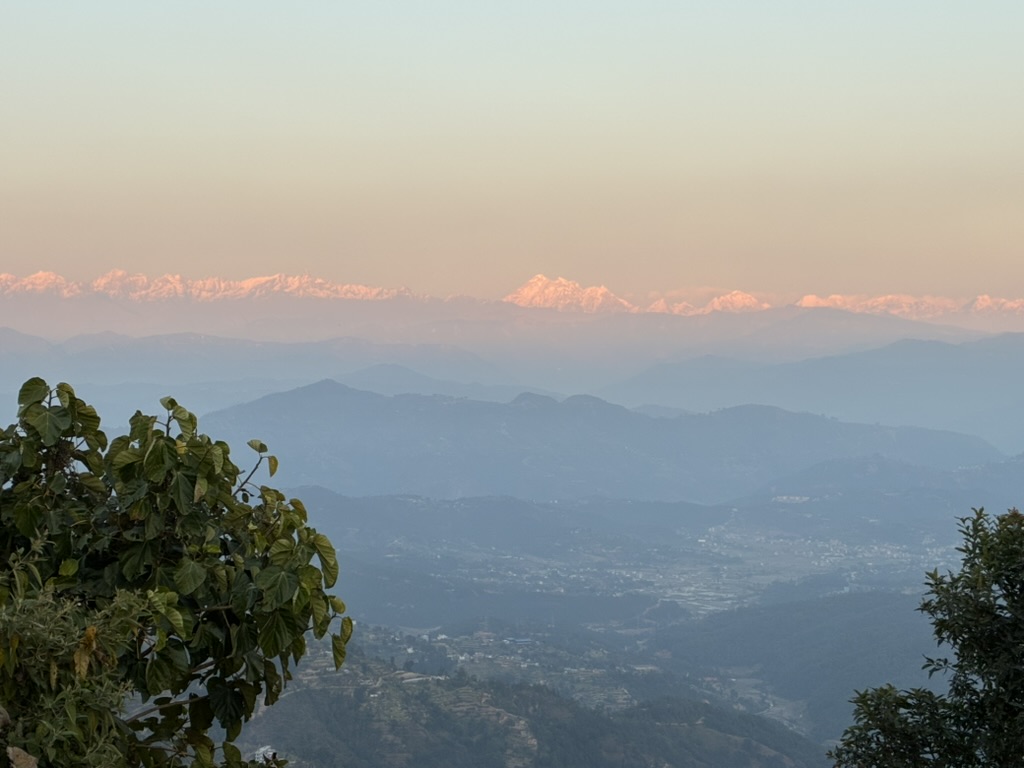
On Sunday I went for a short walk with Ram. The mountains were clear, though the smog haze can be seen here.
I asked him about the erosion of arranged marriage by caste in Kathmandu. Seven years ago I had a conversation with some young Nepalis when going up to Tilicho Lake in the Annapurna Circuit trek. They said that love marriage was on the increase. Ram confirmed this. He got married last year in the traditional way. Young couples make contact on social media, and present the families with a fait accompli. This is underway with his two cousins. They want to marry their girlfriends which are of the Newari social group, thought of as a merchant class, whereas he is a Chhetri, being the warrior class traditionally, just one below the priestly caste, the Brahmins. The father said, well what can I do, they are in love. However, the marriages have been delayed, so we do not know what is really going on.
It is thought that arranged marriage in caste is being maintained much more on traditional lines in India. It is also much more complicated than we can imagine, as there are many sub-castes. The arranged marriage system has advantages, for example divorce rates are lower. It is a different concept of union based on compatibility with an emphasis on support from the community. So, the arranged marriage system is not going to disappear, but it is undergoing a challenge. It is paradoxical, since arranged marriage does have a different concept of what a union should be, with some advantages of stability in the community and in the union itself, and though the caste system itself can be thought of as outmoded, it is likely to be very resistant and resilient. But it’s an example of how the noble and profound idea of rebirth has been changed by human convention, because it is believed that you journey through the castes and arrive at the ‘top’ caste.
As were talking and admiring the view, a group of boys aged about 13 or 14 in orange robes came up from a nearby temple to return to a small boarding school situated above on a knoll. This is a school where Sanskrit is taught, since these boys are Brahmins, and they are training to be priests. The script used for Sanskrit is the same as that for Nepali and Hindi. Sanskrit is the parent of these languages, but completely different, and a dormant language in that it is not used for everyday communication, though it is used for all the important religious ceremonies, so the priests have a guaranteed role. I felt a certain disquieting sympathy for the boys, going as they were to an unheated dormitory.
I have had a certain fascination with Sanskrit as a language, since some of the terms that I am familiar with from my spiritual studies, are Sanskrit ones, and are not translated since there is no easy English alternative. I also am fascinated by those people who are very multilingual, such as Sir William Jones, whose day job was as a lawyer, but who knew 12 languages very well, and another 10 quite well. He was very well paid for the time, in the mid 18th Century in Calcutta. He is famous for coming up with the theory that Latin, Greek and Sanskrit shared many grammatical points, so he speculated they are all born from a now disappeared parent language. Subsequent studies confirmed his analysis that there is a common ancestor, but that the idea that Sanskrit is the most perfect of the three languages is now deprecated, though it does have a very admirable and precise grammar. And Sanskrit is valued for its actual sound, said to have originated from a ‘higher plane’ and thus calming and inspirational. This must be one reason why it is insisted on by Hindu believers.
When I was in the school in Nepal, we were visited by a certain Yogi who also had a boarding school for boys in Kathmandu for the teaching of Sanskrit, and a gentleman from England accompanied him. The Yogi declared, a little ruefully, that he thought the students of the English gentleman had attained a higher level of Sanskrit for their age, taking GCSE Sanskrit. They were students in a group of schools in London and Surrey that had been founded by a British philosopher who was a follower of an Eastern teacher, who obviously also thought that to learn Sanskrit was good for the integrated being of the child. In these schools, Sanskrit is taught from 4-11 with options to continue to GCSE and A Level. The grammar of Sanskrit is so logical and pure that it would be a strong foundation for the learning of other languages, so this is another echo of what William Jones thought. The other point is that Sanskrit has 2000 years of literature to be encountered. The proof would be in the pudding. I have a theory that Sanskrit did originate in the previous world age, ie the Bronze Age. The Kali Yuga (Iron Age) is said to have begun about 3100 BCE. If Sanskrit is older than this date, then it would belong to an age that had a higher vibration that the current one.