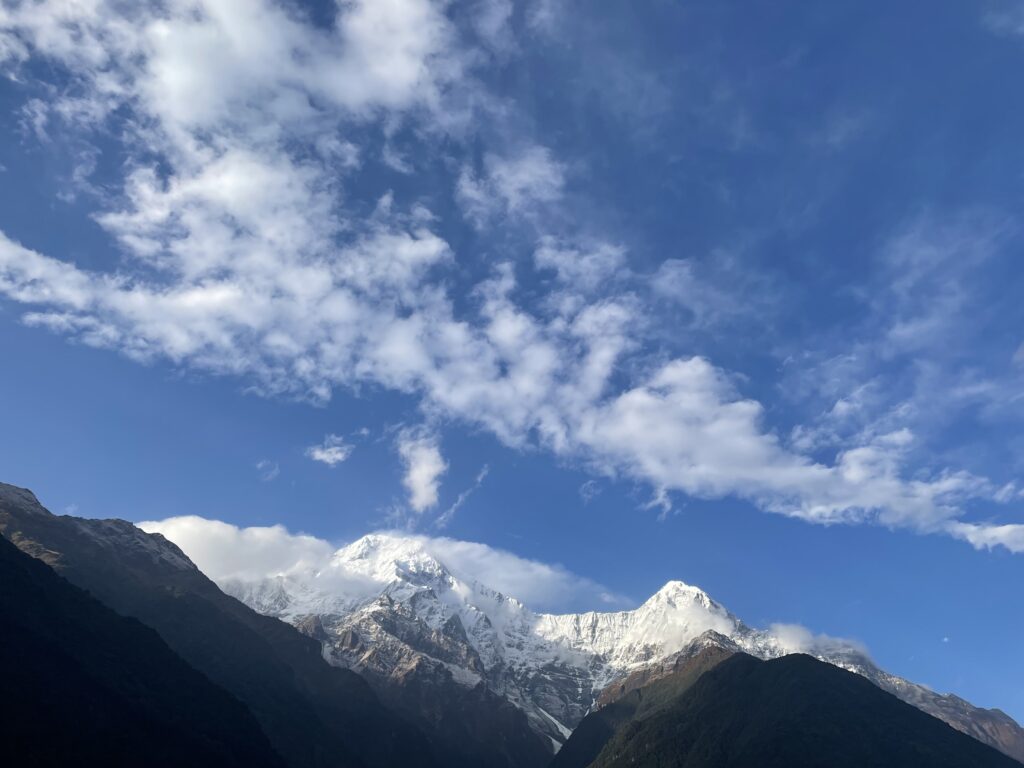
One thing has not changed since the first time I arrived in Nepal, in January 2008, and that is the dramatic and over-loud power horns attached to buses and trucks. 18 years ago, I was at first accommodated quite close to the highway, and the passing traffic certainly made itself known. And now I am staying quite close to the road again, but on the opposite side, still in audible distance of the torrent of discord.
Some of the horns play what sounds like a minor interval, such as C and E flat, exactly like the melancholy note traditionally heard on North American railroads. But the North American train horns are not designed to produce a minor triad, for example, nor any specific musical interval, but merely to be as resonant as possible, simply to be heard as a warning signal. The idea that the sound is melancholy may simply be due to context: the emptiness, the night-time, the loneliness of a long train journey.
Another common type of demanding horn sound here is a chromatic run, brutal and jarring, simply done to demand attention. On my very first visit there was a rhythmic staccato phrase reminiscent of some of the overtures to early Verdi operas, a brassy but more musical riff; but this is rarer now. The road emits sounds late into the night: a moaning of brakes, a rattling of metal bodies of trucks, a constant low rumble punctuated by squeaks, knocks, and jangles. These continue to lap against the windows, echoing as the vehicles recede on their bumpy path to Kathmandu.
The road works from Bhaktapur to Dhulikhel are still going on, and the only way to handle the topography is to have the two opposing traffic streams at different levels, and this has resulted in huge amounts of earth being gouged out, and massive walls of concrete put in place. I suspect that even when it is all finished, the road will mostly be choked with traffic.
As you approach Kathmandu, the massive ranks of motorbikes dominate the whole road, weaving in and out, or simply forming an impassible knot. Whatever happens, those raucous horns are sure to continue. Such jarring noises have been declared illegal, but like many of the well-intentioned laws in Nepal, this prescription has been ignored.
Last week we returned late from Kathmandu, and hurtling through the torrent of darkness were those trucks, which in addition to their strident voices, were bedecked in vivid necklaces of garish lights, insisting that in addition to being heard, they would certainly be seen.
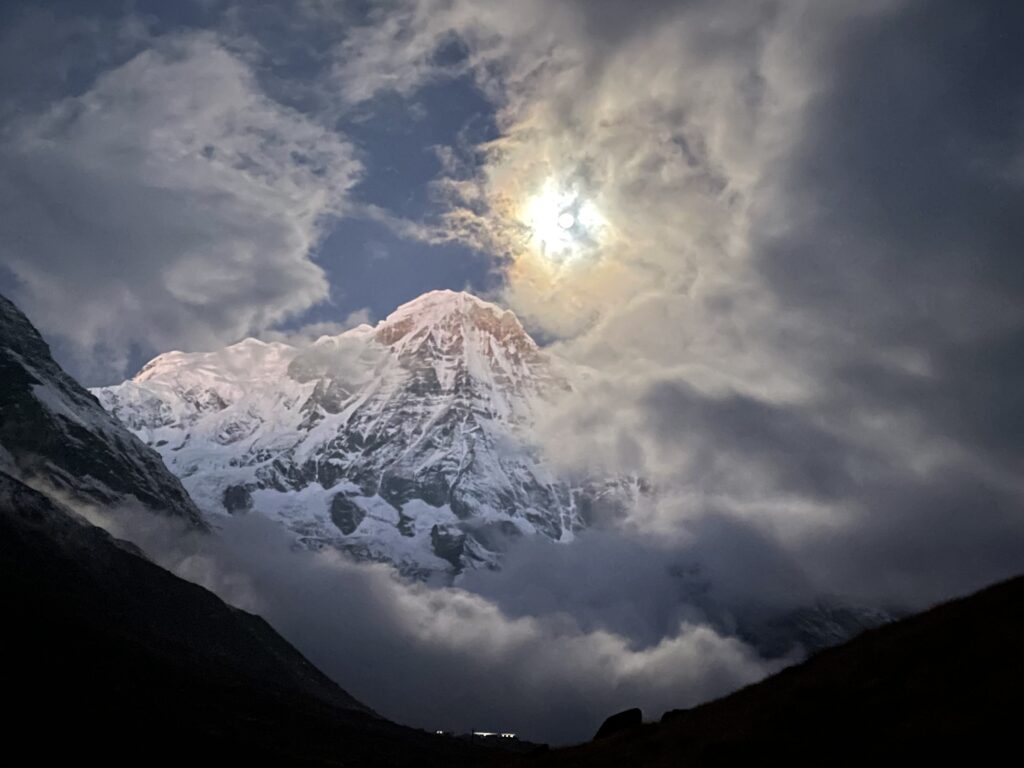
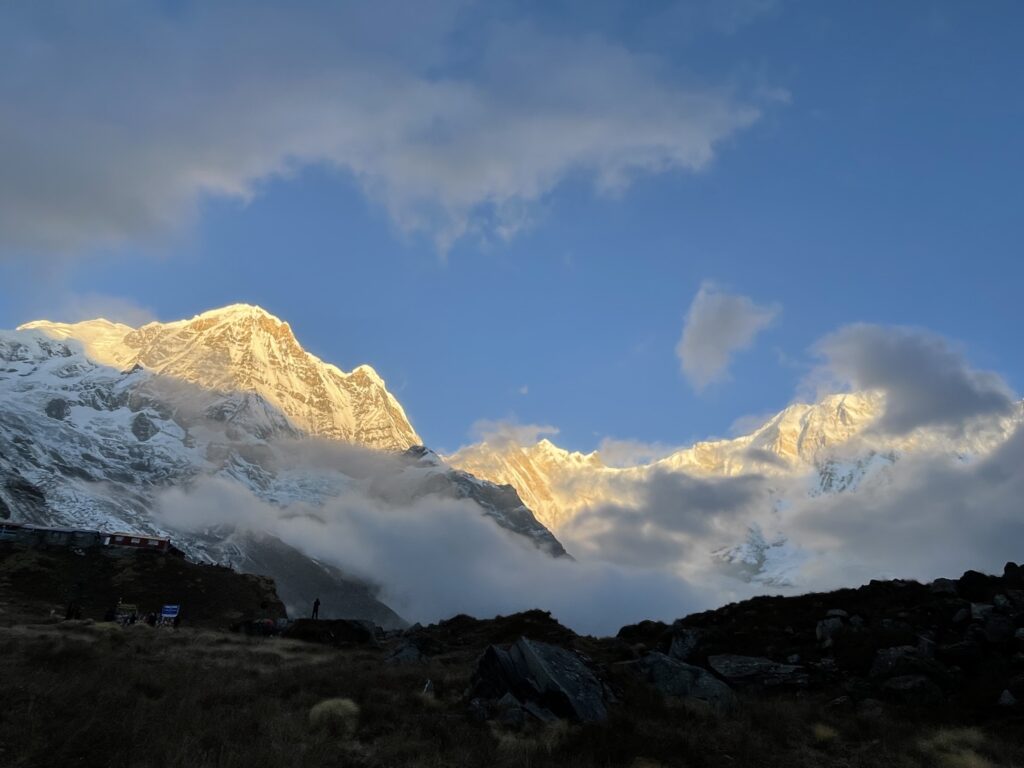
moonlight illuminates Annapurna I, lights of Base Camp visible
In late September 2025, a lingering low-pressure system over the Bay of Bengal and northern India caused a tremendous amount of rain to fall in Kathmandu and eastern Nepal. On Saturday 28th and Sunday 29th September from 240mm to 322mm of rain fell and parts of Kathmandu itself were flooded. It rained heavily for 40 hours, a continuous and dispiriting downpour. Since October is the start of the trekking season, tourism would be affected. Bridges, houses, highways were swept away, people displaced.
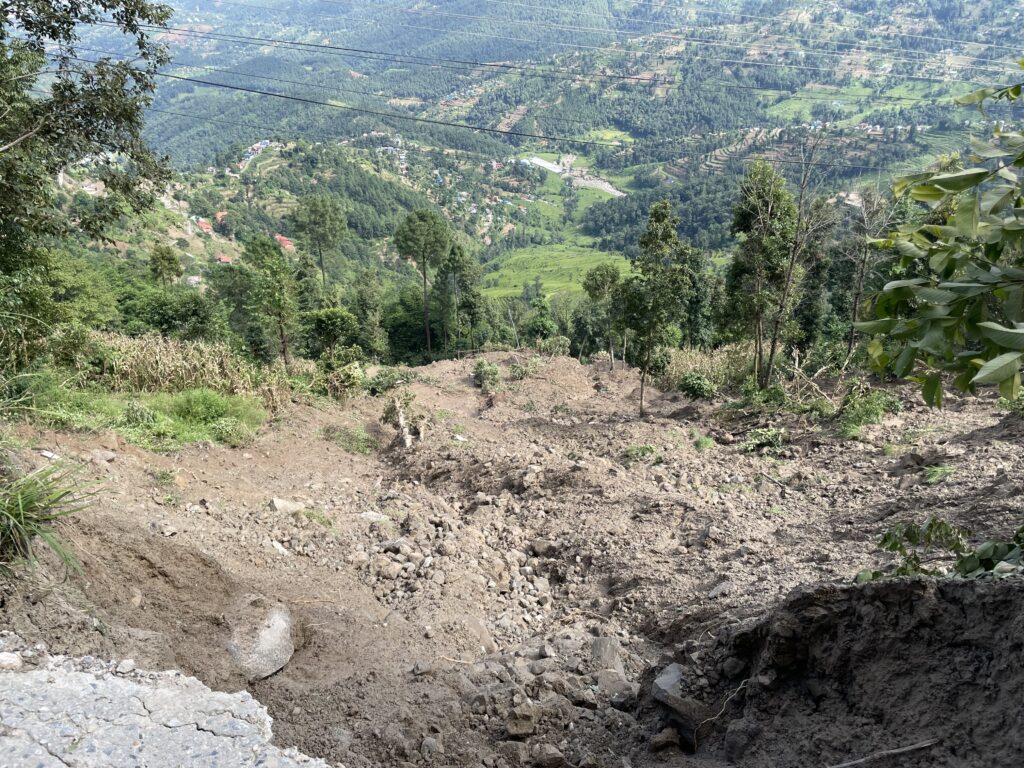
side roads are not built with proper drainage to cope with storms
In the aftermath, we walked a little way out of Dhulikhel towards Namo Buddha, and parts of the road below the Kali Temple, near where I used to live, had been swept away by the surging floods. I had been intending to go to the Everest region, but road transport had been severely affected, and flights were all booked up. The only possibility would be trying to go by helicopter, but these flights were full, and the price kept going up, so we switched to the Annapurna area, as the road to Pokhara was open. It did occur to me that I was acting like a selfish Western tourist, only devoted to getting into the trek, while all this devastation was hitting Nepal, almost like another earthquake. But somehow Nepal is very resilient and just keeps going.
Day 1: Kande to Deurali
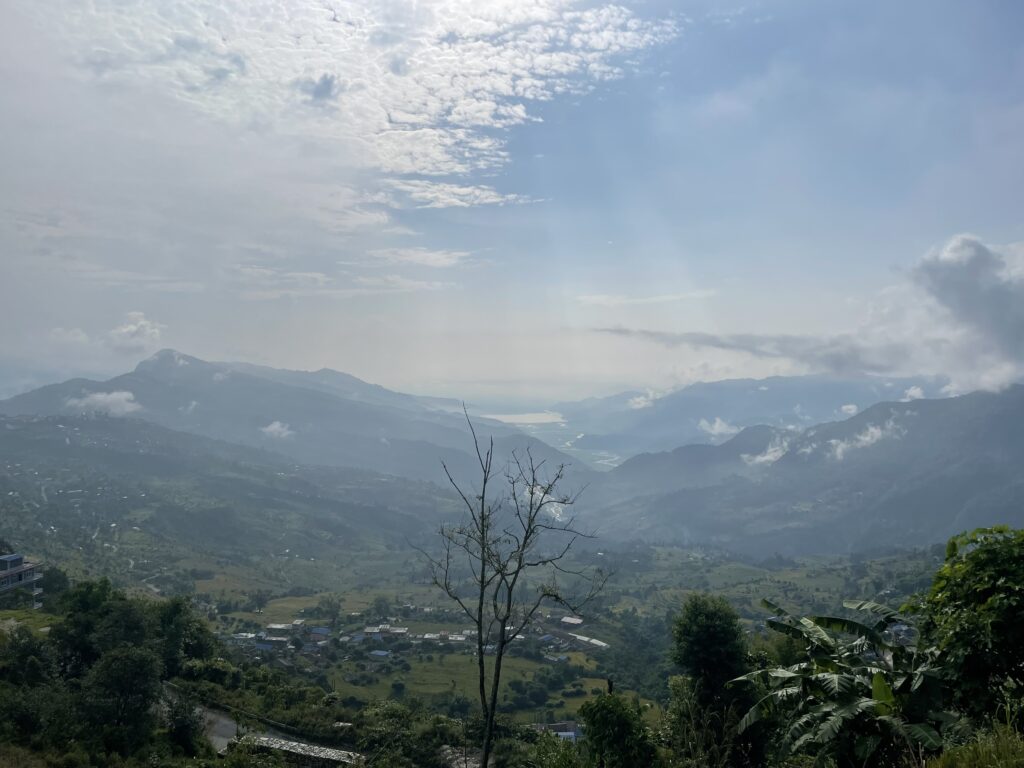
As we looked back towards Pokhara, everything was bathed in milky light; all that rain was still evaporating into a new cycle. Rain started again at 5:00 pm. No visibility, and not a very good outlook for clear views, with the forecast for rain continuing on and off for a week.
Day 2: Deurali to Low Camp
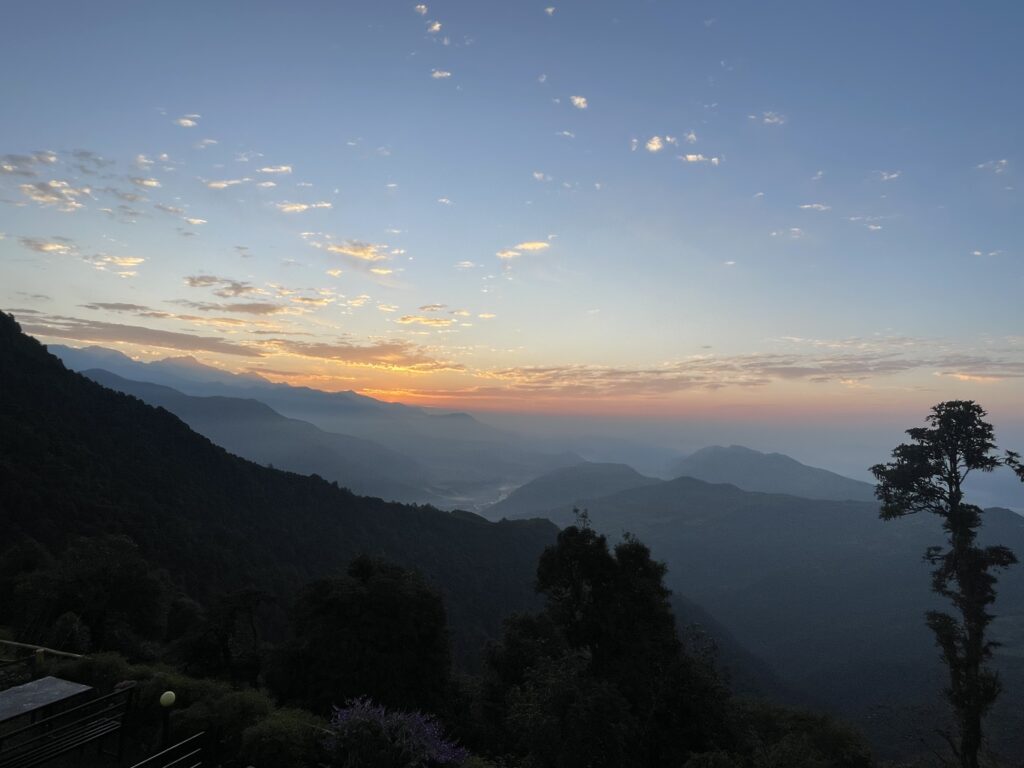
at least the early mornings were clear
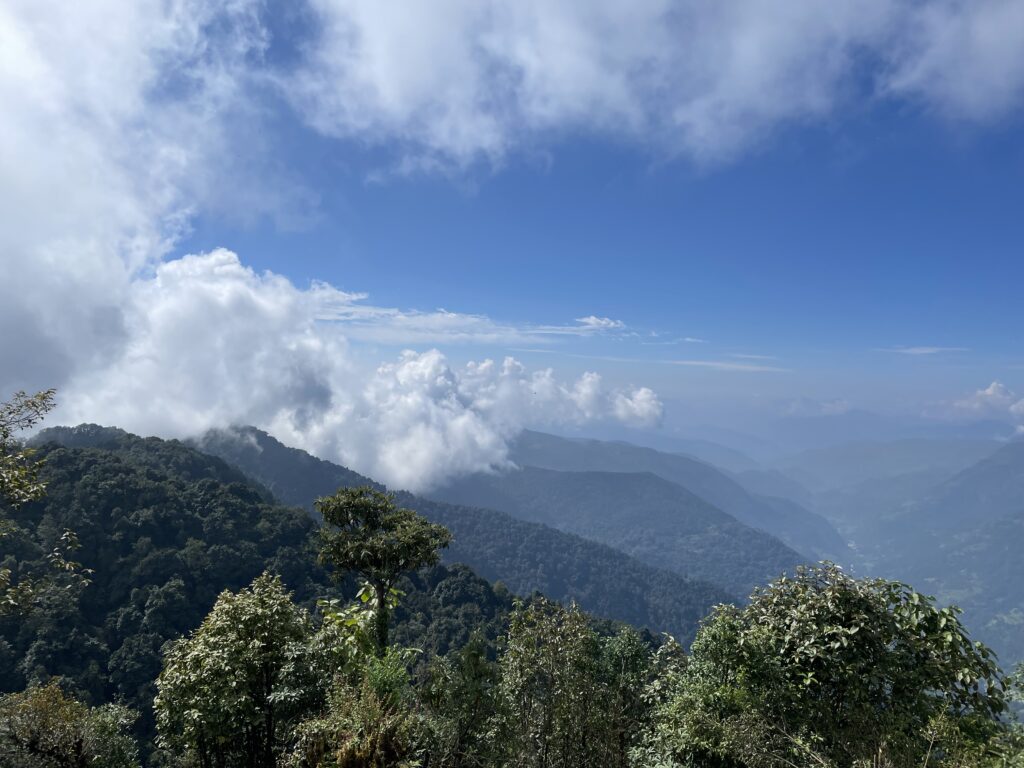
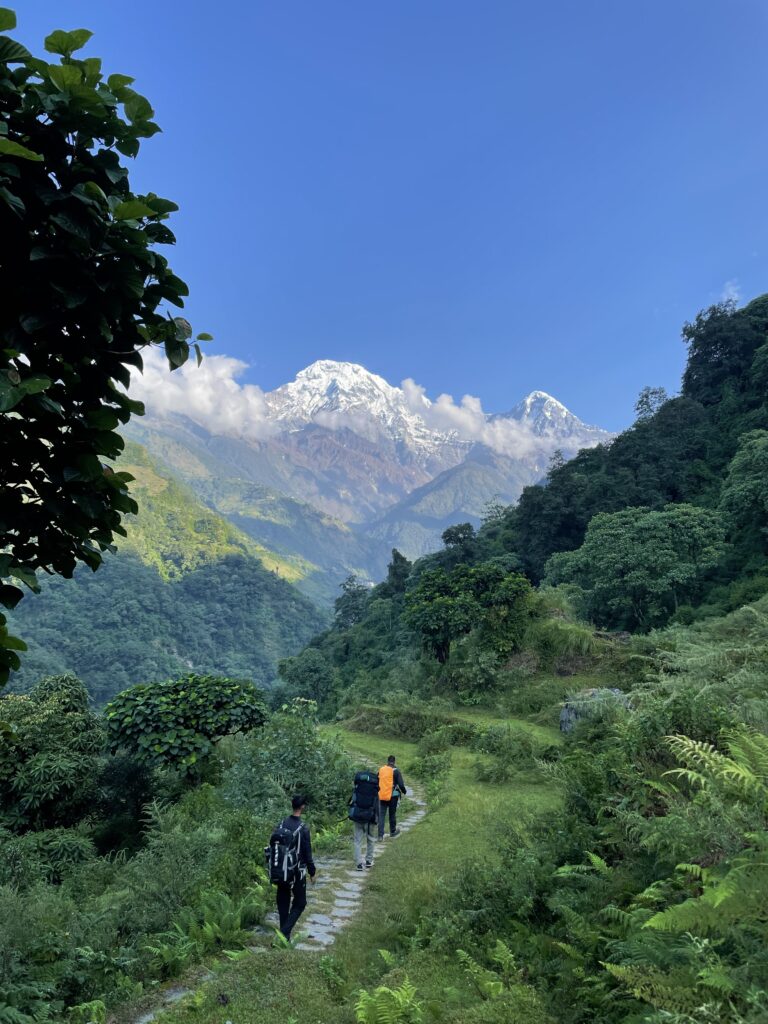
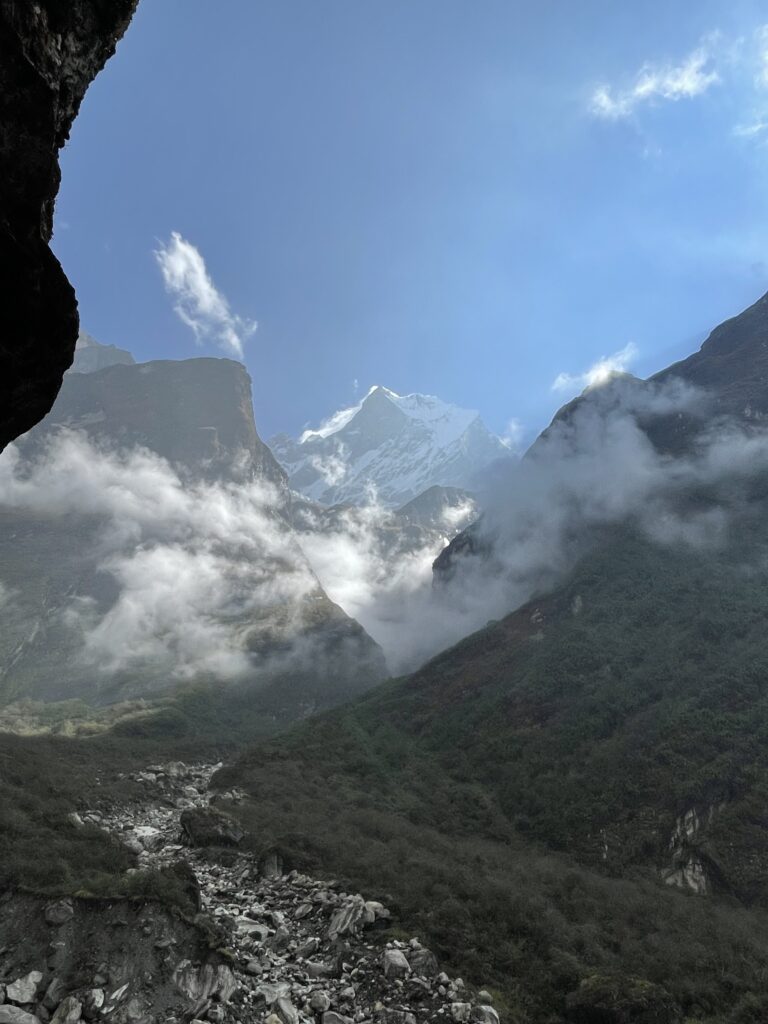
A clear view at 05:30. Cloud billowed up the valleys at about 10:00. Despite all the rain, the path was in good condition, everything held in place by the trees, for example the hardy Himalayan Oak, Rhododendrons, all trunks mossy. It was still and silent, though with the buzz of cicadas.
clouds quickly formed below as the hot and humid air starts to rise
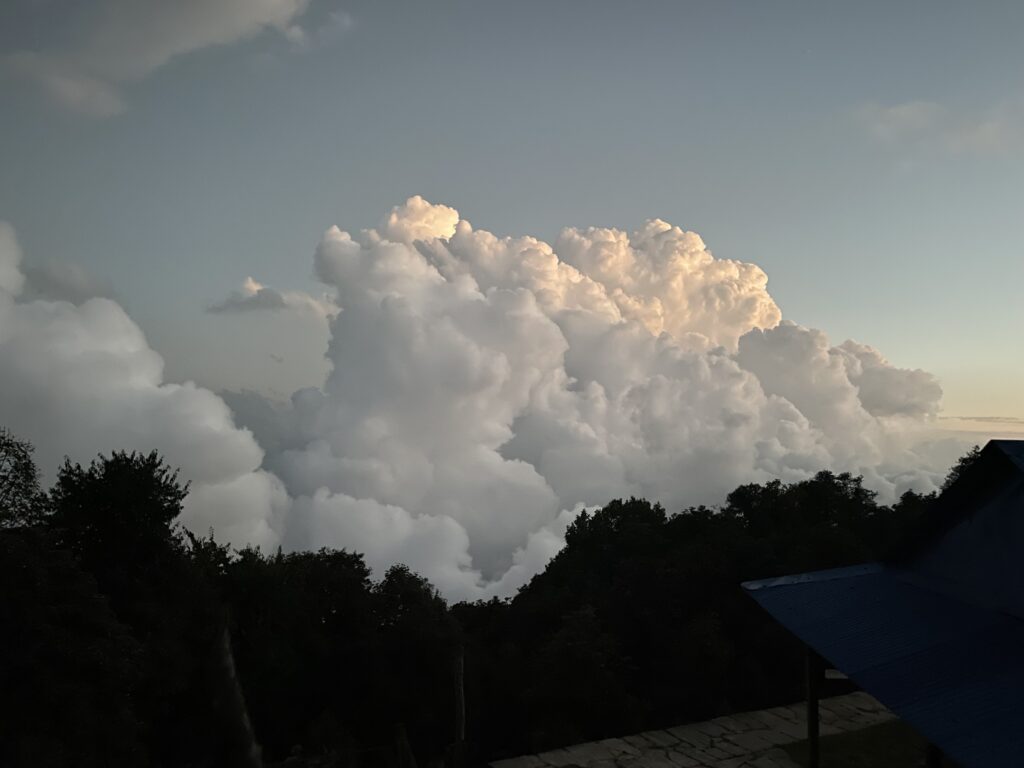
Leeches evident. Blood soaked hand. Left pinkie kept bleeding, thanks to the anti-coagulant they inject. A spectacular thunderhead was visible at 18:00
someone down there is getting a soaking
Day 3: Low Camp to High Camp
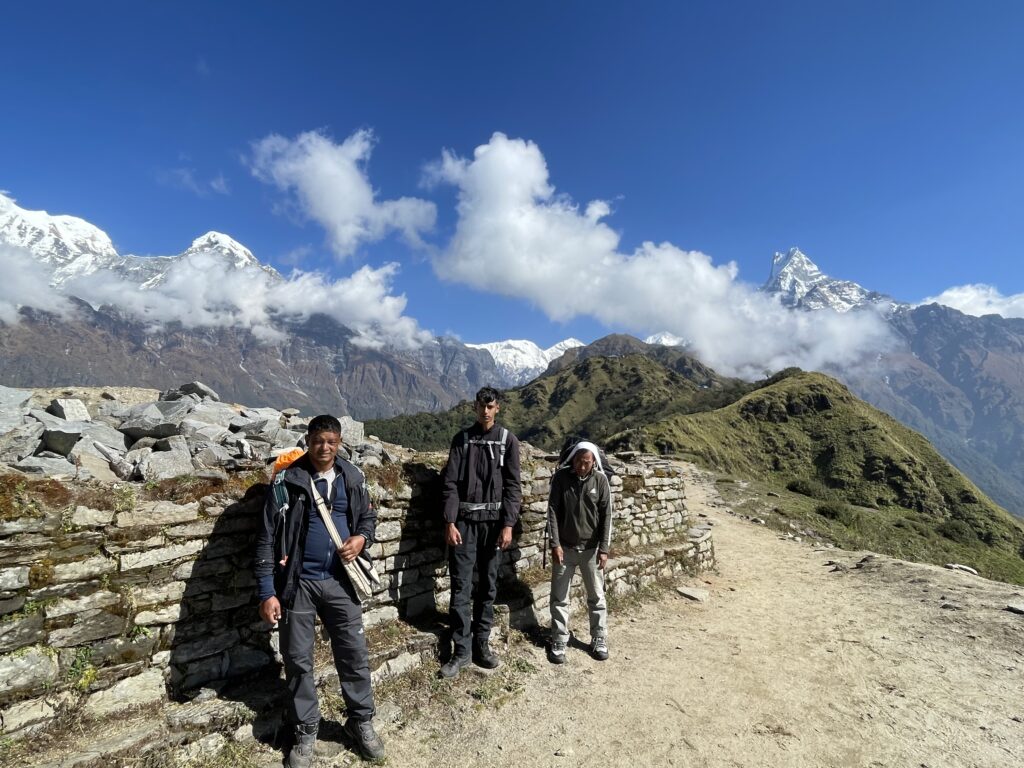
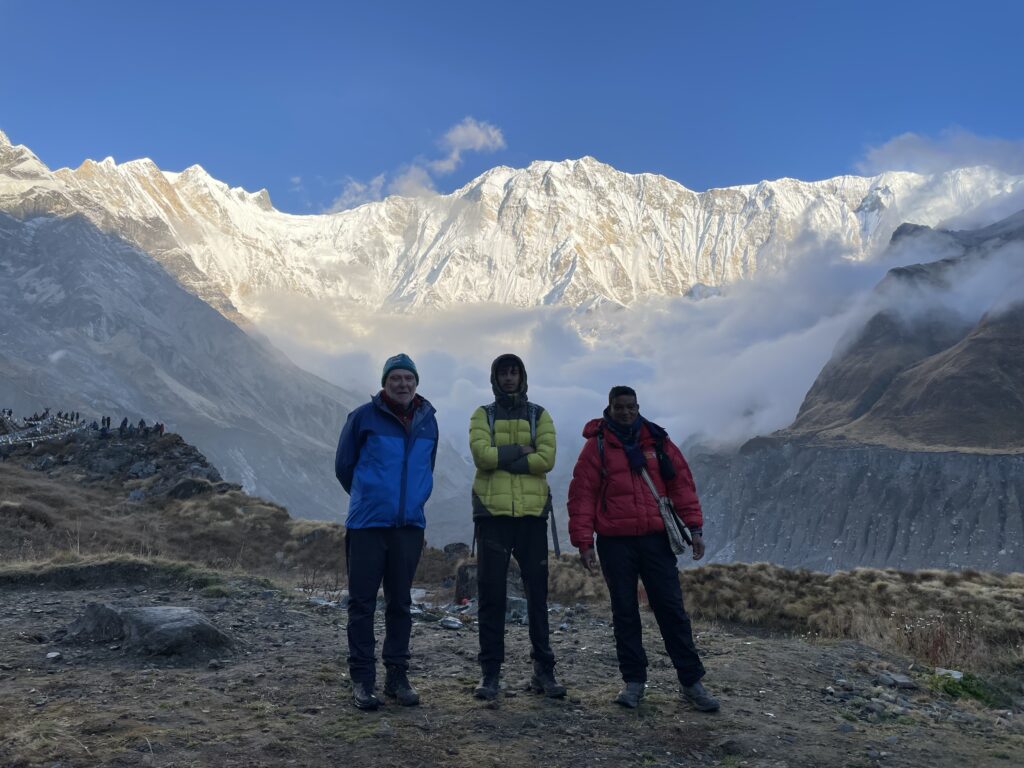
Bishnu, Pashupati and Purna, the ridge stretching ahead
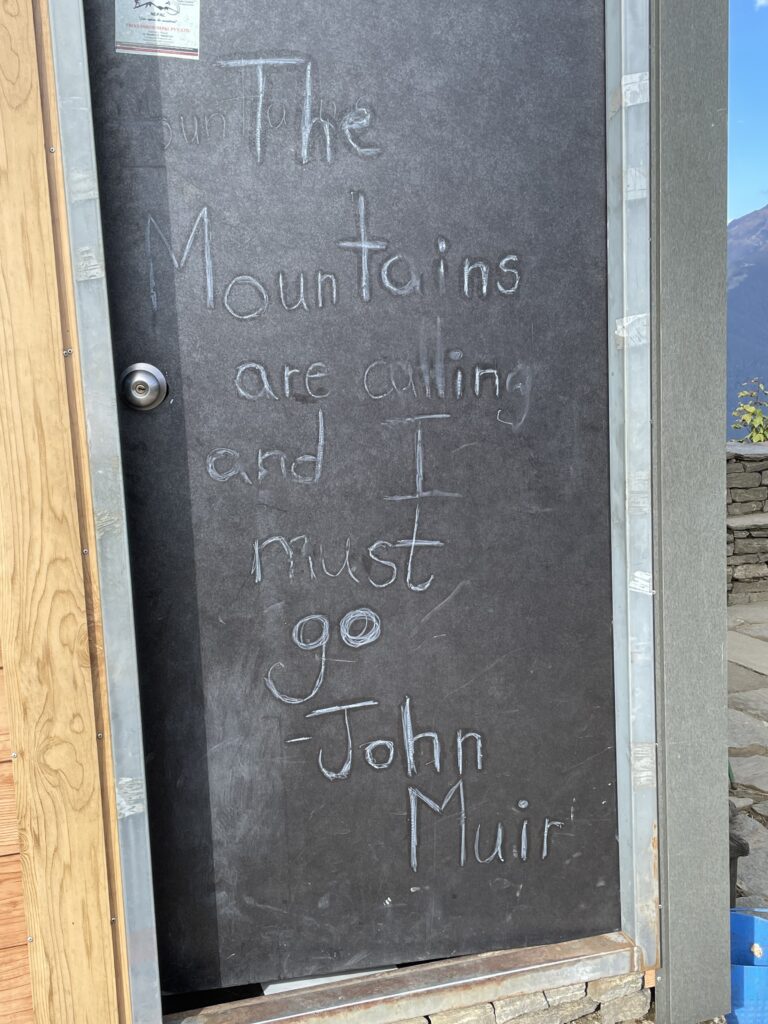
The late monsoon was still producing a lot of moisture, and clouds formed from below through condensation, so clear views were only available early on. As we climbed up the trees started to thin out and became shorter. Suddenly we could see all the way to High Camp with a well-defined ridge. It was quite windy and cool when we approached the lodges at High Camp. Cloud battalions were advancing up the valley towards the Annapurna range. We could see the sheer walls on the Annapurna Base Camp trek, and all the villages beyond Chomrung. It was reassuring to see this quotation from John Muir:
John Muir – Scottish born American naturalist and philosopher of nature (1838-1914)
Day 4: High Camp to Upper Viewpoint, and descent to Forest Camp
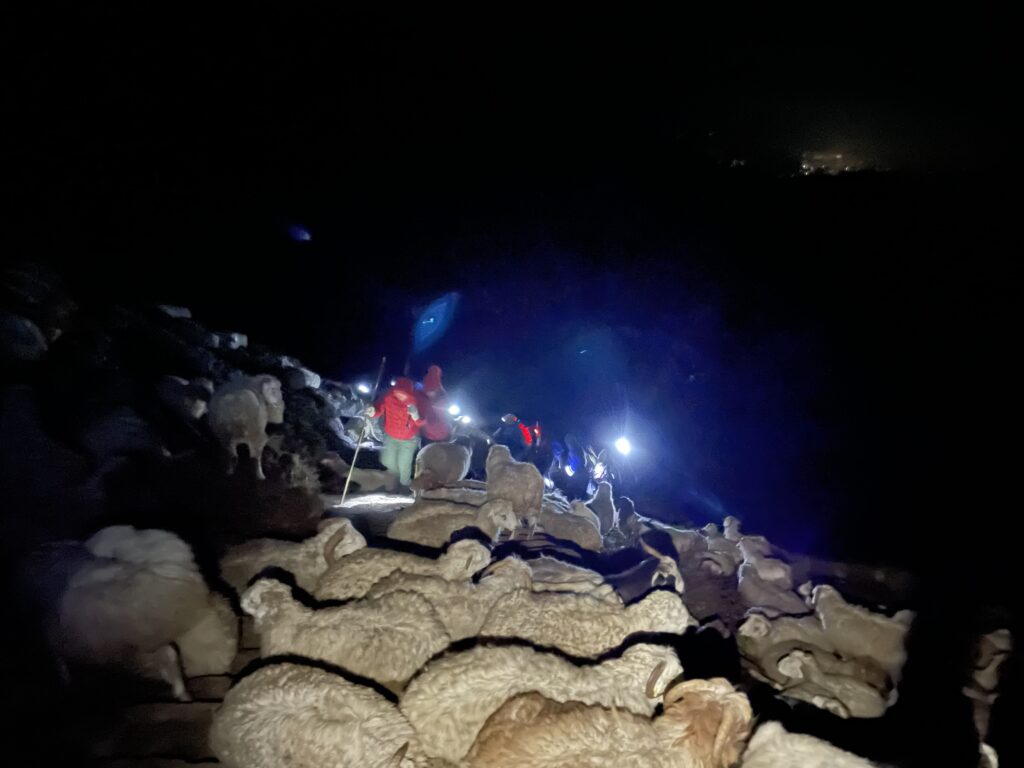
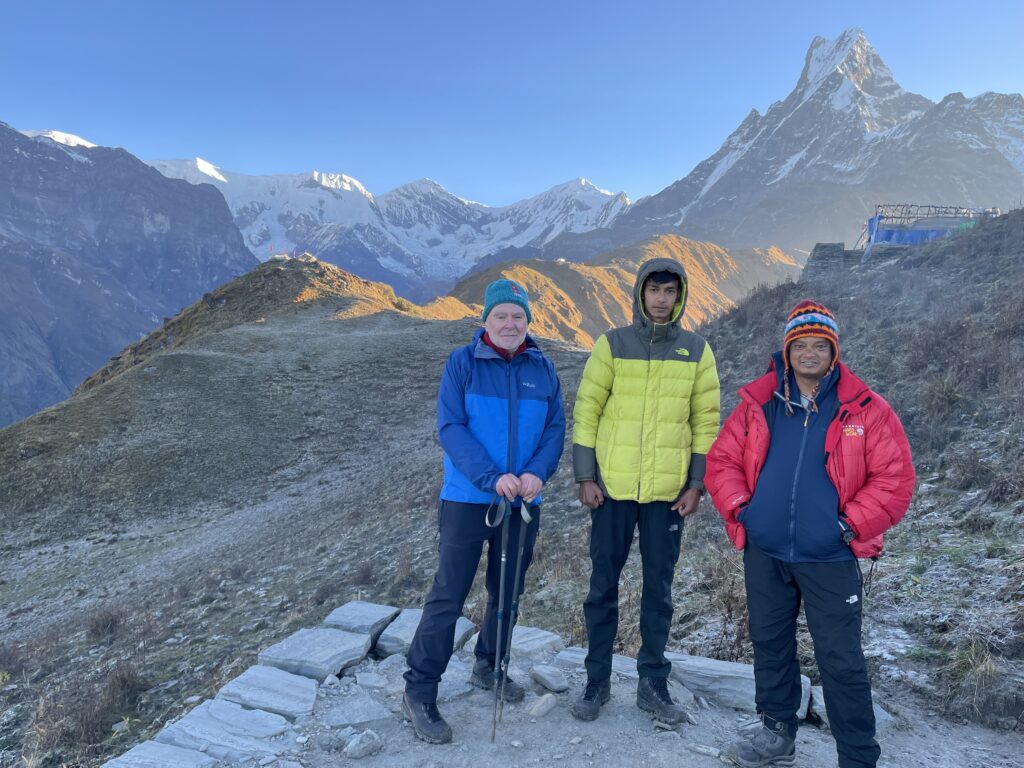
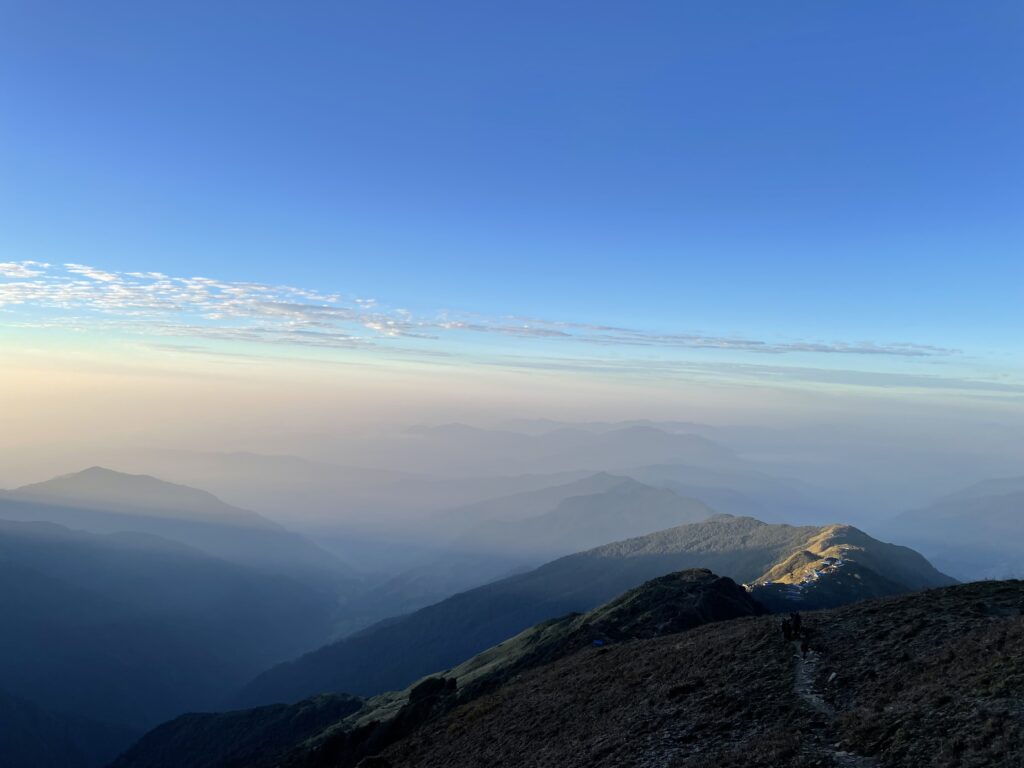
We left at 04:00 to catch the sunrise. Many people were going up, a visible flow of head torches. Sheep were sleeping on the path. We arrived after a two hour ascent, and in time for the sunrise, with about 70 people milling around. It was a little tempting to go on and escape the crowds at the viewpoint, but the ridge does get quite narrow, and there have been reports of people slipping.
sheep rest impassively, blocking the pathdiscretion is the better part of valour
After breakfast at the lodge we continued down, a longish descent of 1600m and 20 km. The highest the rhododendrons will grow is about 4000m and all concentrated on one side of the ridge, either due to the soil or to get some shelter from the prevailing winds. They are stunted but just as beautiful.
going down is always easier
Day 5: Forest Camp to Landruk
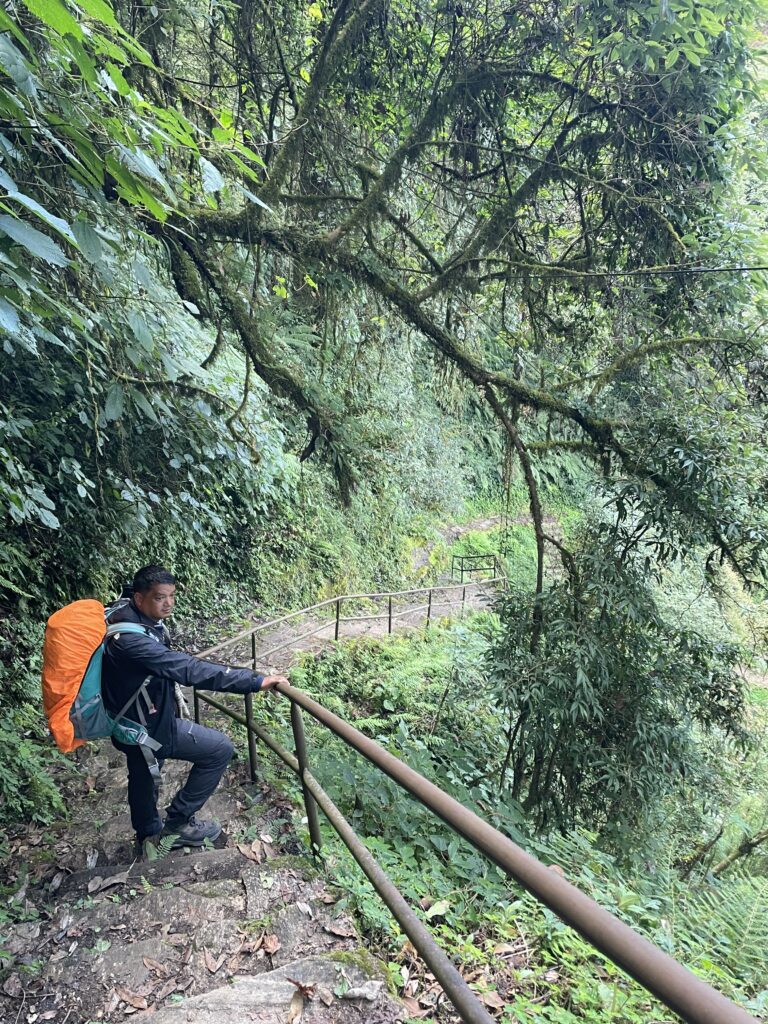
It was a drop of 1045m to Landruk. The weather was humid, windless and cloudy. There were many steep staircases on the way down, all wet and quite slippy. Handrails were in place for safety. We have met the following nationalities on the trek: Belgian, French, Australian, Swiss, Indian, German, Israeli, Japanese.
Bishnu in contemplative mood
Day 6: Landruk to Chhomrong
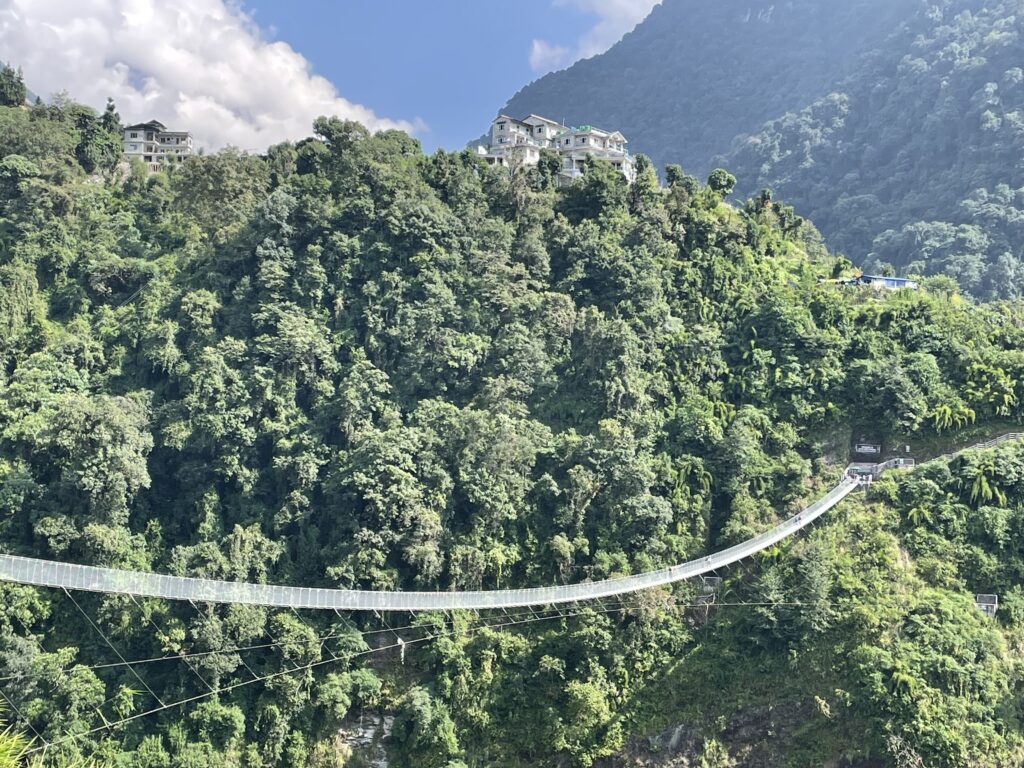
We still had to descend to the river this morning. We met a French guy aged 72, walking alone with a minimal pack. Plucky. Now the trail is much busier. After lunch there was a gruelling rise up to Chhomrong. The second longest suspension bridge in Nepal is impressive, and removes the very steep descent previously necessary.
Day 7: Chhomrong to Bamboo
A strong stream ran by rice fields. A short day, but going up was still quite challenging, through the humid air. A large group had descended from the Base Camp, but there was no room at Bamboo, so they had to keep going to Chhomrong. It is apparent that this trek has become a ‘must do’ for young Nepalis, particularly during the Dasain festival, as I had never seen the trail as busy as this.
Day 8: Bamboo to Himalaya
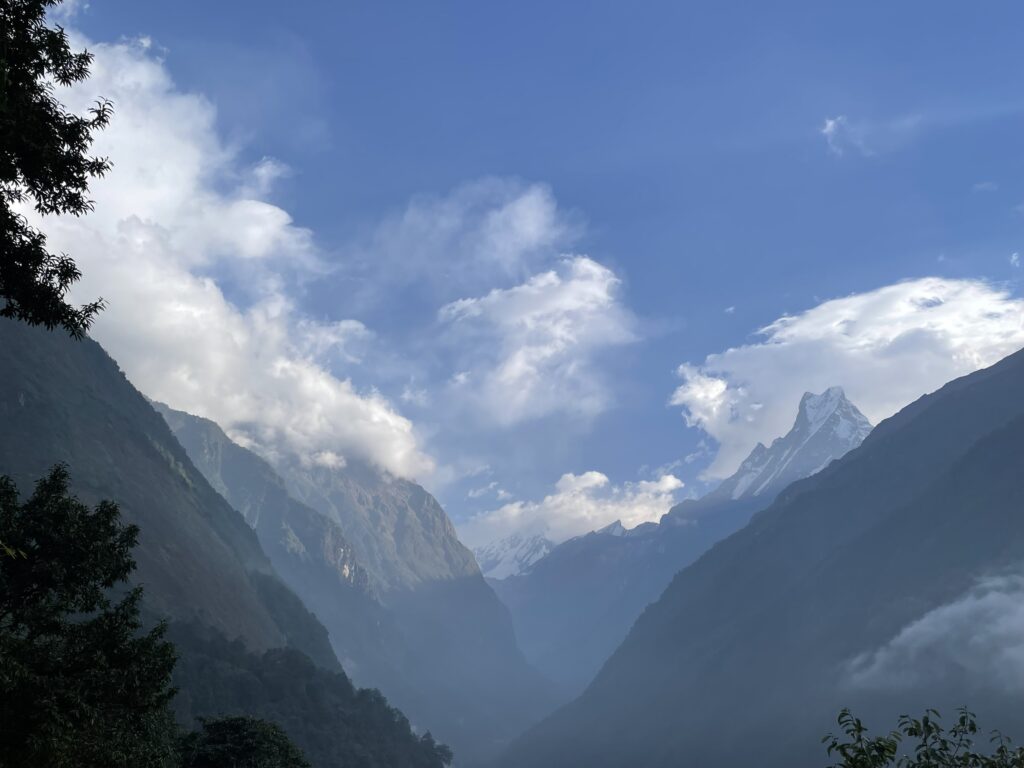
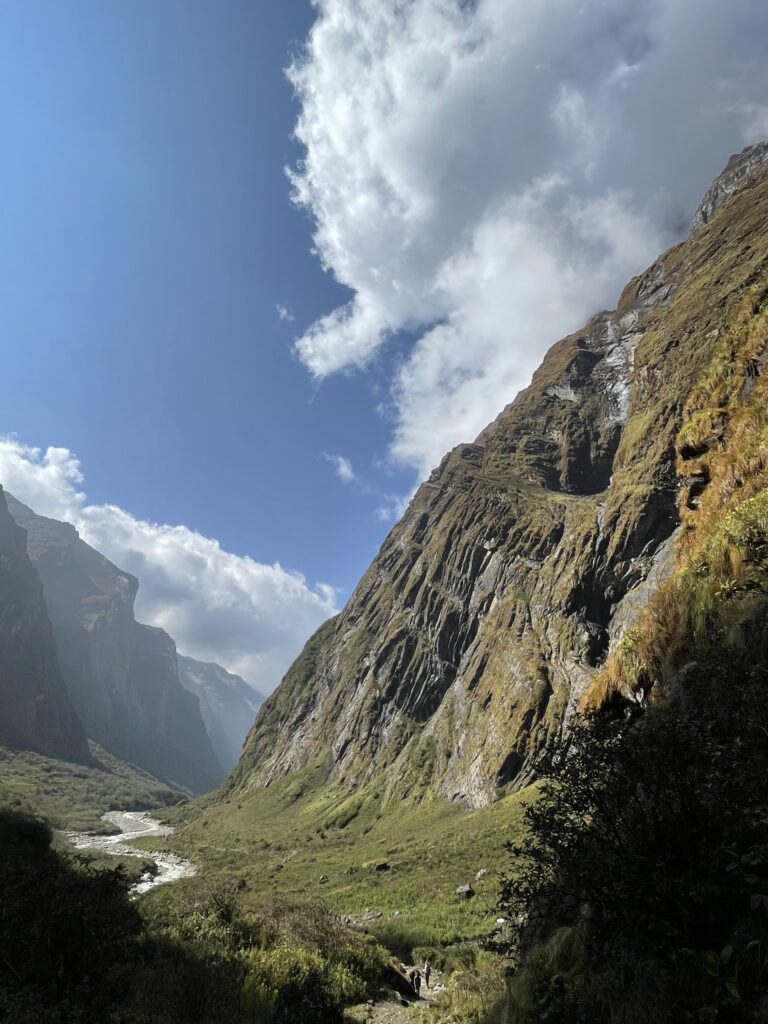
the valley narrows towards the Annapurna Sanctuary
Cloudier weather. Lunch in Doban then a steep rise to Himalaya, where the three lodges were packed. Rain fell shortly after arriving. Many dogs on the path, who seem to shuttle between the lodges.
Day 9: Himalaya to Machhapuchhre Base Camp
The trail is rockier and rather worn. We passed the avalanche zone, Himalayan birch trees by the path. If there is an avalanche, there is no warning and everything shoots off the heights and thunders down below. Anecdotally, someone saved themselves by going towards the river. A long slow climb up to MBC, where the lodges are impressively built stone structures. About 350 people an hour going up or down, certainly an impressive volume, if not tranquil.
Day 10: Machhapuchhre Base Camp to Annapurna Base Camp – down to Himalaya.
A sleepless night. Started off at 04:00. Some hot water to drink, and two Hobnobs on the way. Very much lacked energy, but kept going, and no other altitude effects evident. There were hordes of people out for the sunrise, many perched on the abyss above the glaciated valley which is crumbling away. Some new snow lay just above the base camp at 4130m.
crumbling walls of the ancient glacier basin seen on the right
We had a clear view of the avalanche zone on the way down. The classic U-shaped glaciated valley appeared, though hard to imagine the whole place completely filled up with ice slowly eroding the edges under the law of gravity.
Day 11: Himalaya to Chhomrong
A long descent to Chhomrong, and it was not all down, with some impressive rises on the way as well. A thunderstorm started as we left Sinuwa, with quite heavy rain. But afterwards the air was very clear with impressive views, and new snow could be seen on the rocks of the heights. The following day a jeep took us to Pokhara.
To approach the inner sanctum of the mountains, we first had to descend quite steeply through the forest and cross a couple of rivers. The total ascent for these two days could therefore have been about 2200m, though without any altitude effects, since we were not staying at the top elevation of 4000m, but returning to Lungang Gumpa at 3200m.
What was apparent was that we were not taking the trail on the left hand side of the glacier, that led to the base camp, but the alternative trail on the right hand side. Ani Ri San indicated that there were three yak kharkas that would signal that we were on the right path. A long section went through moss-covered trees, with many fallen trunks. Madhu questioned why there were so many of these. It could be that the competition for sustenance means that some trees submit to self-sacrifice so that the larger forest entity may thrive. Research shows that trees communicate and assist each other. Also, this damp area obviously got much less sun, which may have affected the overall condition of the trees. The trail was quite indistinct, but we found the first kharka, and on we went through thinner, more open forest, where the snow still lay unmelted in shadow.
Madhu, with a stone resembling an image of Ganesh, in the last of the three kharkas
The map is quite misleading in that there is no glacier, or only the shrunken remnants of a glacier. The area of vast historical glacial erosion, perhaps from 10,000 years ago, was not visible to us, and when we finally ascended the innocent looking slope, seen in the above photograph, the hill with stunted trees on the left, it was with a shock that we realised that suddenly the land plummeted vertically down into the eroded valley, and was still crumbling away, so that the earth we stood upon might collapse at any moment!
the clouds are a narrative all of their own – looking towards the sanctuary
Madhu went on a little further to get a better view. He reported rockfalls and small avalanches from the cirque of icy slopes. Then down we retreated, through the snow meadows, with numberless steps, through the mossy green primeval woods and their rushing icy brooks, on a path more imagined than perceived. We came to the tree trunk bridge. It was a different proposition in the dark. I eschewed the challenge, and went towards a shoal of large rocks. ‘Jump!’ I urged Madhu, but I was glad to be pulled upward with Bishnu’s steady hand. Now there was only a shimmer of light in the west. I turned on the head torch, and we covered the last stretch in the thickening darkness, tired but elated, and pleased that we had truly trod a path less travelled.
Nile to Domje: While many of the most famous treks in Nepal are circuits, for example Annapurna, Manaslu, Kanchenjunga, there is also interest in going down the way that you came up, for example in the Everest base camp trek and the Langtang trek, due to the surprising new viewpoints you may have missed on the way up, as you see the landscape from a new perspective. This was a long day, all the way down to Domje, but no stress on the lungs. Leaving Nile, it was worth noting that these weather-beaten welcome gates, hide a rich set of Buddhist illustrations if you look up when passing through the gate.
weather-beaten welcome gate just outside Nile
look up to the heavens inside the welcome-gate
There must be a Tsum Valley diaspora, since on descending we took the path ‘less traveled by’ and came upon this magnificent, and freshly-constructed stupa, which Madhu discovered had cost some $270,000. Contributions must have come from far and wide.
magnificent stupa, with dramatic backdrop
Our descent took us to a pleasant, though seasonally parched, pasture above Chhokang Paro, where the north Indian plain smog could clearly be seen in a layer below, and which did not bother to delay before surging upwards and turning the pristine air murky.
smog layer, about 2400m
Now we had to negotiate the exposed path that descends from Chhokang Paro to Domje. Wild mountain goats above looked down disdainfully. The path was stable, but some nerve was still needed in places, with steps submerged in fine dust.
in the smog again … narrow exposed trail
But we established that the Gompa on the way to the Ganesh Himal base camp is open! Now I only had to rally the troops, reminding them of what we would miss out on if we neglected this adventure. Meanwhile, approaching Domje, I was reminded of the parable of the sower: ‘ … and other seed fell upon rocky ground …’
young wheat shoots amid the boulders
Domje to Gumba Lungdang: The following day we went up through the forest, a magnificent walk. A winding path, not so steep at the start, but later it became quite tough as we went over 3000m, and also the full ascent was about 800m. Madhu said that we were travelling through an oak forest, but the leaves were evergreen. Many species must exist, and there certainly is a Himalayan oak. Meanwhile, views across the valley showed deep gorges and a thick covering of pines. The mountains were closer, with high extensive snowfields.
Hidden Himalaya, in all its untouched glory
We arrived, gratefully, at the Gompa, but only three nuns were in residence; the other ten or so sent, compassionately, for winter leave to warmer climes in India for study courses. Three nuns, and two hungry dogs. Some biscuits made friends of the dogs.
in bright sunshine outside one of the prayer halls at Gumba Lungdang, 3200m
There is not much flat land at the Gompa. Our rooms are perched above a steep drop. The kitchen is organised and warm. It is the universal habit to lop some branches from growing trees, and these long sticks are fed into the stove. A large kettle sits directly above the flames, and the stove door is kept open. But this often leads to rather smoky rooms, though in this case it was mostly smoke free.
Ani Ri San in her kitchen
We asked Ani Ri San why she had become a nun. She said it was of her own volition. She told us that her father had deserted her mother, and life became very difficult. She did not have a very positive image of marriage. Another issue in Nepal is child marriage, often due to poverty, though mainly experienced by marginalised social groups. Nevertheless, some nuns do not maintain their vows and leave the Gompas to seek a marriage partner. I asked if the practice of meditation may have a positive effect not only on the practitioner, but also on the world at large, and she agreed to that.
dusk is early at 16.45 … looking towards the amphitheatre of the Ganesh Himal – small meditation cell seen in the distance on the left
My room is constructed of wood, with many little shelves that could be bookcases. The pillow is even filled with sawdust; nothing is wasted here! There is very little flat land. around the Gompa, except for a few terraces where potatoes may be grown. An apple tree renders tiny fruit. This is a peaceful place. I could imagine spending a longer time here, especially in the winter, looking out longingly for snowfall, and at the wonderful evanescent cirrus clouds.
Leaving Jagat, the Buddhi Gandaki, gushing down – a tributary is providing local hydro power
Jagat to Lokpa: we were still in the common area for trekking around Manaslu. Frequent mule trains descended, unladen, usually placidly, but at times there was jostling and kicking. We could see that this traditional means of transport will be replaced by the gradual extension of the road towards the villages in the Manaslu valley. But one issue is, should a road also come to the untouched Tsum Valley?
The only way to extend the road is to blast through sheer rock faces. This is being done by the engineers and workforce of the Nepal Army. We are cautioned by an infantryman with an automatic weapon to wait, as a routine explosion was imminent. For some reason, there was a ‘test explosion’, then the real one came with a cloud of dust.
Road making inch by inch
Classic Himalayan valley, our route on the right
This type of work may not be done with standard western risk management. There have been fatalities with similar road construction on the Annapurna circuit. But it is hard not to be impressed by the persistence that brings better communications.
Doing the Manaslu circuit in winter has an enhanced risk, even though the weather appeared very stable so far. We met a group of six trekkers who had turned back due to deep lying snow, wind and drifting snow. Later, though, we met two other groups going to attempt the Manaslu circuit: one from Germany and one from Australia, the second with an impressive 75 year old trekker, giving hope to others near that age!
Lopka to Chumling: A forest walk, winding up and down, with the river roaring below. First, a massive landslide that took 45 minutes to cross. It looked alarming, but in the dry season it was stable enough. We heard later that one trekker had taken fright and retreated!
There was only a glimpse of sunshine at the lunch stop. The owner of the tea house explained that they didn’t get sun for two months in the year. Suddenly a suspended walkway appeared in the cliff, but reassuringly ‘Swiss designed’. The metal holding plates had spaces for six bolts but only two were in use. We rationalised that the weight of the metal only required two bolts!
soaring cliffs show the sheer scale of things
Tiny settlements could be seen huddled beneath crags. One thing that has improved in Nepal is electricity provision, and even the remotest villages had their power lines, and the supply is stable, unlike fifteen years ago, when massive ‘load shedding’ was universal.
A rare hot shower was available at Chumling. The views became quite alpine. We ate in the cosy kitchen and later gathered round a small campfire.
Chumling to Chhokang Paro: Altitude started to kick in at 2500m. A group of women descended, asking, ‘Why are you taking this old man up? We are coming down to escape the cold!’ A couple of small children, aged 3 and 5 were walking 2km unaccompanied to school. Then two British chaps, but with Australian accents, as they had moved down under, jaunted down the trail in T-shirts and shorts.
the impressive lodge at Chumling
Our destination at Chhokang Paro was the Bio Hotel. We were grateful that something was open. Again we ate in the warmth of the kitchen. While begging for an internet connection, we elicited from the lodge owner that his father was truly fortunate, living in the present moment, without the distractions of technology. Now we were in the real upper valley, with grand vistas and extensive level agricultural land.
early morning, looking back at Chhokang Paro, as the valley opens out into cultivated fields
Chortens announce the entry to the upper Tsum Valley
Yes … a touch melodramatic, because the Tsum Valley in Nepal is only unknown to those who have yet to explore it. But the idea of the ‘unknown region’ is a symbol for adventurous travel, and maybe for deeper exploration, since Toward the Unknown Region is the title of a poem by Walt Whitman, and also of a piece, with the same name, for chorus and orchestra, by Ralph Vaughan Williams (1906), who also used Whitman’s poetry from Leaves of Grass for his epic A Sea Symphony (1909). The poem has some wonderful phrases, and though I might demur that Time and Space in themselves are worthy of such exalted praise, there is no doubt that Whitman’s words carry us vibrantly along in a mystical, ecstatic trance. https://whitmanarchive.org/published/LG/1891/poems/245
The Tsum Valley is a Buddhist enclave. The inhabitants are of Tibetan origin and speak a dialect of the Tibetan language; there are a number of monasteries, called Gompas, whose inhabitants in this area are nuns. At the head of the valley are at least two entries by high passes into Tibet, still used for seasonal trade, and through which, no doubt, the valley had been populated in earlier times, by explorers from the high plateau beyond. There is also a famous cave where the great saint of Tibet, Milarepa, is said to have been in retreat. The valley is liberally supplied with chortens, stupas, and prayer walls, and omnipresent prayer flags. It is an independent branch of the Manaslu circuit, and those trekkers who come up to the top of the Tsum Valley, will be acclimatised for the higher regions ahead on the main circuit.
Gradually the idea formed of a winter trek in December, by poring over maps, and reading Trekking around Manaslu and the Tsum Valley (Pritchard-Jones and Gibbons – Himalayan Travel Guides). You could see that after quite a steep day of climbing at one point, the land broadened out into a high, level valley, before narrowing again in its ascent towards the border. And I began, also, to speculate about an approach to the Ganesh Himal base camp, which should allow a viewpoint of the high, massive snowfields of these mountains, as yet unthreatened by the climate-induced melting going on in other places, due to their aspect facing north. We would have to stay at Gumba Lundang at 3200m, one of the monasteries, if it were open at this time of year, when people come down to spend a couple of months in Kathmandu and escape the cold.
So while journeying deeper into the mountains, I started to consider how
little I knew about Buddhism. Why was the religion so prominent and persistent in these remote valleys? Why were there so many nuns in the Tsum Valley? Even though Buddhism expresses some of my deepest beliefs, such as the ultimate illusion of our sensory life and our repetitive reappearance here on the earth planet, with only small incremental evidence of progress, I knew that my understanding of its traditions and current realities was superficial. As it happened, after the trek, I found some books in Kathmandu to add to those I had already read, that gave some further understanding, such as the following:
1. Thomas Shor: A Step Away from Paradise
https://www.thomasshor.com/a-step-away-from-paradise
https://www.bbc.com/travel/article/20220830-the-himalayas-hidden-paradise-valleys
2. Lama Yeshe Losal Rinpoche: From a Mountain in Tibet - A Monk's Journey
3. Alexandra David-Neel: Magic and Mystery in Tibet
4. Mick Brown: The Dance of the 17 Lives - the incredible true story of Tibet`s 17th Karmapa.
And I decided to re-read Lost Horizon, the 1933 novel by James Hilton, that immortalised the name, Shangri-La. Yes, fiction, but it also captured the public imagination, that somewhere on earth, there could be a rarefied place where the normal dissolutions that characterise human life, might at least be delayed, and where a conflict between temporal love and higher aspiration is brought keenly into contention.
The journey toward the unknown region would be both an inner and outer experience. Weather-beaten welcome arch at NileThe hidden reality inside the welcome gate, looking upward