Be Kind To Dragons

adventures at higher altitudes

Menu
  • Home
  • Nepal Treks
    • Langtang
    • Annapurna Circuit
    • Tsum Valley
    • Gokyo and Everest Base Camp
  • Out and About
  • Ceaseless Melody
  • The Daily Proverb
  • Classic Texts
Menu

Author: ianraitt

Nepal Notes: Demonic trumpets and vivid necklaces

Posted on January 3, 2026January 3, 2026 by ianraitt

One thing has not changed since the first time I arrived in Nepal, in January 2008, and that is the dramatic and over-loud power horns attached to buses and trucks. 18 years ago, I was at first accommodated quite close to the highway, and the passing traffic certainly made itself known. And now I am staying quite close to the road again, but on the opposite side, still in audible distance of the torrent of discord. 

Some of the horns play what sounds like a minor interval, such as C and E flat, exactly like the melancholy note traditionally heard on North American railroads. But the North American train horns are not designed to produce a minor triad, for example, nor any specific musical interval, but merely to be as resonant as possible, simply to be heard as a warning signal. The idea that the sound is melancholy may simply be due to context: the emptiness, the night-time, the loneliness of a long train journey. 

Another common type of demanding horn sound here is a chromatic run, brutal and jarring, simply done to demand attention. On my very first visit there was a rhythmic staccato phrase reminiscent of some of the overtures to early Verdi operas, a brassy but more musical riff; but this is rarer now. The road emits sounds late into the night: a moaning of brakes, a rattling of metal bodies of trucks, a constant low rumble punctuated by squeaks, knocks, and jangles. These continue to lap against the windows, echoing as the vehicles recede on their bumpy path to Kathmandu. 

The road works from Bhaktapur to Dhulikhel are still going on, and the only way to handle the topography is to have the two opposing traffic streams at different levels, and this has resulted in huge amounts of earth being gouged out, and massive walls of concrete put in place. I suspect that even when it is all finished, the road will mostly be choked with traffic. 

As you approach Kathmandu, the massive ranks of motorbikes dominate the whole road,  weaving in and out, or simply forming an impassible knot. Whatever happens, those raucous horns are sure to continue. Such jarring noises have been declared illegal, but like many of the well-intentioned laws in Nepal, this prescription has been ignored. 

Last week we returned late from Kathmandu, and hurtling through the torrent of darkness were those trucks, which in addition to their strident voices, were bedecked in vivid necklaces of garish lights, insisting that in addition to being heard, they would certainly be seen. 

Nepal Notes: day hike to Namobuddha

Posted on January 3, 2026January 3, 2026 by ianraitt

I have done this walk many times, but this time I noted some of the gradients. After passing through Dhulikhel, there is the steady ascent on ‘the thousand steps’ to the Kali temple, then the path goes down quite a way to the main highway that goes to the Terai, then gradually rising and winding round, with good views of the mountains, if only the humidity and smog were less these days. The road was being levelled and graded probably prior to being resurfaced, and it was quiet too. Above we could see a new building, that looks like a hotel, but incomplete, then another much more elaborate construction of a hotel underway, and finally the rather large and imposing new hotel, Dusit Thani Himalayan Resort. All of these new places have been constructed with the view in mind, though it is a bit further away than Dhulikhel, but it might allow a perspective on the further western ramparts of the Himalayas. 

Finally, we go round the corner and descend slightly. Suddenly, another new hotel, though smaller, comes into view, the construction still going on. But beside it, there was a copy of an old style farmhouse. I wanted to go and see it close up, and Madhu said, yes, we could. So went down and a friendly lady showed us around both the large building, and this smaller, typical house. They had done the small house nicely, but to get to the second floor you had to up a metal spiral staircase on the outside. Both the upper level and the lower level consisted of two rooms, with a bathroom in the middle. The total cost of this house seemed modest from a western price model. I imagined doing something similar, but with slightly expanded dimensions, and an open plan area downstairs with kitchen, dining area and sitting area. Also, there was a third level with lower windows, and gable windows, but this is only accessible via a hatch. This is where they would keep the corn and other crops to store and dry in the traditional houses. Now this is just for the water tank. 

So, finally, the stupa of Namobuddha comes into view, with the golden roofs gleaming. A descent, and another climb up. The views of the Mahabharata Hills are superb, though the air is still misty. The most interesting part for Madhu, is the shrine that celebrates the idea that in his previous incarnation, the Buddha sacrificed his body to a starving tigress, whose cubs were about to die as well. This legend attracts Hindu visitors to this place as well. We also went to the main prayer hall. Here, I think there are seven Buddhas in golden statues of various sizes, which represent different aspects of Buddhahood, such as The Buddha of Compassion. Otherwise, I still wonder why the prayer halls are so crammed with illustration, pillars, roofs, all sporting mandalas. Maybe all this represents samsara, or moreover something similar to the Hindu concept of maya, so all of this quite gaudy display of colour is meant simply to be ignored in the meditational practice. However, every time I go into a Buddhist redoubt, I feel very detached and it doesn’t set the pulse racing. But I always recognise the place Buddhism has in the religious experience. 

The walk back could have been via another route, towards Panauti, which would be a descent, but I opted just to return the same way. I wanted to do the complete walk, which would be at least 25km. And, in fact, this was a good idea, since once you have gone up a short way, there was a long, gradual descent on that road which is being resurfaced, and was still quiet. The final section back to Dhulikhel features quite a long rise up from the road to the Terai, then you reach the Kali temple again, where we bought some drinks, then back down the steps. The whole journey was 27.5km. This was certainly enough for today!

Nepal Notes: Animal Welfare

Posted on January 3, 2026 by ianraitt

On animal welfare, Madhu told me that his cow was due to give birth a few days ago, but that the birth was a little late. He explained that the calf often has to be taught how to suckle, an anxiety shared by mother, calf, and human attendants right at the start. Today he stated that the cow is giving about 12 litres of milk a day, but that calf only needs 4 litres, so that he can sell the majority of the milk. I then started to talk about the dairy industry, since it is only recently that I became aware of the exploitation of dairy cows. This is why people argue for veganism. The most cruel element is separating the calf very early after birth, and of course the routine slaughter of bullocks. The cow will continue to produce milk. The process also involves repeated pregnancies, another form of exploitation. 

But what about letting the calves grow to maturity while taking off the surplus milk, as Madhu is doing? So, briefly, the vegan position is quite absolute. Animals should never be used in any way that may indicate exploitation; they have rights. However, many people, while acknowledging the wrongs of the industrial dairy industry, believe that the surplus produced by lactating cows can ethically be used. Of course, this does not deal with the premature slaughter of bullocks. A writer that we may look at is Peter Singer, an Australian philosopher, who has written on animal rights. He has produced a lot of material. I used to use his book Practical Ethics when I was teaching IB Theory of Knowledge. His approach is utilitarian, that is based on the contentment or suffering of animals, so a practice is wrong if the animal is degraded in any way. But also, other writers have taken a different approach to stand up for animals, arguing that they have inherent rights, so that their defence does not just depend on suffering in itself.

The question of how chickens are treated, and also sheep for their wool, is related. I am sure that we should do more for chickens. I think the EU has regulated this. A campaigning organisation is Compassion in World Farming. Maybe the tide will turn. Animals are sentient. And they are part of the long experience as souls in this world. It is ironic that cows are given huge respect in India and Nepal, but the bullocks are neglected as they have no commercial value. I would often see them abandoned by the side of roads, woefully looking for scraps of grass, even ingesting plastic.

After some debate, we have confirmed we will do the Mustang trek. I got a book from a bookshop in Kathmandu about the lesser known walks in Mustang. There is a lot there to do for many years. The landscape is extremely interesting. It is mostly treeless, and there are some amazing geometries out there, and also startling colours. Some summits are so gradual that you could easily ascend the 6000m in a carefree way, though still slowly in the thin air. The yellows that you can see apparently indicate uranium ore which the Chinese are interested in (that would be a disaster). At the top of the trek there is Lo Manthang, the walled town, at 3800m. The whole trek has become very popular with Nepalis in October, their festive season. But we have to walk on the road part of the way, so in the busy season, motorbikes would ply the route, not so good. Foreigners have to pay $50 a day, but it’s all a bit crazy since Nepalis don’t, and the idea of restricting access should apply to them as well, since it is a Buddhist culture, thriving in isolation. 

I looked up the weather up there for the next fifteen days on windy.com and it indicates some snow from 7th January, so I urged Bishnu to start the trek two days earlier since I would love to be in falling snow up there. But looking at the website later on the same day, then the snow forecast had just vanished! It will be about minus 20 though!

Nepal Notes: a wondrous sound

Posted on January 3, 2026January 3, 2026 by ianraitt

A visit to the Sanskrit School

Madhu suggested a stroll up towards the well known viewpoint above the house, where there is a tower that you can climb up, to see the hills. Today was a particularly misty day, with all the usual pollutants, but I think the mistiness was due to higher humidity, so visibility was even more reduced. I have been checking the weather forecast in the hope that there might be some snow in the mountains. Nothing is really on the way. But I did note that the pollutants are not reaching up into the Mustang area.

I suggested that finally we could go down to the Shiva Temple. It is in a grove, a peaceful place. Sounds of the city recede, though the penetrating horns of the buses and trucks still rend the air. We sat for a while with the Sadhu, who was warming himself in front of wood fire. Madhu asked him some questions. In a small receptacle, reposed some marijuana. These Sadhus are known to use it as way of getting into what they think is a more receptive state towards the god. However, he also explained that he added hemlock, which sounded dangerous. I looked this up, and there is a ‘hemlock’ tree which is used in incense, as opposed to the plant which is the neurotoxin of Socrates fame, causing gradual paralysis, and death. The consumption of poisons by such Sadhus emulates the great acts of Shiva who saved the universe by consuming poison. The idea is that the holy man will demonstrate his immunity to the poison due to the level of spirituality he has reached. But it remains in doubt if the gentleman was referring to the real plant hemlock. 

He mentioned that he suffered from thieves in the night raiding his supplies of rice, for example. This is quite a symptom of societal breakdown. Madhu and he discussed the problem of refugees in Nepal. It turns out that such countries as Bangladesh and Myanmar are expelling immigrants of Nepali origin. He has a small plot for growing vegetables. Ginger was drying in the sun. He depends on donations. He left his home at the age of 25. A Brahmin, he would be celibate to take on this role. I asked Madhu if he could not do service in this temple for some time, then move on to something else, but this is not so in Nepal, but would be practiced in India where there are more priests to circulate. The previous post holder was reverenced by a statue within an enclosure. 

As we were walking up from the sacred grove, I stopped below the Sanskrit School, entranced by the sound of the boys chanting. Madhu said we could go in, so we walked up into the precinct.  Boys were sitting in small groups in the sun, receiving instruction. We were invited to enter a prayer hall, shoes off first. On a raised dais, sat a rotund teacher in the same maroon robes as the boys. While Buddhist monks in Nepal, Bhutan and Tibet all use the maroon coloured robes, here the Brahmin boys were all using the same colour. Chairs were brought for us to sit on. Madhu made a brief introduction. I suggested that they continue the lesson. There were thirteen boys seated in front of the teacher, and all chanting in the most melodious fashion.  The scripture had been learned by heart and was beautifully rendered in unison, but somehow there seemed to be a subtle and gentle harmony, as if a few were forming a major triad. As they continued, I surrendered to the beautiful sound, which brought tears to the eyes. 

When they stopped, the teacher suddenly produced an infant, much like a conjuror. This was the first time I had seen someone teaching while harbouring a small child. The child was quiet and biddable. The teacher, who was the Principal of the school, said that the chanting pacified the little girl and could put her to sleep! He motioned to us to join him in the adjoining room, where we conversed in general terms about the school. There are 55 students from age 10 to 18. I mentioned that Sanskrit is taught in the St James group of schools in the south of England, and he knew of these schools. He mentioned that the school enters the boys for IGCSE Sanskrit, taken at the British Council. I mentioned A level Sanskrit, but they did not seem to have thought of that. 

The students do quite an extensive early morning meditation practice, and it must be Transcendental Meditation, as he mentioned the Maharishi. It may be a total meditation period of about two hours. 

So, now I found out that a Brahmin priest does not need to be celibate, this is a choice in others for their form of devotion as a sadhu. Madhu thought that the boys can pursue a normal career in engineering for example, or go on further in Sanskrit studies. Of course, as well as being such a precise and elegant language, it harbours the whole range of profound religious texts. They do the normal SEE exam (aged 16) and then the +2 examination at age 18, focused on social studies, so with three languages. But what a wondrous sound, this grade 9 group made, and it is not always easy to find boys willing to vocalise in this way in Europe.

Nepal Notes: Christmas

Posted on January 3, 2026 by ianraitt


I am mildly curious if I will find some way to celebrate Christmas this year. Probably hotels will put on a Christmas meal for those interested. When working at the school, I recall a couple of Christmas Days when I would work as usual and not take the day off, but a doctor from the Bath area in the UK was out working as a volunteer for a few months in Dhulikhel Hospital, and he would invite a few British people to his flat, quite near where I lived in Dhulikhel, for a Christmas meal in the evenings, which was certainly welcome. So, although I don’t miss the Christmas and New Year atmosphere, there is a lingering attachment to some kind of recognition of that special day.

The incredible smog continues here, but the Nepalis appear to be oblivious of it, just accepting it as normal. At least it is not so far an irritant to eyes and throat. Rajiv, who works in the health sphere, is on a contract for WHO in the Terai, the border area with India, which being warmer has a greater amount of infectious diseases and plenty of parasites. He is working with vaccination programmes. He mentioned that it was getting colder down there, but still it can’t be as cold as Kathmandu which is about 1500m up. He was surprised when I said most of the air pollution was coming from India. It can be quite warm from about 11.00 am to 4.00 pm, but noticeably cooler when out of the sun. And after 4:00 pm you really notice how damp it is. windy.com reports presents humidity of 55%, but on the Indian border it rises to 83%. It is windless. windy.com also shows all the layers of the pollution, which is even worse in the north Indian plain, that is sulphur dioxide, carbon dioxide, nitrogen dioxide, and PM 2.5, the fine particulate matter which can enter into the lungs and is just not a good thing for us to be breathing, being linked to all kinds of health conditions. The air quality here is one reason I would be reluctant to live anywhere in this region. Generally, in the south of Spain, the air quality is good. Today almost no PM 2.5 is reported. 

The Nepalis are very stoical as the houses are unheated, so this means a cold December and even colder January, when schools close for three weeks. It’s important, as in Spain, to try to have a least one room which will get winter sunshine, but often that is not so, as the house in which I used to live in here proved each winter. The sun barely gave any warmth through the forest above, and now some organisation has erected a building above which blocks the sun even better!  But suddenly, in the last week of February, there can be a surge up to 23 degrees, as it warms up much faster than southern Spain, being on the same latitude as Mauritania. So, the upcoming trek to Upper Mustang will feature cold temperatures at night, but not as low as on the Everest trek, which goes up to 5500m, whereas the destination of Lo Manthang, the ancient town, is at 3800m. 

But this is also the picnic season, probably to avoid the hot sun at other times of the year. There are numerous picnic grounds, usually on the tops of hills with a view, where organisations or families meet to enjoy the brief hours of sunshine. Today we passed quite a few groups out for a picnic. There were a couple of extended family groups, and one group of youngsters with girlfriends in a circle, gambling with cards, while a pot of rice bubbled on a wood fire. I hoped they would extinguish the fire properly before they left. Visitors to Nepal often deplore the litter problem, and indeed we could see piles of plastic and other discarded refuse in various locations. 

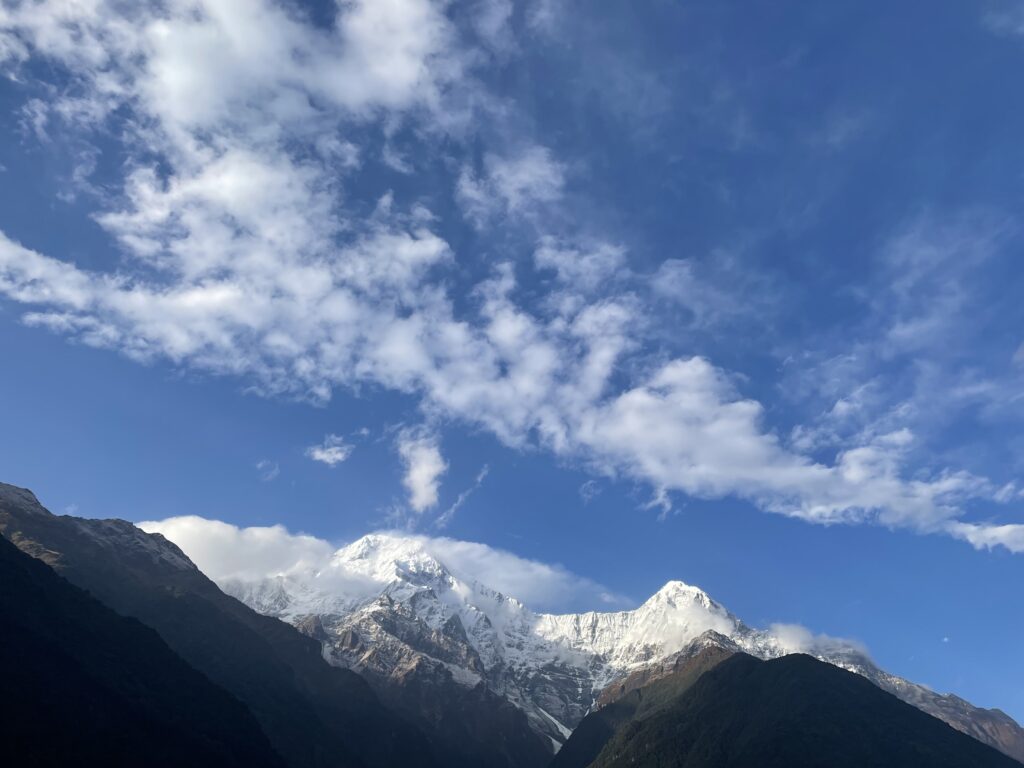
So I managed a 13 km walk today and yesterday, but of course this is a much lower altitudes, though today there was a bit of climbing. Probably the Mustang trek will be the most appropriate, since it will be cold, but not extreme. But oh, would that the mountain wall of the Himalaya were clear and bright in the still air! Clouds appeared today, like stately galleons. There was a slight breeze at times, useful to disperse the smog maybe. 

Nepal Notes: Cultural Changes and Traditional Leanings

Posted on January 3, 2026January 3, 2026 by ianraitt

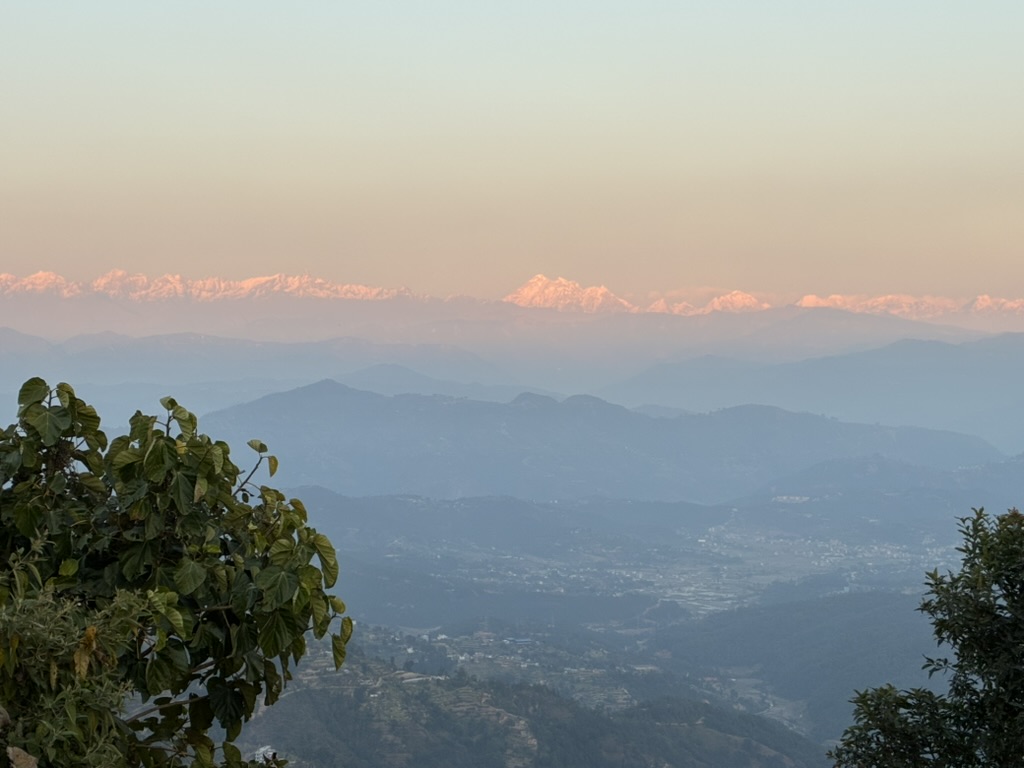
On Sunday I went for a short walk with Ram. The mountains were clear, though the smog haze can be seen here. 

I asked him about the erosion of arranged marriage by caste in Kathmandu. Seven years ago I had a conversation with some young Nepalis when going up to Tilicho Lake in the Annapurna Circuit trek. They said that love marriage was on the increase. Ram confirmed this. He got married last year in the traditional way. Young couples make contact on social media, and present the families with a fait accompli. This is underway with his two cousins. They want to marry their girlfriends which are of the Newari social group, thought of as a merchant class, whereas he is a Chhetri, being the warrior class traditionally, just one below the priestly caste, the Brahmins. The father said, well what can I do, they are in love. However, the marriages have been delayed, so we do not know what is really going on. 

It is thought that arranged marriage in caste is being maintained much more on traditional lines in India. It is also much more complicated than we can imagine, as there are many sub-castes. The arranged marriage system has advantages, for example divorce rates are lower. It is a different concept of union based on compatibility with an emphasis on support from the community. So, the arranged marriage system is not going to disappear, but it is undergoing a challenge. It is paradoxical, since arranged marriage does have a different concept of what a union should be, with some advantages of stability in the community and in the union itself, and though the caste system itself can be thought of as outmoded, it is likely to be very resistant and resilient. But it’s an example of how the noble and profound idea of rebirth has been changed by human convention, because it is believed that you journey through the castes and arrive at the ‘top’ caste.

As were talking and admiring the view, a group of boys aged about 13 or 14 in orange robes came up from a nearby temple to return to a small boarding school situated above on a knoll. This is a school where Sanskrit is taught, since these boys are Brahmins, and they are training to be priests. The script used for Sanskrit is the same as that for Nepali and Hindi. Sanskrit is the parent of these languages, but completely different, and a dormant language in that it is not used for everyday communication, though it is used for all the important religious ceremonies, so the priests have a guaranteed role. I felt a certain disquieting sympathy for the boys, going as they were to an unheated dormitory. 

I have had a certain fascination with Sanskrit as a language, since some of the terms that I am familiar with from my spiritual studies, are Sanskrit ones, and are not translated since there is no easy English alternative. I also am fascinated by those people who are very multilingual, such as Sir William Jones, whose day job was as a lawyer, but who knew 12 languages very well, and another 10 quite well. He was very well paid for the time, in the mid 18th Century in Calcutta. He is famous for coming up with the theory that Latin, Greek and Sanskrit shared many grammatical points, so he speculated they are all born from a now disappeared parent language. Subsequent studies confirmed his analysis that there is a common ancestor, but that the idea that Sanskrit is the most perfect of the three languages is now deprecated, though it does have a very admirable and precise grammar. And Sanskrit is valued for its actual sound, said to have originated from a ‘higher plane’ and thus calming and inspirational. This must be one reason why it is insisted on by Hindu believers. 

When I was in the school in Nepal, we were visited by a certain Yogi who also had a boarding school for boys in Kathmandu for the teaching of Sanskrit, and a gentleman from England accompanied him. The Yogi declared, a little ruefully, that he thought the students of the English gentleman had attained a higher level of Sanskrit for their age, taking GCSE Sanskrit. They were students in a group of schools in London and Surrey that had been founded by a British philosopher who was a follower of an Eastern teacher, who obviously also thought that to learn Sanskrit was good for the integrated being of the child. In these schools, Sanskrit is taught from 4-11 with options to continue to GCSE and A Level. The grammar of Sanskrit is so logical and pure that it would be a strong foundation for the learning of other languages, so this is another echo of what William Jones thought. The other point is that Sanskrit has 2000 years of literature to be encountered. The proof would be in the pudding. I have a theory that Sanskrit did originate in the previous world age, ie the Bronze Age. The Kali Yuga (Iron Age) is said to have begun about 3100 BCE. If Sanskrit is older than this date, then it would belong to an age that had a higher vibration that the current one.

Mardi Himal Ridge and Annapurna Base Camp

Posted on August 13, 2025 by ianraitt
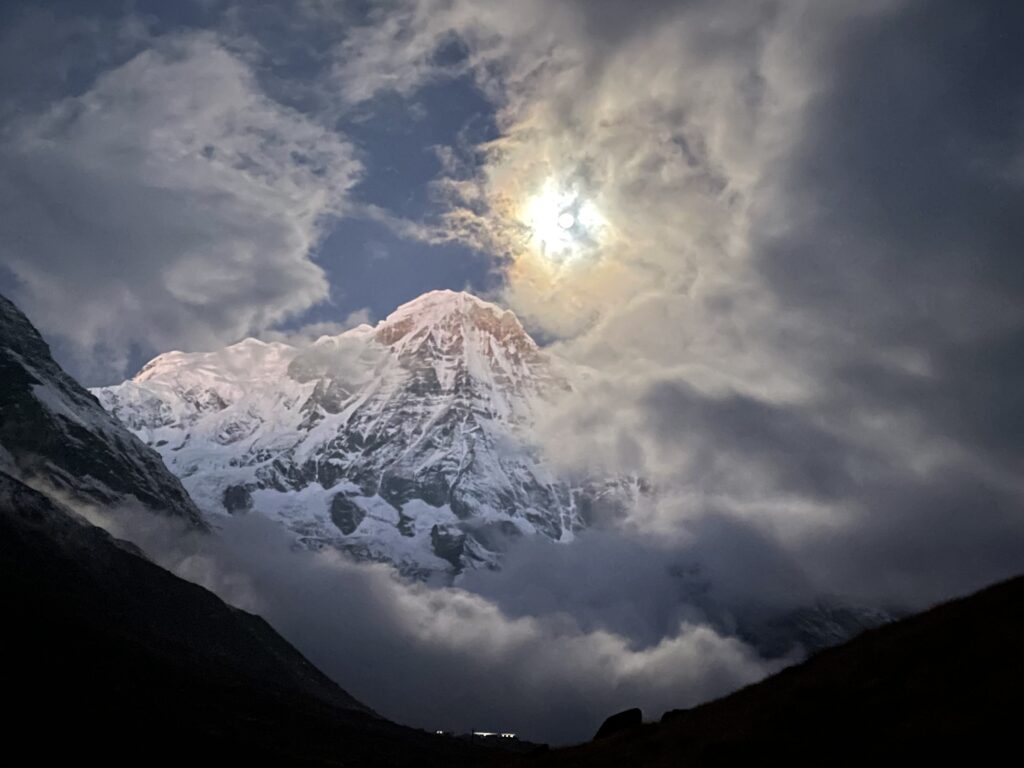
moonlight illuminates Annapurna I, lights of Base Camp visible

In late September 2025, a lingering low-pressure system over the Bay of Bengal and northern India caused a tremendous amount of rain to fall in Kathmandu and eastern Nepal. On Saturday 28th and Sunday 29th September from 240mm to 322mm of rain fell and parts of Kathmandu itself were flooded. It rained heavily for 40 hours, a continuous and dispiriting downpour. Since October is the start of the trekking season, tourism would be affected. Bridges, houses, highways were swept away, people displaced.

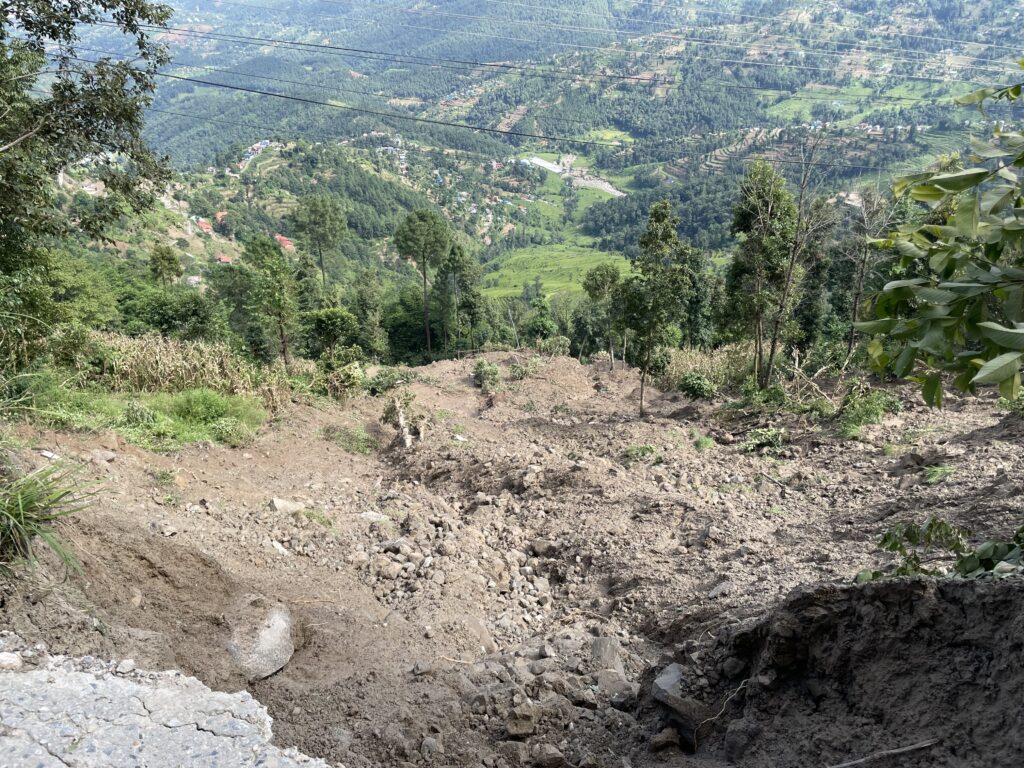
side roads are not built with proper drainage to cope with storms

In the aftermath, we walked a little way out of Dhulikhel towards Namo Buddha, and parts of the road below the Kali Temple, near where I used to live, had been swept away by the surging floods. I had been intending to go to the Everest region, but road transport had been severely affected, and flights were all booked up. The only possibility would be trying to go by helicopter, but these flights were full, and the price kept going up, so we switched to the Annapurna area, as the road to Pokhara was open. It did occur to me that I was acting like a selfish Western tourist, only devoted to getting into the trek, while all this devastation was hitting Nepal, almost like another earthquake. But somehow Nepal is very resilient and just keeps going.

Day 1: Kande to Deurali

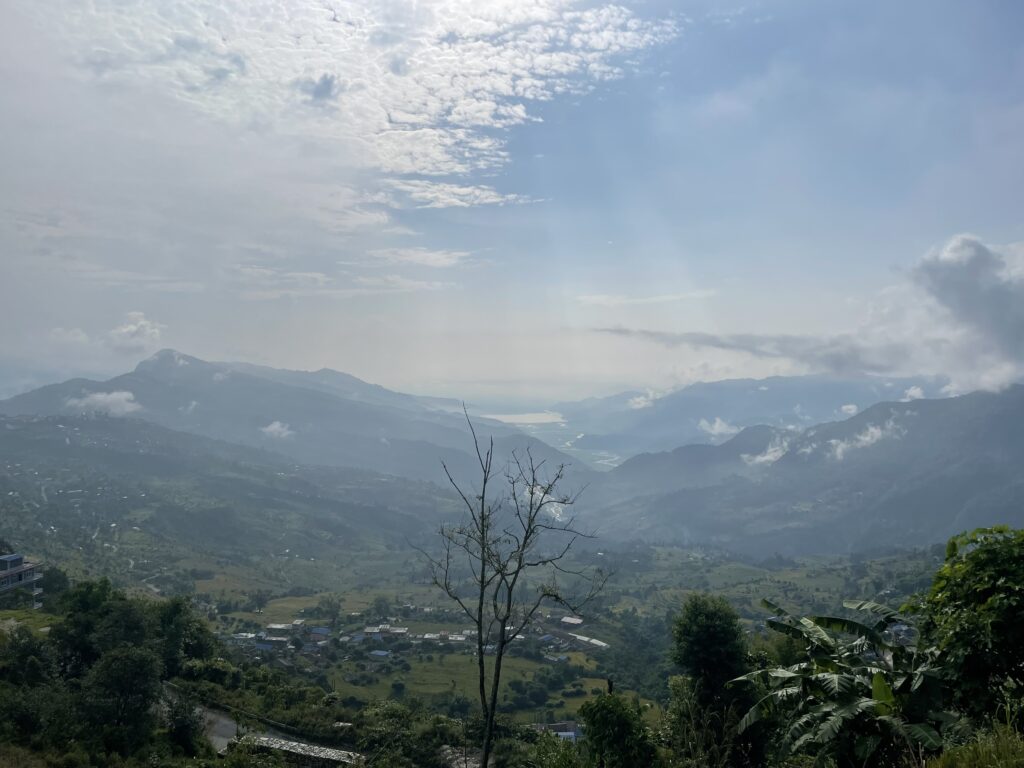
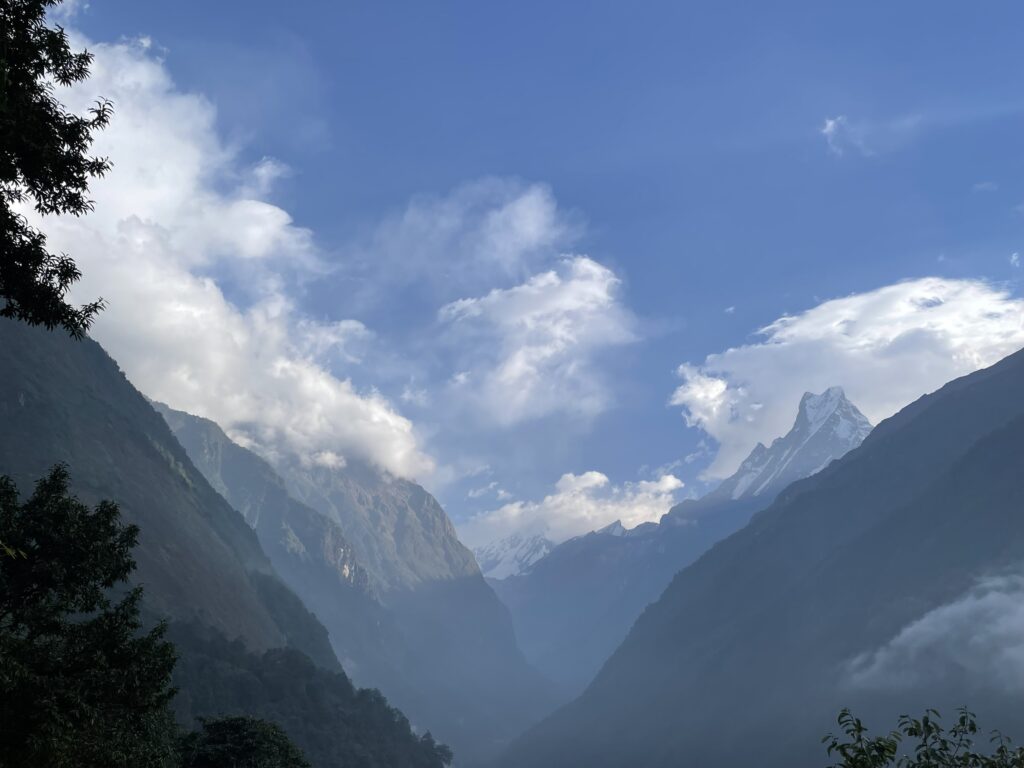
As we looked back towards Pokhara, everything was bathed in milky light; all that rain was still evaporating into a new cycle. Rain started again at 5:00 pm. No visibility, and not a very good outlook for clear views, with the forecast for rain continuing on and off for a week.

Day 2: Deurali to Low Camp

at least the early mornings were clear

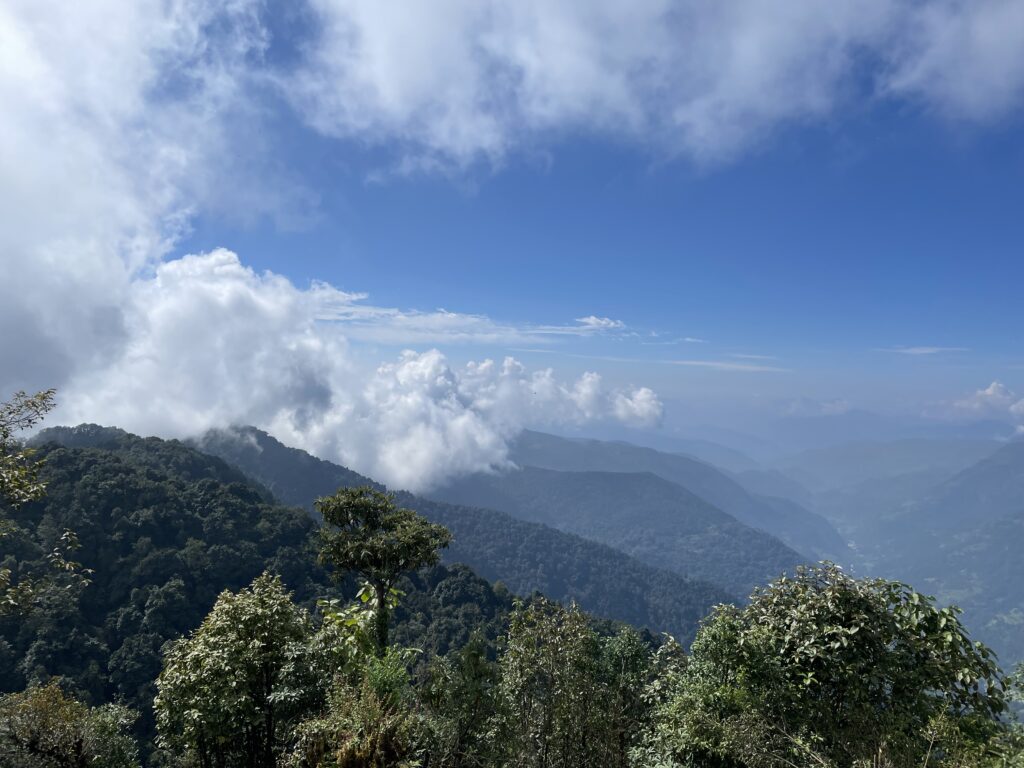
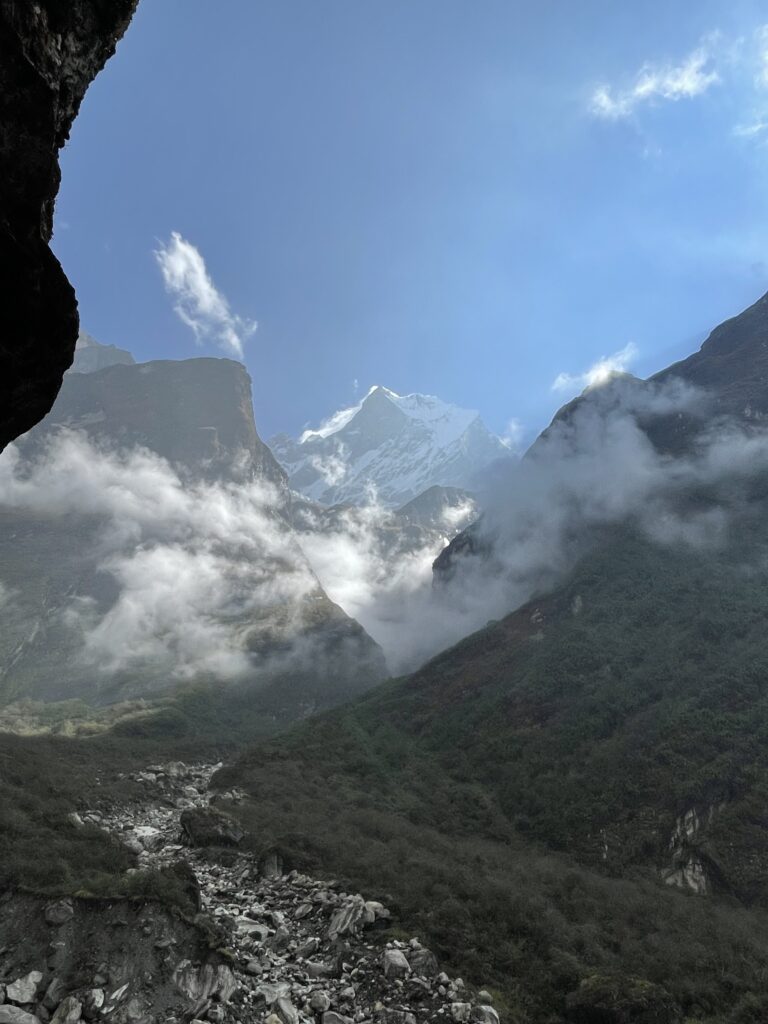
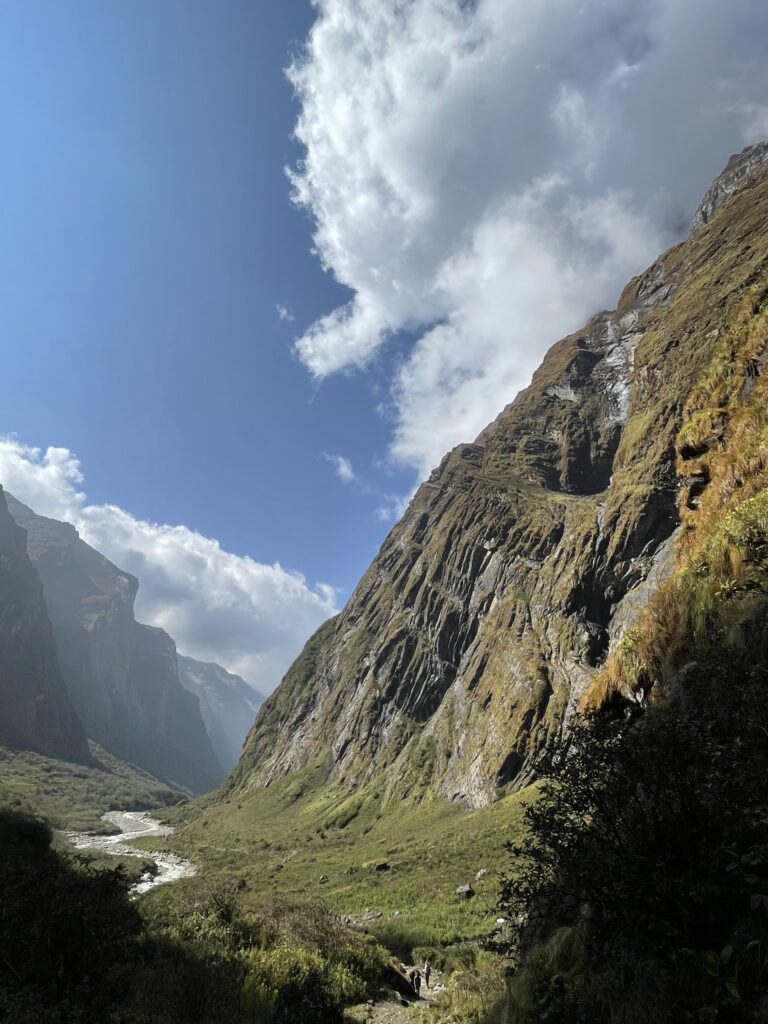
A clear view at 05:30. Cloud billowed up the valleys at about 10:00. Despite all the rain, the path was in good condition, everything held in place by the trees, for example the hardy Himalayan Oak, Rhododendrons, all trunks mossy. It was still and silent, though with the buzz of cicadas.

clouds quickly formed below as the hot and humid air starts to rise

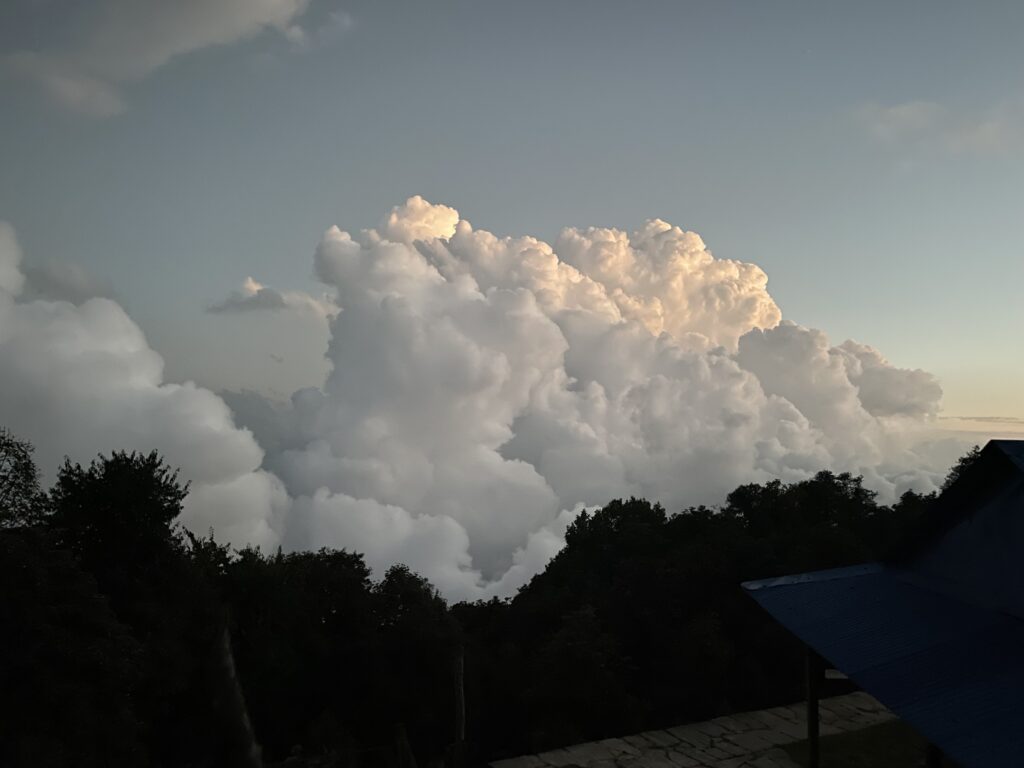
Leeches evident. Blood soaked hand. Left pinkie kept bleeding, thanks to the anti-coagulant they inject. A spectacular thunderhead was visible at 18:00

someone down there is getting a soaking

Day 3: Low Camp to High Camp

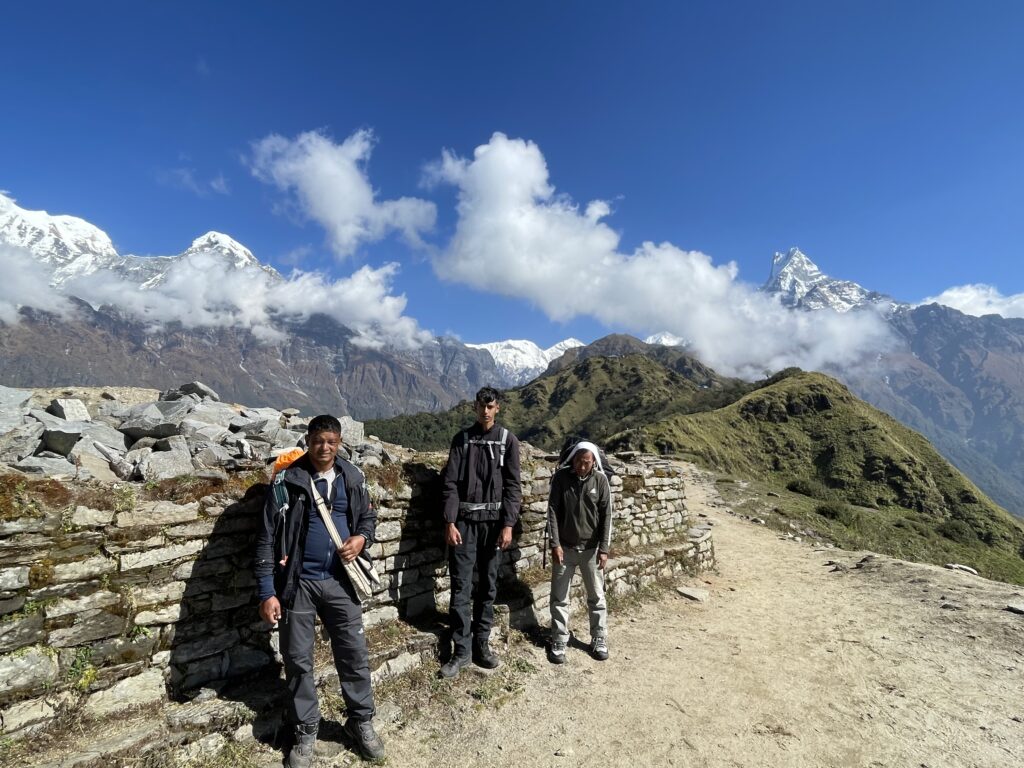
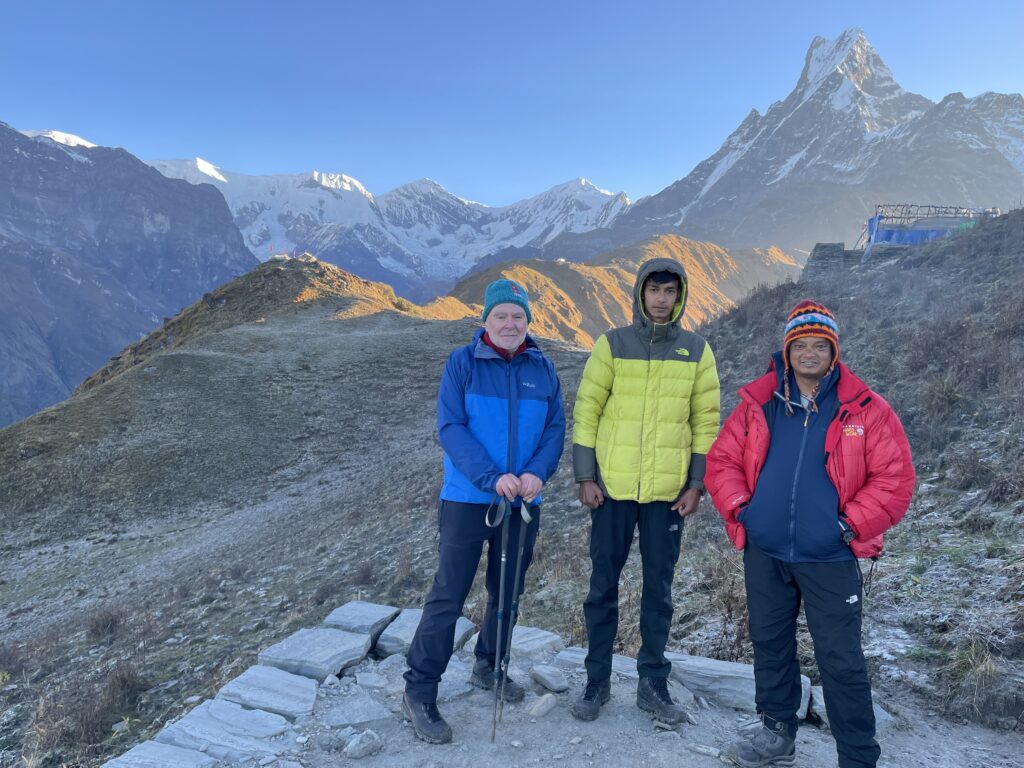
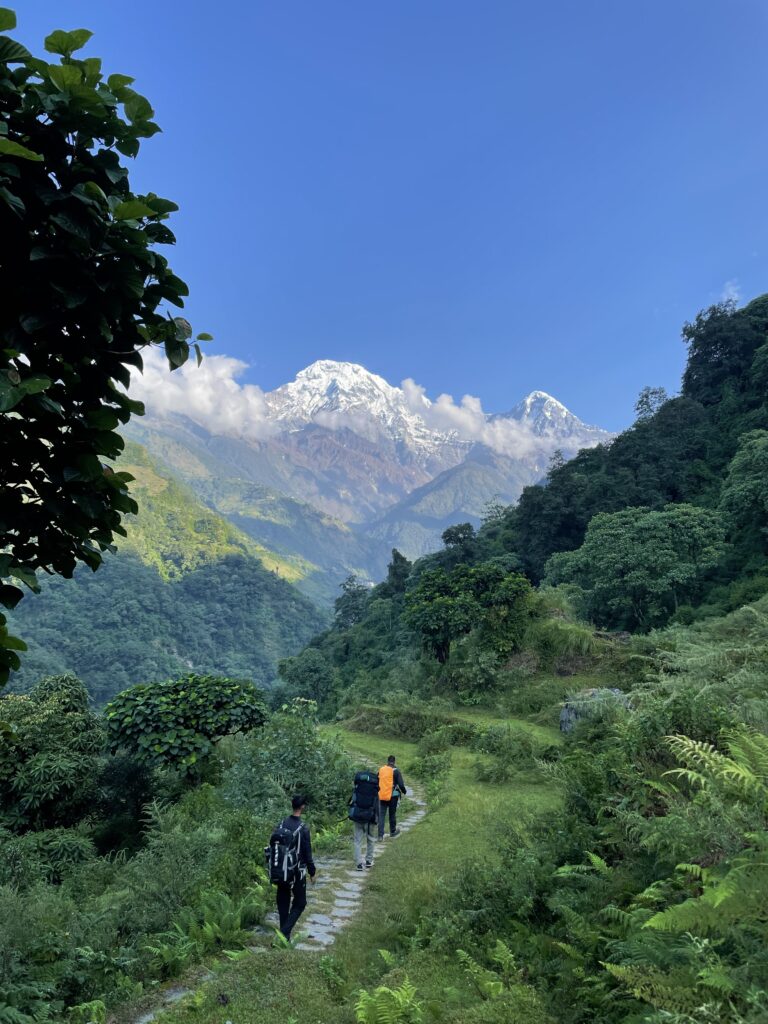
Bishnu, Pashupati and Purna, the ridge stretching ahead

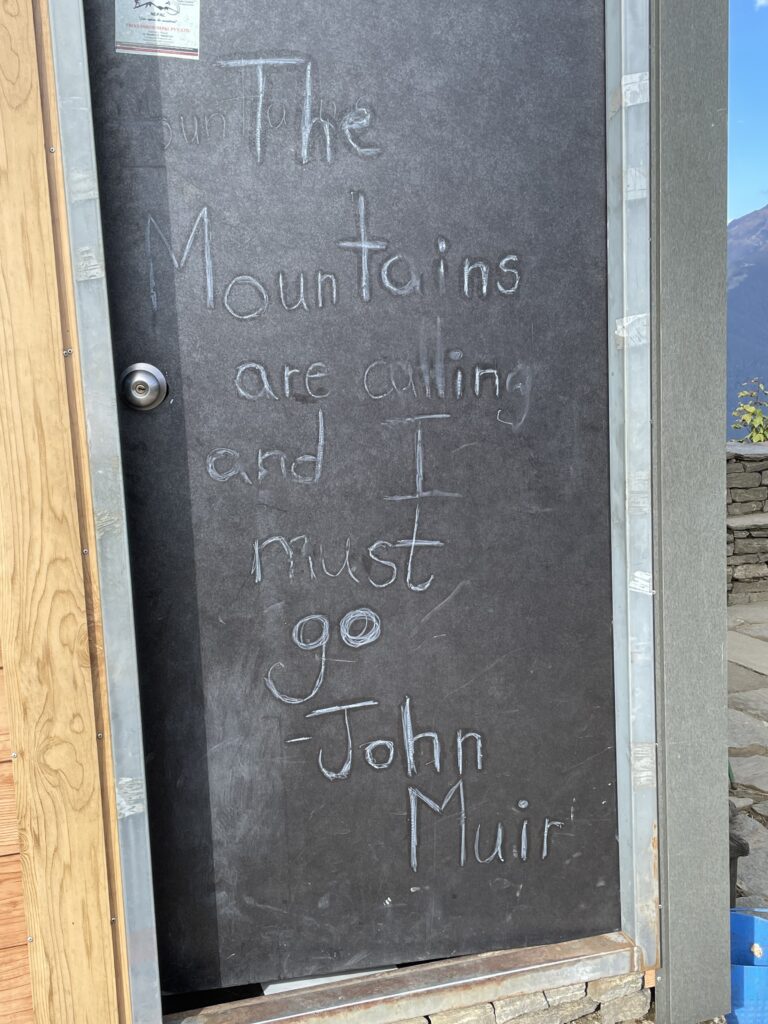
The late monsoon was still producing a lot of moisture, and clouds formed from below through condensation, so clear views were only available early on. As we climbed up the trees started to thin out and became shorter. Suddenly we could see all the way to High Camp with a well-defined ridge. It was quite windy and cool when we approached the lodges at High Camp. Cloud battalions were advancing up the valley towards the Annapurna range. We could see the sheer walls on the Annapurna Base Camp trek, and all the villages beyond Chomrung. It was reassuring to see this quotation from John Muir:

John Muir – Scottish born American naturalist and philosopher of nature (1838-1914)

Day 4: High Camp to Upper Viewpoint, and descent to Forest Camp

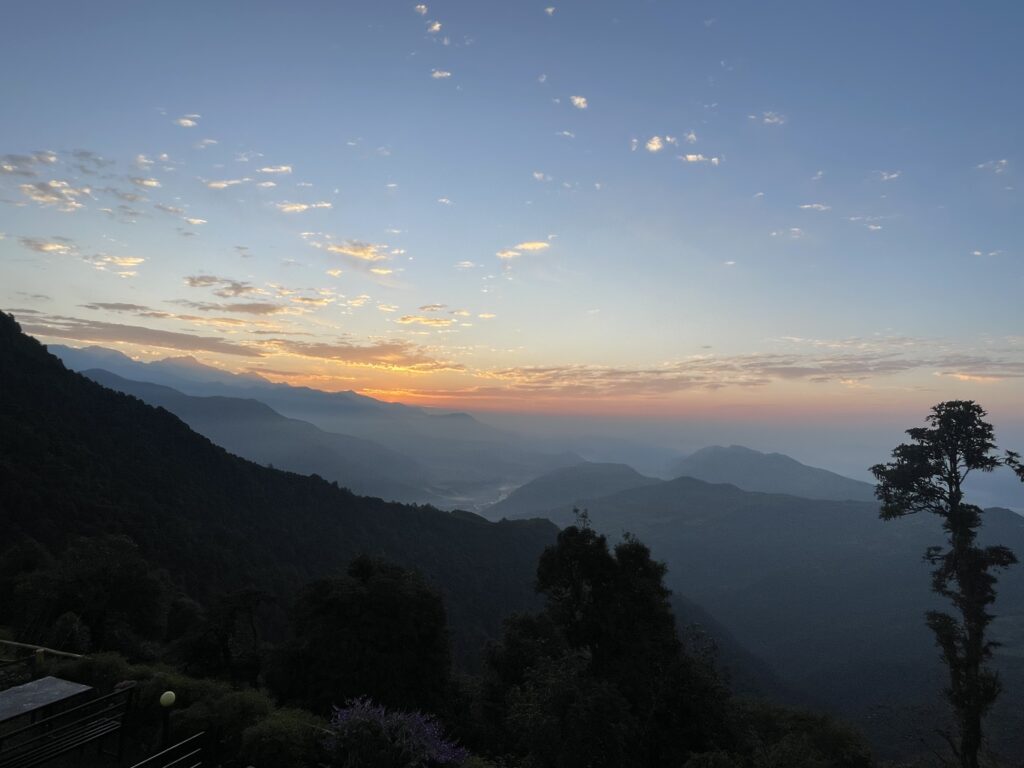
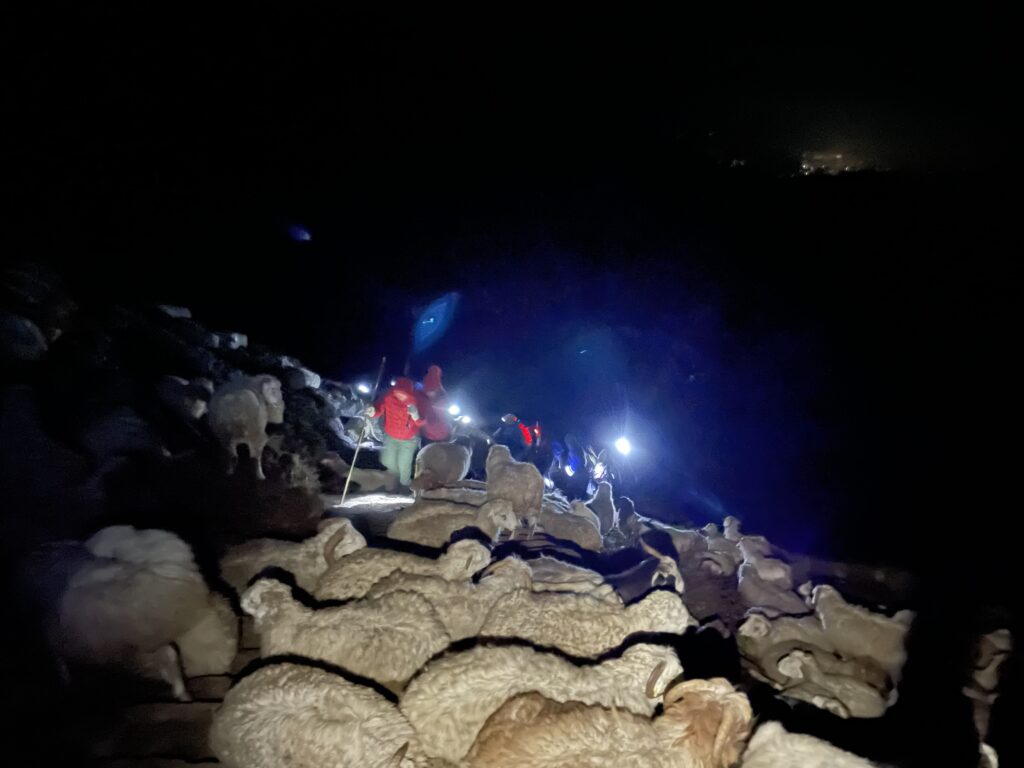
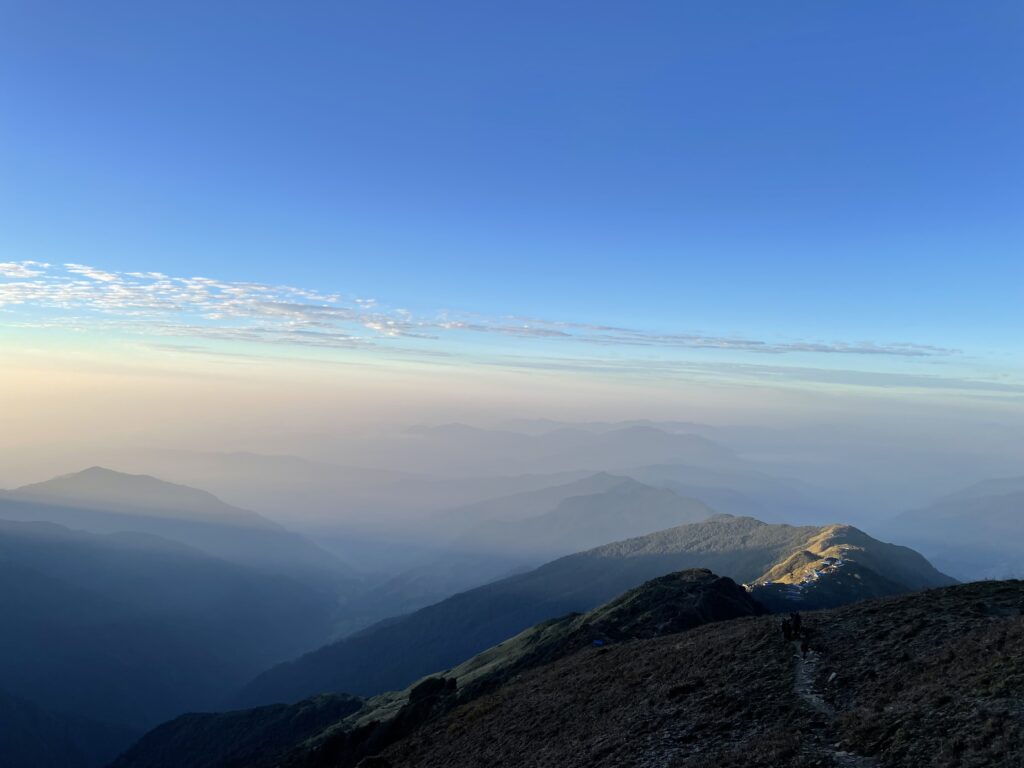
We left at 04:00 to catch the sunrise. Many people were going up, a visible flow of head torches. Sheep were sleeping on the path. We arrived after a two hour ascent, and in time for the sunrise, with about 70 people milling around. It was a little tempting to go on and escape the crowds at the viewpoint, but the ridge does get quite narrow, and there have been reports of people slipping.

sheep rest impassively, blocking the path
discretion is the better part of valour

After breakfast at the lodge we continued down, a longish descent of 1600m and 20 km. The highest the rhododendrons will grow is about 4000m and all concentrated on one side of the ridge, either due to the soil or to get some shelter from the prevailing winds. They are stunted but just as beautiful.

going down is always easier

Day 5: Forest Camp to Landruk

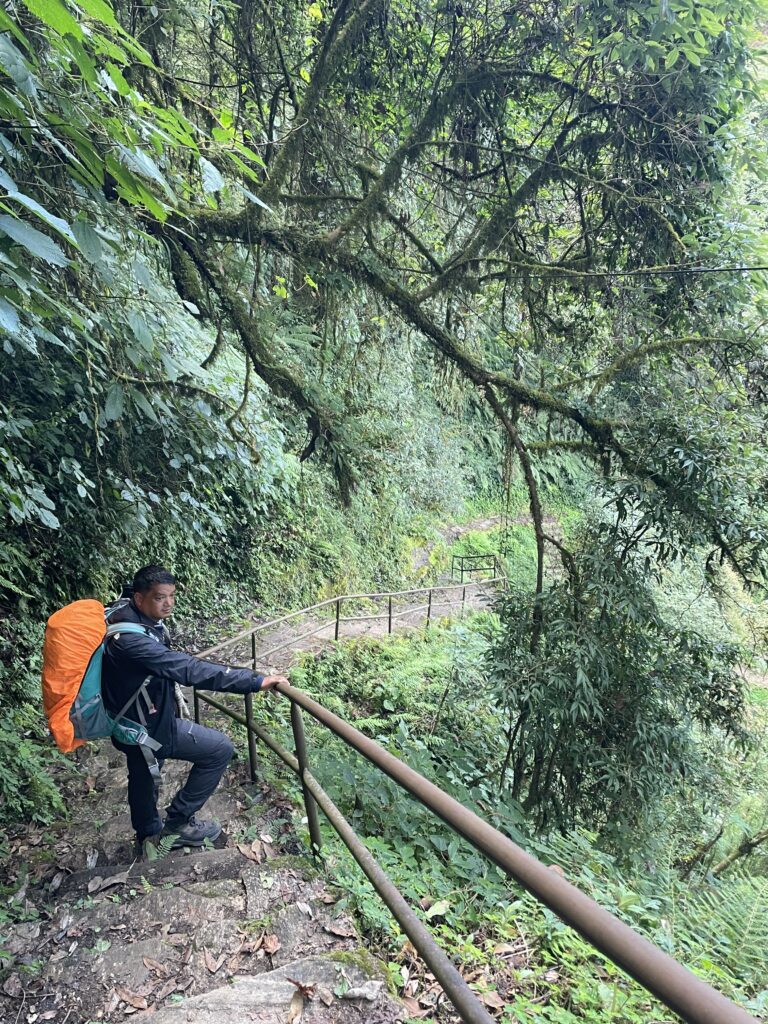
It was a drop of 1045m to Landruk. The weather was humid, windless and cloudy. There were many steep staircases on the way down, all wet and quite slippy. Handrails were in place for safety. We have met the following nationalities on the trek: Belgian, French, Australian, Swiss, Indian, German, Israeli, Japanese.

Bishnu in contemplative mood

Day 6: Landruk to Chhomrong

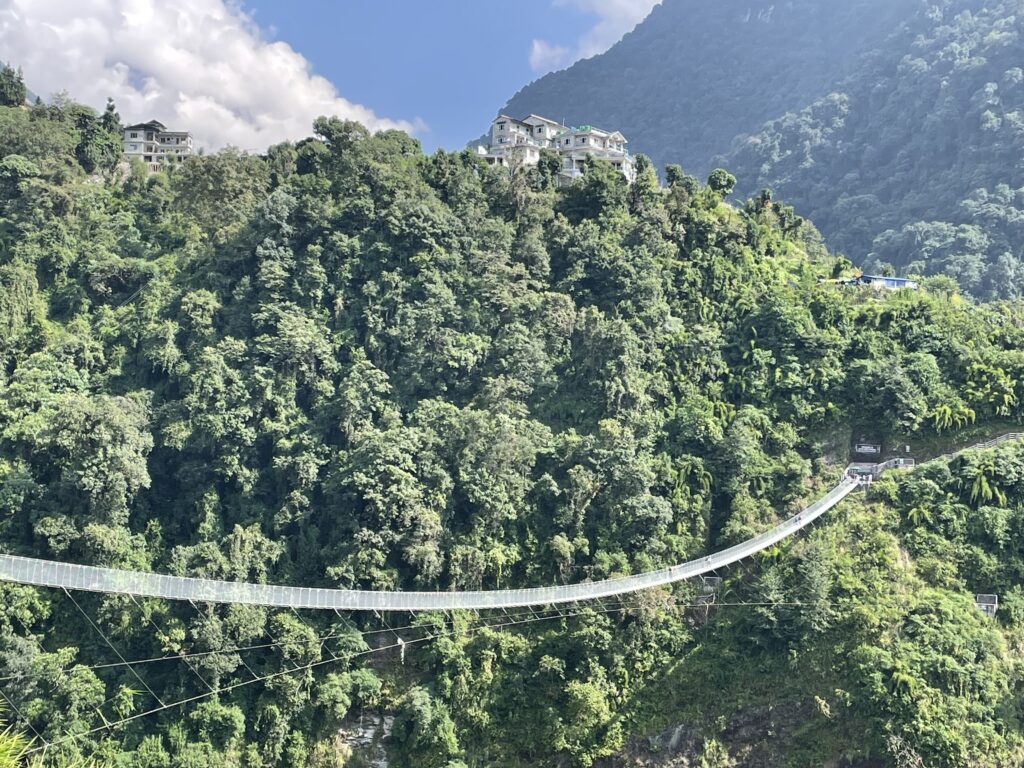
We still had to descend to the river this morning. We met a French guy aged 72, walking alone with a minimal pack. Plucky. Now the trail is much busier. After lunch there was a gruelling rise up to Chhomrong. The second longest suspension bridge in Nepal is impressive, and removes the very steep descent previously necessary.

Day 7: Chhomrong to Bamboo

A strong stream ran by rice fields. A short day, but going up was still quite challenging, through the humid air. A large group had descended from the Base Camp, but there was no room at Bamboo, so they had to keep going to Chhomrong. It is apparent that this trek has become a ‘must do’ for young Nepalis, particularly during the Dasain festival, as I had never seen the trail as busy as this.

Day 8: Bamboo to Himalaya

the valley narrows towards the Annapurna Sanctuary

Cloudier weather. Lunch in Doban then a steep rise to Himalaya, where the three lodges were packed. Rain fell shortly after arriving. Many dogs on the path, who seem to shuttle between the lodges.

Day 9: Himalaya to Machhapuchhre Base Camp

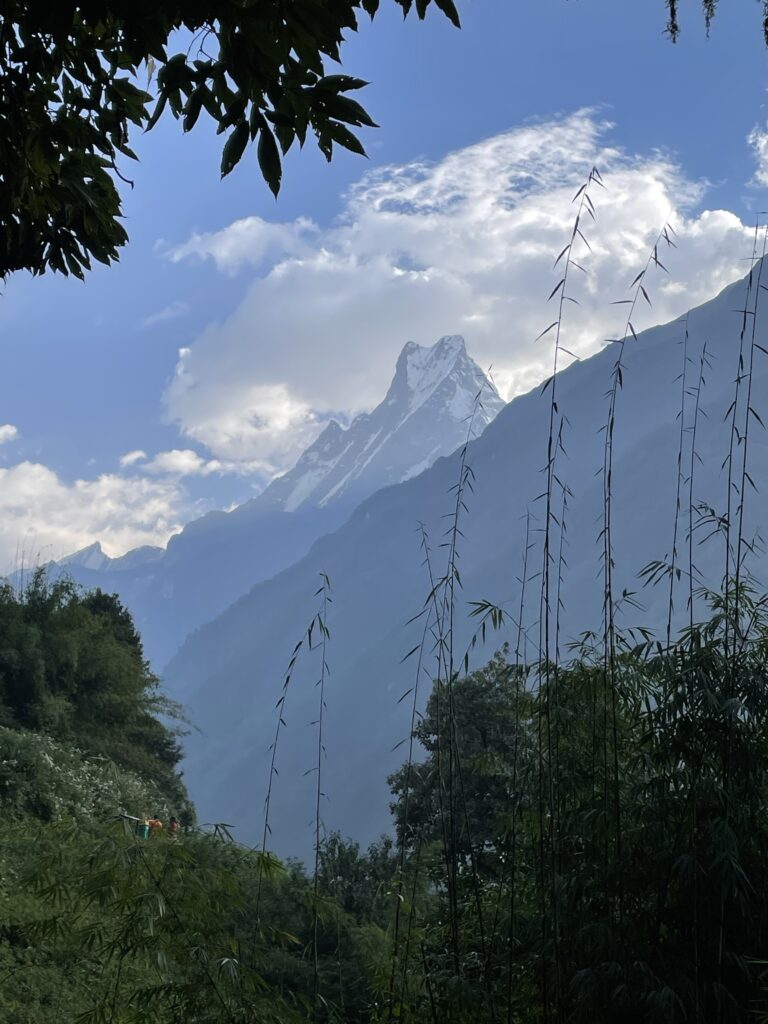
The trail is rockier and rather worn. We passed the avalanche zone, Himalayan birch trees by the path. If there is an avalanche, there is no warning and everything shoots off the heights and thunders down below. Anecdotally, someone saved themselves by going towards the river. A long slow climb up to MBC, where the lodges are impressively built stone structures. About 350 people an hour going up or down, certainly an impressive volume, if not tranquil.

Day 10: Machhapuchhre Base Camp to Annapurna Base Camp – down to Himalaya.

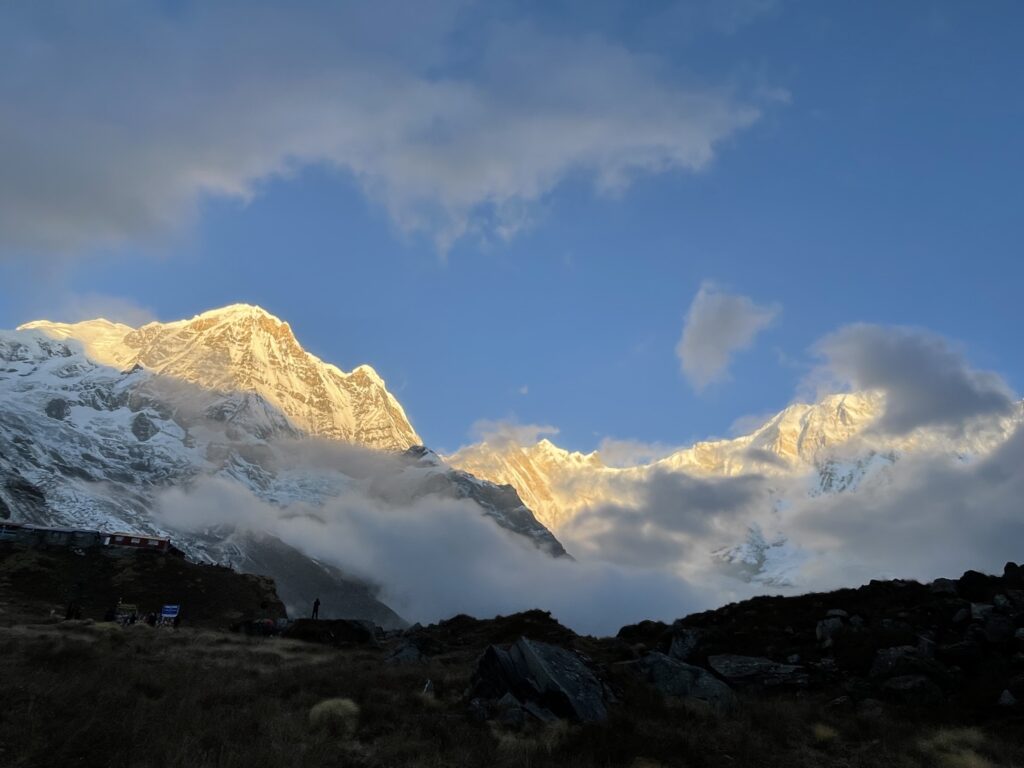
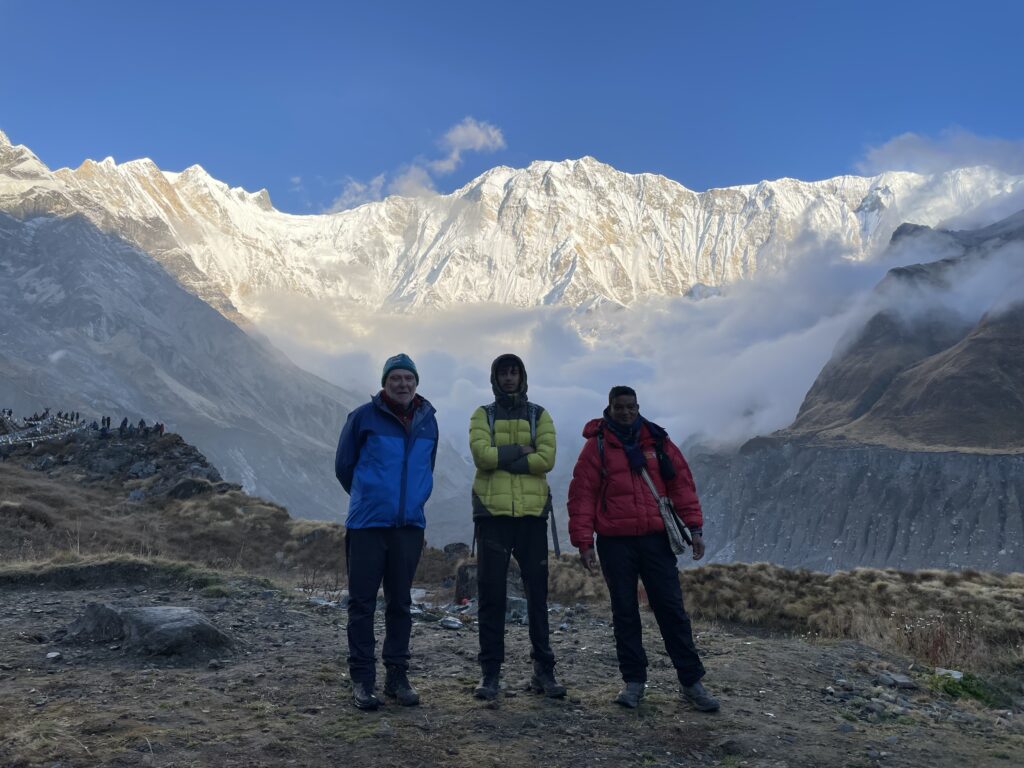
A sleepless night. Started off at 04:00. Some hot water to drink, and two Hobnobs on the way. Very much lacked energy, but kept going, and no other altitude effects evident. There were hordes of people out for the sunrise, many perched on the abyss above the glaciated valley which is crumbling away. Some new snow lay just above the base camp at 4130m.

crumbling walls of the ancient glacier basin seen on the right

We had a clear view of the avalanche zone on the way down. The classic U-shaped glaciated valley appeared, though hard to imagine the whole place completely filled up with ice slowly eroding the edges under the law of gravity.

Day 11: Himalaya to Chhomrong

A long descent to Chhomrong, and it was not all down, with some impressive rises on the way as well. A thunderstorm started as we left Sinuwa, with quite heavy rain. But afterwards the air was very clear with impressive views, and new snow could be seen on the rocks of the heights. The following day a jeep took us to Pokhara.

Call of the Great Master- another spiritual classic

Posted on August 11, 2025August 11, 2025 by ianraitt

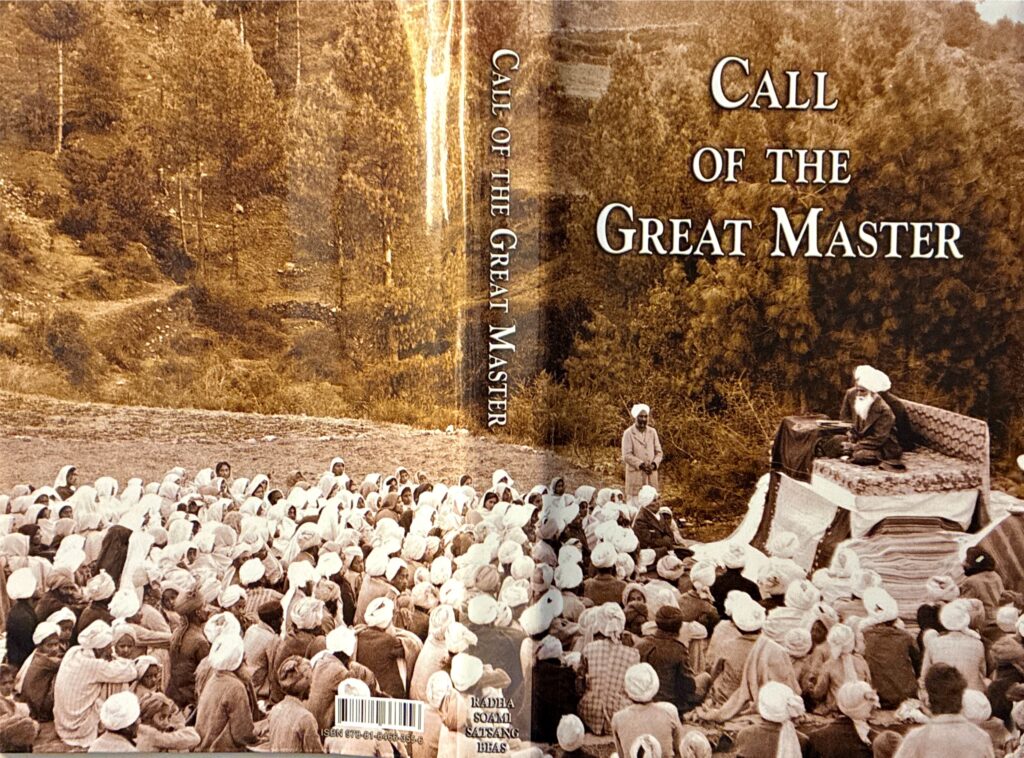
This book was written by Daryai Lal Kapur, and it is an account of the teachings of Sant Mat, or Surat Shabd Yoga, as presented by Maharaj Sawan Singh (1858-1948), who was known as ‘the Great Master’ by his disciples, and who consolidated the teachings in a line of Masters founded by Shiv Dayal Singh (Soami Ji) in 1861 in Agra, India, also known as the Radha Soami tradition, which continues to this day. The book is in the form of answers to questions posed by visitors to the Radha Soami headquarters in Beas, in the Indian state of the Punjab. Some of these were European Christian teachers at a nearby college, and the responses frequently refer to aspects of the Christian Bible, as well as discussion on how Surat Shabd Yoga differs from the six schools of Indian philosophy and spiritual practice. (Please consult https://www.bookfinder.com/ or https://scienceofthesoul.org/books-english.html for availability of this title).

One chapter is entitled Miracles, and gives a clear account of why a true spiritual Master will pay little attention to any of those supposed demonstrations of mental powers that can effect a change in this physical world, and if there are any exceptions, he will keep quiet about them. Now, the writer was present at the discussions between Sawan Singh Ji and visiting enquirers, and always keeps a low profile in his account, but he starts this chapter by explaining that the Master delegated to him the task of explaining how miracles are approached in the true Sant Mat tradition. The author says he was : “overwhelmed with a sense of my incompetence to deal with the subject” but did not protest after receiving a piercing glance … “oh, that glance! It was not a glance; it was a flash of light that, passing through my eyes, entered my brain.”

The fundamental position is as follows: “Saints never perform miracles for public exhibition. Sometimes these things just happen, but in every case it is kept a secret.” There are two contrasting examples given in this chapter that I would like to discuss. The first one is a story about how a Master reacted when his son performed a miracle. This is a very well-documented story from the Sikh tradition, and concerns Baba Atal Rai, known as Tal, the son of Guru Har Govind, the 6th Guru in the line of Masters founded by Guru Nanak. Tal was precocious in the sense of already being noted for insight, wisdom and saintliness beyond his tender age.

Tal was only nine years old, when his friend Mohan died from a snake bite. Tal went to his friend’s house and found the deceased boy’s family deeply distressed by the death of the child. He claimed that Mohan was just feigning death as he did not want to lose at a game the two boys were playing from day to day. He circled the body, prayed, and called on Mohan: “Why do you sleep so soundly?” Mohan stirred, and got up. The revival of the boy, a reversal of death, was reported to his father, the Guru, who sent for Tal and said: “My son, you have not done well. Now, either you must leave this world, or I shall have to go.” The boy perfectly understood the implication of his action, and the following day performed ritual prayers and ablutions, went into meditation, and left his body.

The narrator of this book now gives another example, just to make us wonder. The Great Master, that is Sawan Singh Ji, was travelling on horseback from Sikanderpur to Sirsa, with a small group of devotees walking on foot. A Muslim disciple of the Master called Mian Shadi was bitten by a viper. There are various poisonous snakes in that area and the Russell’s Viper is one of the most potent, a bite being fatal unless an antidote is given. Shadi changed colour and could not walk, but he implored his companions not to bother the Master with his stricken condition, even though this was their natural reaction. He fell down senseless. However, the Master looked back and returned to the group. They tried to put Shadi on the horse, but he could not support himself. The Master stated that the leaves of a Neem tree had healing properties, but in this open space there were no trees. Finally, the Master asked for a branch from a shrub to be brought saying: “I have heard that passes of a green branch like this remove the poison.” The author then comments: “But we all knew what was removing the poison.” After ten minutes the stricken man revived, but still complained that he did not deserve to live, though the initiative had been taken by the Master alone.

Neither of these examples will impress a rationalist, who would state: “You see, these examples are contradictory. The whole business in incoherent!” You can imagine how easy it is to construct a sceptical position in both cases. In the first case, apart from the doubt that such a resurrection is ever possible, there would be outrage that a father could say to the child, repeating a religious belief, in this case the inviolability of the law of karma: “Either you or I shall have to die.” The implication is that the child is able to accept the unlawfulness of harnessing spiritual energy for a mundane resurrection, and a payment in balance is due, and that it should be the child who pays, as the father is in the middle of his spiritual mission as the 6th Guru, with a huge community dependent on his leadership, in temporal and spiritual matters.

The other example is also poignant, since the devotee begs the others to do nothing to inform the Master. Persisting in this attitude, on revival he is disappointed, believing himself to be unworthy of life, showing an immense detachment from this earthly sphere. It is clear that he thinks he deserves to die. Nevertheless, in this case, the intervention was judged permissible, in terms of the law of karma. We know nothing about the karmic debts from former lives of Tal’s friend Mohan, except that according to this belief, the snake bite was a necessary event in karmic balance. But in the case of Mian Shadi, despite his self-deprecating lamentation, he was an initiate, therefore his fate karma is now under the administration of the Master, who judges that his development is best served through continuation of life in the physical sphere. The contradiction can be resolved.

The theme of ‘a miracle is a changed consciousness’ is also embraced in this chapter, with a notable example, that I will leave to the reader’s curiosity to discover. Perhaps all of us can think of some event that changed the course of our lives for the better, that event most powerfully being a change of attitude or a realisation. That is the real miracle.

Autobiography of a Yogi – another look at a classic text

Posted on July 26, 2025August 8, 2025 by ianraitt

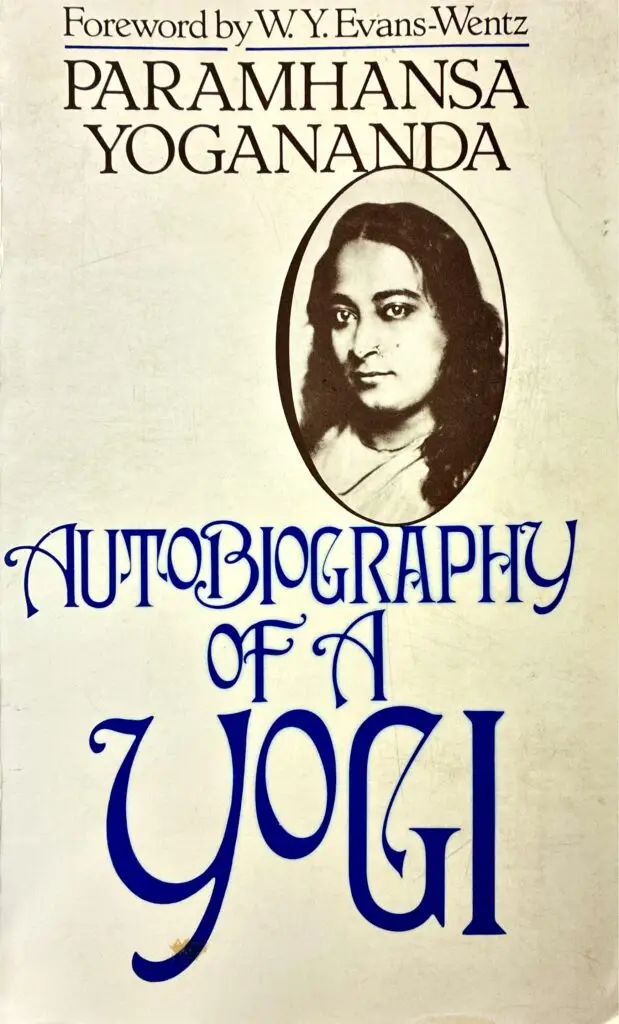
I first read this book around 1977. Then again in 2018. And once again in 2025. On this last re-reading, I was surprised by how the book seemed so fresh, as if I were encountering it for the first time. This perception might merely be related to declining memory retention, but what does persist and is re-encountered, is a sense of the book’s atmosphere. This is constructed from the author’s manifest sincerity, his ability to patiently instruct Western readers in Indian yogic tradition, and from a gentle humour that infuses the text. There is a clear account of his early life, of his acceptance by a Master into a yogic tradition, and of his teaching role in the West. Most of all, the book emanates an unapologetic sense of the miraculous, that there is an energy, wisdom and purpose beyond our mundane world-view. This book challenges the maya and illusion in which we conventionally live, and explains why in India, there is an alternative, as old as the hills.

He was born in January 1893 as Mukunda Lal Ghosh, of the Kshatriya caste, Yogananda being his given name upon entering the ancient monastic Swami Order in 1914. Immediately in the first chapter we have a couple of miracles. There is the story of Abinash Babu, who worked in the same office of the Bengal-Nagpur railway as his father, Bhagabati, who was Abinash’s superior. Abinash asked for leave to visit his guru, Lahiri Mahasaya, in Benares. His father ridiculed this idea, but when the two of them met up going in the same direction in the fields, there was a dichotomy in their thoughts. His father sought to console the employee, and counselled worldly success, but Abinash was simply repeating the name of his guru internally. Suddenly the form of the guru appeared on the path, and admonished the father: ” … you are too hard on your employee!” The vision of the guru vanished into thin air, but Bhagabati had got the message, and resolved not only to grant leave to Abinash, but also to take his wife and go with him to the guru in Benares. On meeting the guru the following day, Lahiri Mahasaya repeated the exact words to Bhagabati: “You are too hard on your employee!”

This immediate introduction to the occasional deployment by gurus of incontrovertible forms of communication sets the tone for many such interventions. For example, in the same chapter there is an account of the time when as a young boy Mukunda was stricken with Asiatic cholera, and close to death. By this time, the parents were established devotees. His mother instructed him to look at a picture of Lahiri Mahasaya on the wall, with the admonition ‘bow to him mentally’. A blinding light, also witnessed by his mother, enveloped the whole room, and his nausea and other symptoms disappeared. Furthermore, in this chapter, we have an example of the inscrutability and playfulness of the guru. He resisted being photographed. This is a common trait in some gurus: they do not want disciples to rely on a photo, which ultimately is a dead image. When, against his wishes, a photo was taken of the guru with a group of disciples, on development it was found that the image of the guru was absent. Then a renowned photographer thought he would be crafty and took a series of twelve photos of Lahiri Mahasaya in meditation. On each one the background screen was visible, but there was no image of the master. Finally the guru posed for the distraught photographer and the image was clear. Yogananda thinks it the only one to exist, and it is reproduced in the book.

Warming to his theme, subsequent chapters have such titles as: The Saint with two bodies (Swami Pranabananda), A “Perfume Saint”, The Tiger Swami, The Levitating Saint. As Yogananda says, “My inquisitiveness about saints was well known among my friends; they delighted in setting me on a fresh track.” He was, at a young age, already inevitably in search of this own guru. But in describing the very real perfumes produced by the Perfume Saint, he declares: “Performances of miracles as shown by the “Perfume Saint” are spectacular but spiritually useless. Having little purpose beyond entertainment, they are digressions from a serious search for God.”

He also relates that the Tiger Swami developed a phenomenally rippled body, and a fearsome will power and sense of psychological dominance. He was indeed able to overcome with bare hands the fiercest of tigers in a caged environment. But his ultimate triumphant encounter, described in detail in the book, resulted in a weakened state after blood poisoning set in, and convinced him to accept the advice of a guru to “subdue the beasts of ignorance roaming in the jungles of the human mind” instead of live tigers. But Yogananda is kinder in his comments about the bi-locating saint and the levitating saint, whom he believes were not practising this kind of siddhi with the aim of impressing others, but that these powers were offshoots of intense and persistent meditational devotion over the years.

One of the endearing characteristics displayed by Yogananda is his reluctance to spend much time on his studies in school or later in university. He relates that he spent far more time at the Calcutta bathing ghats next to the cremation grounds, which he describes as “especially gruesome at night … considered highly attractive by the yogi. He who would find the Deathless Essence must not be dismayed by a few unadorned skulls.” He was not burning the midnight oil over his books, but next to the burning ghats. This led to a crisis of panic before the Hindu High School final exams, especially as he had promised his father that his devotional practices would not interfere with graduating from secondary school.

His dilemma was solved in a way that we might whimsically mention was also ‘miraculous’. First of all, he meets a classmate who as the ideal scholar provides him with a quick guide to the kind of questions that will come and the pitfalls to avoid. He gets coaching in all the subjects from the classmate, all that is, except Sanskrit. But the following morning in taking a short cut through a weed-strewn vacant lot, what should he see lying there but some loose printed sheets: “A triumphant pounce; in my hand were Sanskrit verses!” The next step is to get some intense instruction from a pundit, and whatever transpired it helped him pass the Sanskrit exam. A further irony awaits in the future, as when he at last meets his guru, Sri Yukteswar, the guru requires him to enrol in a university, because seeing the future, he could discern that Yogananda would be more accepted in the USA with a university degree in tow. Needless to say, the revision crisis repeats itself during his university studies, but is also resolved in another ‘miraculous’ way.

His early life displayed that he was the odd one out in his loving family, and even though the parents had been devotees of a spiritual master who had passed away, he was urgently set on finding a guru, and living a life of devotion. All his anecdotes about visiting swamis and miracle workers were the prelude to leaving home and entering an ashram in Benares. However, this does not bring peace and realisation, but instead conflict and dissent, as his fellow devotees chastise him for wanting to meditate more than carry out chores in the ashram. He meets test after test, but these problems and challenges lead up to the perfect moment for encountering the true master, who is equally overjoyed in meeting the chela.

Looking again at this remarkable and enduring document, has explained why Steve Jobs made it his task to read the book once a year. It is simply packed with more implications and indirect teachings, all hidden in plain sight, than one can possibly grasp on a single reading. Adding to its special character, the style is a little arch, a little florid, a little ornamented, perhaps redolent of the late 19th century, and whether you want to characterise it as an expression of ‘Indian English’ or not, the tone is self-deprecating, free from vanity and imbued with puckish humour. In addition, the copious and always fascinating footnotes, constitute themselves a primer in the Indian spiritual traditions. Everything in this book, while charting a life of devotion and service to the spiritual ideal, is also there as a teaching example to be cherished.

We must also remember, that the true miracle is a changed consciousness.

Birds of a feather flock together

Posted on March 17, 2025July 28, 2025 by ianraitt


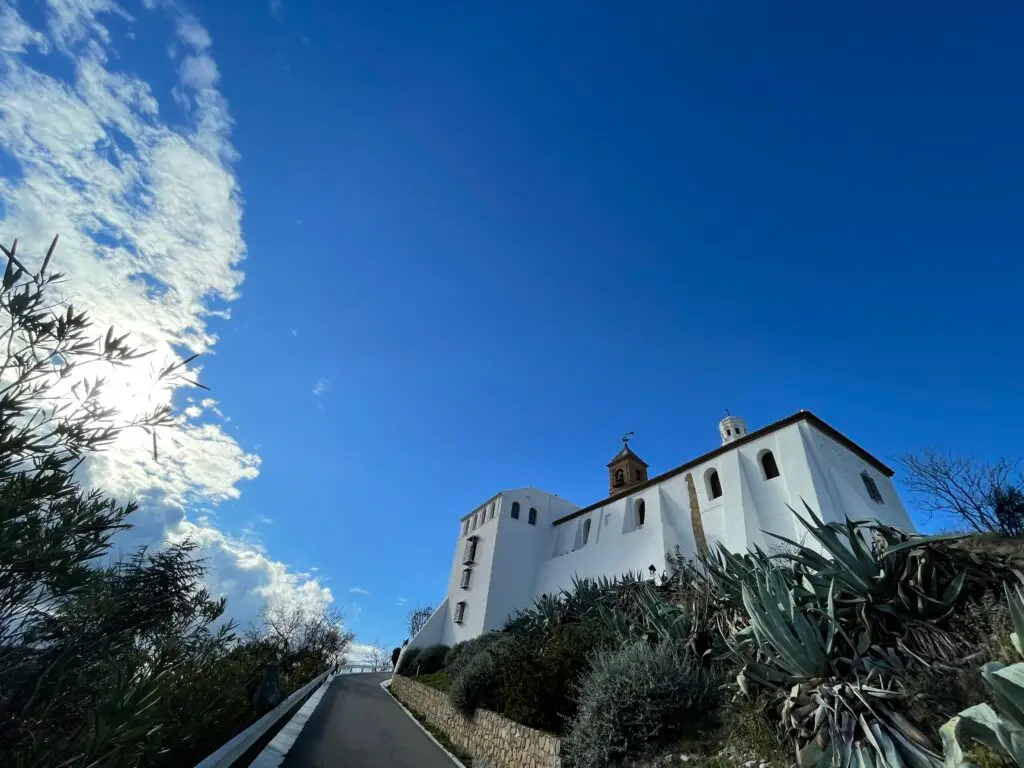
Looking up at the hilltop convent in Archidona

There is a short but quite steep walk up to the convent above the town of Archidona. This vicinity also has a number of defensive walls from earlier times, and those above the convent have recently been restored, quite sensitively and thoroughly. It is worth the further climb up there, as then the view opens up in all directions from this vantage point in central Andalucia. It is quite appropriate that monasteries should be isolated, and also on the heights.

The walls of a monastery keep the world out and provide a safe community for inner contemplation. But we could also say that the walls keep the contemplators inside. How many have regretted those vows that forgo the pleasures, activities, and variety of the outside world?

Apart from some of one’s friends who have passed on, the number of people that one is in touch with is shrinking, because we tend to drift apart from some friends, if there has been no contact. Luckily I have quite a strong tolerance for solitude. But, it is true, unless we have our attention on things they weaken. 

Thinking of monasteries, in this lifetime I was quite attracted to residential communities. When I was in Edinburgh after university, I had a difficult time finding my place in the world of work, until I finally did teacher training. Ironically, during that time, I remember that I was for a short time in charge of a hostel for people who were undergoing assessments for employment re-training; they may have been out of work for a long time, or they may have had an accident and could not do the same work. It was called the Employment Rehabilitation Centre, and it had a hostel. I had to arrange social activities for the residents. so sometimes I had to stay overnight.

I used to talk to the psychologist there. It was ironic since I was looking for my own employment path. He gave me some suggestions, for example, that I could train as an archivist … but I think that despite my love of books, I would have gone nuts working in a library … I was better off in schools, with all the energy there, despite all the stress; and teaching suited the acting element in my personality, as I had done amateur dramatics in my mid 20s, which boosted confidence a lot.

Later on, I was quite attracted to boarding schools. Once I had an interview for the famous boarding school in Malawi, Kamuzu Academy. There was an impressive panel of eight people in London, but I didn’t get that position. Finally I worked in the great St George’s College, for five years, in Quilmes, Argentina. Tiring, but the best experience I had in any school. Then, in Nepal, the school had weekly boarding. I wonder if all this might be linked to predilections, sanskaras from former lives, for example living as a monk. We are usually not aware of the details of past lives, but we might get an idea of themes. Probably I was involved in Christianity. It would be quite interesting to find out, but only when one would be even more detached about it. 

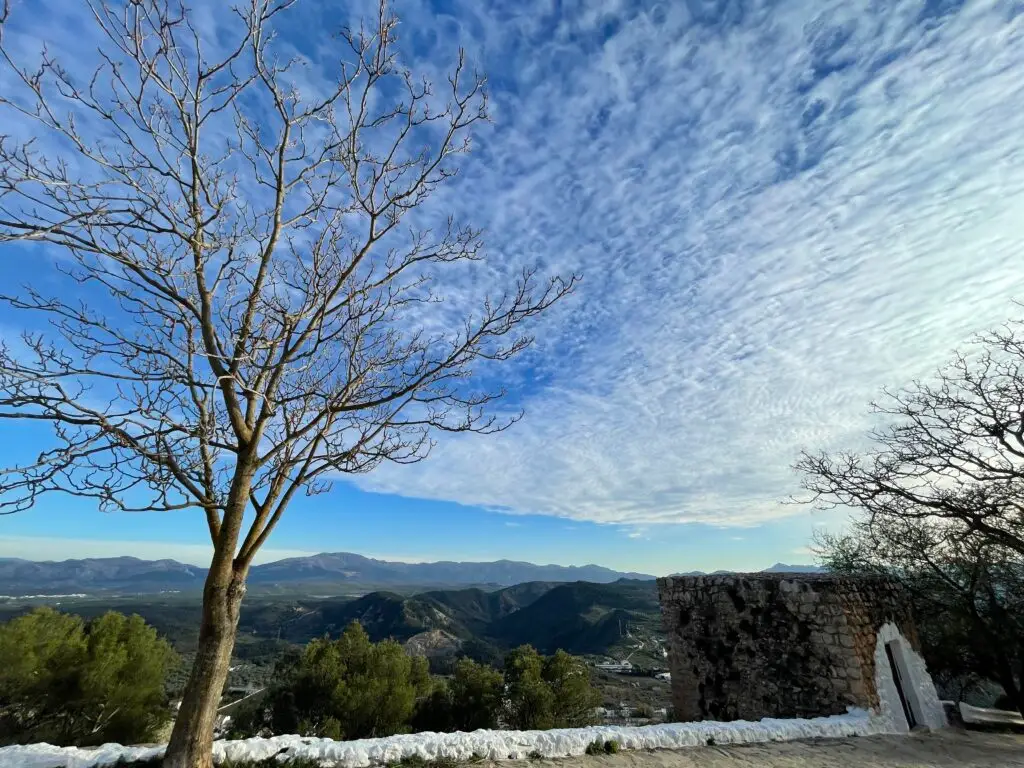
looking south …. calm winter sky

Withdrawal from the world has been a conscious choice, as I have seen in the Buddhist communities in the Tsum Valley, Nepal, and in other residential communities in all the religions. Yes, we do need to withdraw, not only when in the sleep state, but at least at some point during the day, to explore and contemplate the infinity within. Perhaps detachment is the better option in the twenty first century. And we need to find those birds of a feather who share the same essential quest.

Snow Mania – Winter in Britain: 1962-63

Posted on March 2, 2025March 14, 2025 by ianraitt

A few memories linger from that winter. The first tiny, tiny flakes of snow that fell tentatively from a heavy sky, then thronged in a graceful dance, and finally cascaded down relentlessly. The unexpected wildness of deep drifts on the steep bank of the playing fields shared by the two schools, the Junior and Senior Academies. And the great, joyful snowball fights that erupted at break times. My response to the snow was purely aesthetic, but the craving for the obliteration of all distinctions and differences comes from a deeper wellspring of the psyche. The longing for the sight, sensation and swish of falling snow has never left. But it caused so much disruption as Britain did not prepare for these infrequent severe winters.

With my 11th birthday in January of 1963, I must have been in Primary 7 of Perth Junior Academy, the qualifying year, when the somewhat dreaded 11+ exams had to be taken. Often stealing glances out of the classroom window towards Necessity Brae, with its fringe of dark pine woods, I would look with a joyful expectancy at the dark margin against which the tell-tale advance of a new snow shower could be seen. Icy slides in the playground, probably now banned under Health and Safety regimes, dared the adventurous. The snowball fights gave first glimmerings that I might command a force of some kind, though that only manifested a long time later on!

The cold started in December and didn’t let up until late March

Any significant snowfall and lasting cold conditions depended on the establishment of high pressure over Scandinavia, with low pressure pushing up against it from the Bay of Biscay. This brings in a strong easterly flow from Russia, where temperatures are frigid, and the wind over the North Sea picks up moisture emerging in frequent snow showers on eastern coasts. But the greatest snowfall could occur in the south of England, rather than in Scotland, as this was the intersection between the milder Atlantic moisture-laden air and the sub-zero flow pouring in from distant Siberia.

Classic anticyclone over Scandinavia with Atlantic low pressure to the south, generating the cold easterlies

Described as a ‘battle’ between the opposing air masses, the winds generated led to blizzard conditions and huge drifts of snow in hilly areas. The heaviest accumulation could be in Devon, Cornwall and south Wales, which in normal years might enjoy a milder winter climate. It was ironic that one of the coldest places was Kent, with its proximity to a glacial continental mass, colder at times than Scotland. Even if the milder air was bound to win ultimately, it might be pushed back a few times in the campaign, and at least the cold ground and snow-covered land would see a last blizzard, a final stand, preceding the great melting.

Thus began a daily march of snow showers along the quiet valley of the broadening Tay from Dundee and the North Sea. Some salted pavements shone wet and shiny, but as temperatures dropped again in late afternoon a familiar blurring of the air over Kinnoull Hill to the east hazed the outstretched town of Perth with drifting-down snow, whitened up pathways, filled and softened the daily commerce of footprints.

https://www.theguardian.com/uk/gallery/2010/dec/15/weather-big-freeze-1962-pictures

You never tired of watching flakes drift down in amber light of lamps, laying siege to window sills, smothering spindly rose bushes, dusting iron railings of front garden fences. The small bedroom, a north facing cave, a hideout, was privy to secret rituals and observances. The sash window opened up; a kneeling figure leaned a head out. Sensing falling snow on nose and hair, it breathed in the hushed garden, cherished perpetual flakes replenishing, nourishing, deepening the great white coverlet.

Then, in March, after two months of cold, the battle approached the end. Strengthening south-easterly winds brought snowfall to England, followed by rising temperatures. The last frontier of resistance was Scotland. Pavements had encrusted ice, but the temperature hovered around 39 Fahrenheit, bleak skies glowered. Finally, the moment of precipitation was near, and as the snow belt moved in, that evening the temperature fell suddenly to 32 degrees, exactly on freezing point, and immense waves of fine snow fell blindly, negligently smothering everything in the last great blizzard of the winter.

But there was no exhilaration in the northern cave the following morning. Window up, take a look out, check the temperature, now 35 degrees, and only a sense of heavy, soggy snow. Despite its impressive depth, the snow was thawing, slivers sliding off the sturdy apple tree, a quiet, sad dampness in the air. The great freeze was finally at an end, and something greatly welcomed by all but the quirky boy snow-celebrant in Needless Road, Perth, Scotland.

Langtang _ Day 1: Thursday 13th February, 2020 -Dunche to U Kyang

Posted on March 2, 2025March 14, 2025 by ianraitt

Madhu said there was no point in trying to get transport to Syabrubesi from Dunche, as it is infrequent and already full, but this was just as well as it provided the opportunity to make a new approach into the Langtang Valley, and we had the time.

The road ahead: this time on foot, but earlier times on a bus

As we left the town, we could see the road ahead hugging the mountain, and how it had been carved out of the rock. Some sections had buttressing and support below. Simple but impressive engineering, but how secure was it? There were no safety rails anywhere to be seen. This view was instantly recalled from earlier visits, how alarming it looked, and how you had to trust; not only the road itself, but the driver of the bus, full as it was of talkative, unmindful fourteen year olds, the grade nine students from our school.

Winter is a time when the vast northern Indian plain sends its terrible air quality seeping up onto Nepal. It joins with Kathmandu’s local pollution and continues on into the Himalayas. While the air in the early hour after sunrise appears clear enough, as soon as the sun’s rays start to slice the atmosphere the refraction of the light shows up the myriad small particles that have come all this way from the cars and factories. Nepal, which has supposedly the highest and purest mountain air in the world, is not being spared the planetary curse of polluted air.

So maybe the air is not so clear after all: PM2.5?

The extent of the pollution could be seen on the weather app windy.com, which has layers showing air quality and the various pollutants – take your pick from nitrogen dioxide, PM2.5 and aerosol; then you can check the ozone reading too. So the information from satellites had been distilled into this amazing app, and allowed us to compare what we saw with our eyes with the online map confirming the air quality. Yes, there was air pollution, and it stretched all the way to the Tibetan plateau. The question was: at which point would we come out into pristine clarity on this trek?

Langtang in Winter _ Day 2: Friday 14th February 2020 – U Kyang to Lama Hotel

Posted on March 2, 2025March 14, 2025 by ianraitt

A bittersweet experience on a trek is the knowledge that height gained is often sacrificed in height lost. Thus today we could see the long descent to the floor of the Langtang valley where the path would join the main trail. Finally in the valley was a lodge where we could have a hot cup of ginger tea, though the morning was chilly as the narrow valley was still in shade.

All day a helicopter flew up the valley and back, carrying long baskets of steel for concrete pillar construction; a disruptive, angry noise in this natural area, as many as fifteen trips. We met a group returning which had climbed Yala Peak (5500m), one of the easier trekking peaks, as they are called. They mentioned that there was plenty of snow at the top.

Lunch was at Bamboo lodge, finally in warming sunshine. It’s an area where the very rare red panda lives, eating the bamboo shoots, of course. It is threatened by loss of habitat. More prevalent were the red monkeys, who were chased off by a stone-throwing girl at the lodge. Half-grown chickens scrabbled in the dirt.

The winding route up Langtang reveals constantly changing vistas beside the rushing waters

Conversation turned to the cow family in Nepal. We would see Dzo on the trail, a hybrid between yak and domestic cattle. The Dzo is male and infertile, but the female, called Dzomo is fertile. Yaks are in the cow family, but buffaloes are not, in Nepali eyes. Thus the large Hindu Newari community, may eat buffalo meat, because they don’t define the buffalo as being of the cow family. Brahmins and Chhetris may eat goat or mutton as well as chicken. Madhu recognised that the universal dal bhat (lentils and rice) lacks protein, but he mentioned that goat meat is fatty, so not so healthy.

One of the saddest animal sights in Nepal is the dumping of young bulls at roundabouts where they try to forage some sort of provender, but may end up swallowing plastic refuse. They have no economic value. They cannot be eaten, but to look after them involves the expense of providing fodder. So only the cow is venerated and protected, the bull is marginalised and excluded.

We passed the cliffs where wild bees have their honeycombs and where bee collectors make a perilous descent to extract the highly valued and reputedly psychotropic melliferous product. It was not long before we arrived in Lama Hotel, the usual first day stop on the Langtang trail. Earlier in the winter there had been a fair bit of snow, particularly in the Gosaikunda area, but it was relatively mild now, in mid-February. My experience in Nepal in earlier years, is that the weather often became warmer in the last week in February, a rush of sap and springtime. So we were on the cusp of that.

Honeycombs of wild bees on riverside cliffs in lower Langtang

Langtang in Winter _ Day 3: Saturday 15th February – Lama Hotel to Langtang Village

Posted on March 2, 2025March 22, 2025 by ianraitt

We were invited to sit in the kitchen while waiting for breakfast. Cooking was done on a semi-open fire, and surprisingly there seemed to be little smoke from the wood used. It was a cheery sight, and though a bit wasteful of wood the blaze got the breakfast ready fast.

Waiting for breakfast in the cheery kitchen

The path crossed landslides triggered by the 2015 earthquake, but the terrain appeared well-trodden and stable.

Landslides are evidence of the earthquake, but now stable to cross.

No disturbing whine came from the helicopter, its entrance deterred by mist patches coalescing in bright air. We climbed out of the narrow valley and stopped for another ginger tea in brilliant sunshine.

Looking back down the valley with mist coming and going

The setting of the old Langtang village came into view with Tsergo Ri in the distance. The earthquake had funnelled a mass of rock, silt and ice from above, submerging all dwellings. A single untouched house remained, hedged from the descending projectiles by proximity to the mountain. Huge slabs of rock had fallen off, creating a sharp pressure wave. The explosive force severed the tops of trees on the other side of the valley: their stubs remained.

Sea of rock debris covering the original site of Langtang village

New houses had been built on higher ground further up and away from the cliffs. They beckoned across a bleak sea of rocky debris. The buildings encroached on yak pasture, but no one could construct on that movable morass of stone and silt, under threatening cliffs. An expression of trust, a bold rejuvenation – would the new village remain safe?

New building and signs of hope. Tsergo Ri beyond, objective of this trek.

Now that Tsergo Ri was visible and closer, the determination to have a go at climbing it became stronger. We could see the long sloping shoulder that we would have to go up, free of snow and leading onto the rocky approach to the summit. It looked possible.

A half-grown kitten accepted a tea-dipped ginger biscuit, returning enthusiastic for a dry crumbled one. It had an attractive coat, though the beastie was gaunt. Bishnu complained that village cats became too lazy to hunt mice these days, being fed liberally enough, though not kept as pets. Such a creature as this would probably be hungry all the time, in the austere boondocks of upper Langtang. I could only be its friend for a moment, before the tide drew us apart.

I am quite partial to a ginger biscuit, myself. A friend appears.

Langtang in Winter_ Day 4: Sunday 16th February 2020

Posted on March 2, 2025March 14, 2025 by ianraitt

A high wind in the night, then stillness. Sleep came with difficulty in the mountain air. Then a bright morning with no wind; warm in the sun. The valley opened out to a Scottish highland glen, with its boulders, its rushing river, its small hydroelectric scheme with insulated pipe. A majestic stupa crowned a rise.

The highland valley, with stupa just visible in the middle distance.

Kyanjin Gompa had undergone a building boom of new lodges for the trekkers, with some having three levels, many in the bright colours Nepalis like, all jumbled together and overshadowing their neighbours. But the crowding was due to a prohibition on building on the grazing land, so it had logic. The trekkers congregated at the one lodge that was open. Sunlight warmed the common area.

Jumble of new buildings at Kyanjin Gompa, crushed together to preserve grazing land

In the afternoon we climbed up on the approach to Tsergo Ri, a time-honoured ritual of acclimatisation: go high, sleep low. Even another 300m up from Kyanjin Gompa would help the lungs manage the real climb the following day. The path was clear. Bishnu kept going up just a bit more, to make sure the effort didn’t stop short of the required pain. From this vantage point, you could see the familiar peaks and glaciers from a different perspective, including the twice-ascended Kyanjin Ri.

Looking down to Kyanjin Gompa, a layer of pollution visible below. Look how far we had to come to escape it!

We met a well-muffled Greek trekker who had reached the summit. He reported that after 2.00 pm the wind got up. He congratulated me on the mere presence of such an aged spirit at this height. We eschewed a handshake for the protocol of elbow bumps. We fed the local crows biscuits. The one which pecked aggressively also had the biggest head … the male of the species?

Bishnu and the crows

Two high passes cross from Helambu to Langtang, the Ganja La and Tilman’s pass. We thought we could see two entrances to the Ganja La on the opposite slopes of the valley. These passes with their steep snowfields at the top are only for autumn, perhaps springtime. It is a bit late in life for more adventurous trekking, so these peaks and passes have to be considered carefully, but for the embodied spirit a dream still beckons.

The frozen slopes of the upper valley in brilliant sunshine

Langtang in Winter _ Day 5-7: Monday 17th February to Wednesday 19th 2020 – Tsergo Ri and return

Posted on March 2, 2025March 14, 2025 by ianraitt

This was the climax of the trip. Would I get up without any altitude symptoms, weakness, headache? Pepe, a young Catalan from Barcelona, joined us at the start. We gave him some suncream. Then he streaked ahead.

It was just a long, long ascent. The only tricky part was when you reached an intermediate saddle adjoining a corrie. There were large snow-covered rocks, and as the snow was not firm and frozen you could have dropped through and twisted an ankle. Bishnu was good at spotting the most secure way. Now we met Pepe leaping his way down. We could see the ridge to the summit, with its boulders and lip of snow.

Looking back down to the valley as we approach the summit ridge

A surge of optimism and energy arrived, with the delight of knowing you would make it in fine weather, and still no altitude problems. Tremendous 360 degree views. The unassuming Yala Peak (5500m), just a rocky bump on a ridge that continued higher, remained for a camping trek in the future.

Looking west from the top

The whole ascent had been 1000m. Care was needed on the descent, with rocks more reliable than snow, and the path proving slippery. Looking down there was a sense of achievement. Had we really come all this way up? Eight hours, including thirty minutes at the top, at my slowish pace. But slow and steady won the race.

Looking north to Yala Peak, the small bump at the right side

You always leave something else that you may do, to give a reason to come back. It may be Yala Peak, Gosaikunda pass, or Kanja La pass and peak. Or all three together, perhaps. Langtang is a great place for a short trek in winter, and also offers those additional variations when the weather is warmer in the main trekking seasons.

Descending

The following day: a last look back at Tsergo Ri, then the descent to Lama Hotel. Then sitting again in that kitchen, where the smoke mysteriously disappeared, invisible, through a space in the roof. Then the next day, down into the damper and hazier air at Syabrubesi, and to enjoy the usual luxuries of a softer bed, a warmer room, and richer food, before getting in to our jeep and the journey back to Kathmandu.

New lodge: fine stone work in a concrete frame

In search of the Ganesh Himal base camp

Posted on February 7, 2024March 14, 2025 by ianraitt

To approach the inner sanctum of the mountains, we first had to descend quite steeply through the forest and cross a couple of rivers. The total ascent for these two days could therefore have been about 2200m, though without any altitude effects, since we were not staying at the top elevation of 4000m, but returning to Lungang Gumpa at 3200m.

What was apparent was that we were not taking the trail on the left hand side of the glacier, that led to the base camp, but the alternative trail on the right hand side. Ani Ri San indicated that there were three yak kharkas that would signal that we were on the right path. A long section went through moss-covered trees, with many fallen trunks. Madhu questioned why there were so many of these. It could be that the competition for sustenance means that some trees submit to self-sacrifice so that the larger forest entity may thrive. Research shows that trees communicate and assist each other. Also, this damp area obviously got much less sun, which may have affected the overall condition of the trees. The trail was quite indistinct, but we found the first kharka, and on we went through thinner, more open forest, where the snow still lay unmelted in shadow.

Madhu, with a stone resembling an image of Ganesh, in the last of the three kharkas

The map is quite misleading in that there is no glacier, or only the shrunken remnants of a glacier. The area of vast historical glacial erosion, perhaps from 10,000 years ago, was not visible to us, and when we finally ascended the innocent looking slope, seen in the above photograph, the hill with stunted trees on the left, it was with a shock that we realised that suddenly the land plummeted vertically down into the eroded valley, and was still crumbling away, so that the earth we stood upon might collapse at any moment!

the clouds are a narrative all of their own – looking towards the sanctuary

Madhu went on a little further to get a better view. He reported rockfalls and small avalanches from the cirque of icy slopes. Then down we retreated, through the snow meadows, with numberless steps, through the mossy green primeval woods and their rushing icy brooks, on a path more imagined than perceived. We came to the tree trunk bridge. It was a different proposition in the dark. I eschewed the challenge, and went towards a shoal of large rocks. ‘Jump!’ I urged Madhu, but I was glad to be pulled upward with Bishnu’s steady hand. Now there was only a shimmer of light in the west. I turned on the head torch, and we covered the last stretch in the thickening darkness, tired but elated, and pleased that we had truly trod a path less travelled.

dawn, at Gumba Lungdang, the following day
the descent towards Lokpa at sunset that same day

Further into the unknown region: The Ganesh Himal base camp.

Posted on February 7, 2024March 14, 2025 by ianraitt

Nile to Domje: While many of the most famous treks in Nepal are circuits, for example Annapurna, Manaslu, Kanchenjunga, there is also interest in going down the way that you came up, for example in the Everest base camp trek and the Langtang trek, due to the surprising new viewpoints you may have missed on the way up, as you see the landscape from a new perspective. This was a long day, all the way down to Domje, but no stress on the lungs. Leaving Nile, it was worth noting that these weather-beaten welcome gates, hide a rich set of Buddhist illustrations if you look up when passing through the gate.

weather-beaten welcome gate just outside Nile
look up to the heavens inside the welcome-gate

There must be a Tsum Valley diaspora, since on descending we took the path ‘less traveled by’ and came upon this magnificent, and freshly-constructed stupa, which Madhu discovered had cost some $270,000. Contributions must have come from far and wide.

magnificent stupa, with dramatic backdrop

Our descent took us to a pleasant, though seasonally parched, pasture above Chhokang Paro, where the north Indian plain smog could clearly be seen in a layer below, and which did not bother to delay before surging upwards and turning the pristine air murky.

smog layer, about 2400m

Now we had to negotiate the exposed path that descends from Chhokang Paro to Domje. Wild mountain goats above looked down disdainfully. The path was stable, but some nerve was still needed in places, with steps submerged in fine dust.

in the smog again … narrow exposed trail

But we established that the Gompa on the way to the Ganesh Himal base camp is open! Now I only had to rally the troops, reminding them of what we would miss out on if we neglected this adventure. Meanwhile, approaching Domje, I was reminded of the parable of the sower: ‘ … and other seed fell upon rocky ground …’

young wheat shoots amid the boulders

Domje to Gumba Lungdang: The following day we went up through the forest, a magnificent walk. A winding path, not so steep at the start, but later it became quite tough as we went over 3000m, and also the full ascent was about 800m. Madhu said that we were travelling through an oak forest, but the leaves were evergreen. Many species must exist, and there certainly is a Himalayan oak. Meanwhile, views across the valley showed deep gorges and a thick covering of pines. The mountains were closer, with high extensive snowfields.

Hidden Himalaya, in all its untouched glory

We arrived, gratefully, at the Gompa, but only three nuns were in residence; the other ten or so sent, compassionately, for winter leave to warmer climes in India for study courses. Three nuns, and two hungry dogs. Some biscuits made friends of the dogs.

in bright sunshine outside one of the prayer halls at Gumba Lungdang, 3200m

There is not much flat land at the Gompa. Our rooms are perched above a steep drop. The kitchen is organised and warm. It is the universal habit to lop some branches from growing trees, and these long sticks are fed into the stove. A large kettle sits directly above the flames, and the stove door is kept open. But this often leads to rather smoky rooms, though in this case it was mostly smoke free.

Ani Ri San in her kitchen

We asked Ani Ri San why she had become a nun. She said it was of her own volition. She told us that her father had deserted her mother, and life became very difficult. She did not have a very positive image of marriage. Another issue in Nepal is child marriage, often due to poverty, though mainly experienced by marginalised social groups. Nevertheless, some nuns do not maintain their vows and leave the Gompas to seek a marriage partner. I asked if the practice of meditation may have a positive effect not only on the practitioner, but also on the world at large, and she agreed to that.

dusk is early at 16.45 … looking towards the amphitheatre of the Ganesh Himal – small meditation cell seen in the distance on the left

My room is constructed of wood, with many little shelves that could be bookcases. The pillow is even filled with sawdust; nothing is wasted here! There is very little flat land. around the Gompa, except for a few terraces where potatoes may be grown. An apple tree renders tiny fruit. This is a peaceful place. I could imagine spending a longer time here, especially in the winter, looking out longingly for snowfall, and at the wonderful evanescent cirrus clouds.

Tsum Valley: The Upper Sanctuaries

Posted on February 7, 2024March 14, 2025 by ianraitt

Chhokang Paro to Nile: So now that we were in the upper valley, did the atmosphere provide subtle emanations linked to the remote, untouched nature of the place, and to the constant vibrations transmitted from the places of inner devotion, the gompas with their adherents always in solitary, meditative retreat from the maya and illusion of this impermanent world?

Yes. Maybe. Maybe it did.

We saw in the distance, amid a thick pine forest, one of the gompas of this upper valley, that reminded you of one of the fairy tale castles to be found in Bavaria. Remote, almost invisible, still in the shade, mysterious.

distant mysterious gompa in the woods

It was, mercifully, a more gentle day. The valley was wide and spread with fertile fields, many of them already planted with winter wheat. Mules, unladen, came down at a strong pace. We stopped for an early lunch in a small, sunny courtyard. The sun was warm, but the wind still cold. Looking up you could see continuous chutes of powder snow falling down, down the crags. The lodge owner told us that even now some yaks are are on high pastures. The people keep an eye on the weather, and will go up to bring them down if it threatens a storm. Then we saw the characteristic fluted snowfields of the Ganesh Himal, beneath a faint new moon.

fluted snowfields of the Ganesh Himal, with new moon
Gompa (inhabited by nuns) beneath the crags; haze of green on the fields, planted with winter wheat

We went up from the trail towards Milarepa’s cave. It cost an effort. Horses and mules grazed. The guardian came running, explaining that he had been at a cremation, and had seen us moving up. The site was well-maintained, with a new staircase leading up, and small retreat houses beneath the cliff. One room had a shrine with a footprint of the saint. Another was a prayer-room with a shrine to Buddhist gurus; it had a gigantic prayer wheel. The shrine of Milarepa himself had an image of the saint, looking a little wild.

The dining room at the tea house in Nile was warm. It’s a phenomenon in winter when the sun streams in. Enjoy it while you can! The night will be cold.

approaching Nile (3200m), still in the winter sunshine

Nile to Mu Gompa: At 3700m the monastery catches the morning sun early due to the opening out of the valley, compensation for the colder, thinner air. On the way we crossed a wide river bed, not a landslide, but tribute to a mighty flood, an impressive sea of stone. Yaks grazed. We could not stay at Mu Gompa, but the resident monks gave us a cup of tea. Many further yak kharkas (summer pastures) are indicated on the map, all closer to the Tibetan border. In that direction, the southern facing slopes are free of snow.

border lands: a path leads to two main crossing points – snow-free slopes, crumbling into fine gravel

The monks won’t return the hand gesture in prayer mode that is universal while saying ‘Namaste’ in Nepal. Probably they don’t want to participate in a specifically Hindu phase, ‘I recognise the sacred within you,’ as it can be rendered. One monk mentioned that he was going to take water to an injured yak, as an act of service. At last we are clearly out of all remaining remnants of the north Indian plain smog, reminding us that windy.com often has the impure air going almost up to the border. Now the thought of the Ganesh Himal base camp has arisen. Will the Gompa up there be open? Will there be too much snow? Will I have enough energy? The idea of going there is surprisingly resilient, though.

Tsum Valley Approaches: December 2023

Posted on February 7, 2024March 14, 2025 by ianraitt
Leaving Jagat, the Buddhi Gandaki, gushing down – a tributary is providing local hydro power

Jagat to Lokpa: we were still in the common area for trekking around Manaslu. Frequent mule trains descended, unladen, usually placidly, but at times there was jostling and kicking. We could see that this traditional means of transport will be replaced by the gradual extension of the road towards the villages in the Manaslu valley. But one issue is, should a road also come to the untouched Tsum Valley?

The only way to extend the road is to blast through sheer rock faces. This is being done by the engineers and workforce of the Nepal Army. We are cautioned by an infantryman with an automatic weapon to wait, as a routine explosion was imminent. For some reason, there was a ‘test explosion’, then the real one came with a cloud of dust.

Road making inch by inch
Classic Himalayan valley, our route on the right

This type of work may not be done with standard western risk management. There have been fatalities with similar road construction on the Annapurna circuit. But it is hard not to be impressed by the persistence that brings better communications.

Doing the Manaslu circuit in winter has an enhanced risk, even though the weather appeared very stable so far. We met a group of six trekkers who had turned back due to deep lying snow, wind and drifting snow. Later, though, we met two other groups going to attempt the Manaslu circuit: one from Germany and one from Australia, the second with an impressive 75 year old trekker, giving hope to others near that age!

Lopka to Chumling: A forest walk, winding up and down, with the river roaring below. First, a massive landslide that took 45 minutes to cross. It looked alarming, but in the dry season it was stable enough. We heard later that one trekker had taken fright and retreated!

There was only a glimpse of sunshine at the lunch stop. The owner of the tea house explained that they didn’t get sun for two months in the year. Suddenly a suspended walkway appeared in the cliff, but reassuringly ‘Swiss designed’. The metal holding plates had spaces for six bolts but only two were in use. We rationalised that the weight of the metal only required two bolts!

soaring cliffs show the sheer scale of things

Tiny settlements could be seen huddled beneath crags. One thing that has improved in Nepal is electricity provision, and even the remotest villages had their power lines, and the supply is stable, unlike fifteen years ago, when massive ‘load shedding’ was universal.

A rare hot shower was available at Chumling. The views became quite alpine. We ate in the cosy kitchen and later gathered round a small campfire.

Chumling to Chhokang Paro: Altitude started to kick in at 2500m. A group of women descended, asking, ‘Why are you taking this old man up? We are coming down to escape the cold!’ A couple of small children, aged 3 and 5 were walking 2km unaccompanied to school. Then two British chaps, but with Australian accents, as they had moved down under, jaunted down the trail in T-shirts and shorts.

the impressive lodge at Chumling

Our destination at Chhokang Paro was the Bio Hotel. We were grateful that something was open. Again we ate in the warmth of the kitchen. While begging for an internet connection, we elicited from the lodge owner that his father was truly fortunate, living in the present moment, without the distractions of technology. Now we were in the real upper valley, with grand vistas and extensive level agricultural land.

early morning, looking back at Chhokang Paro, as the valley opens out into cultivated fields

  • 1
  • 2
  • 3
  • Next
Ian, the Scot

Ian, the Scot

A Scot who lived in five continents, now using some free time to attempt some of the classic treks in Nepal, where he lived before. As well as contemplating why we like to move through majestic three dimensional geometry, there could be some reflections on life´s higher altitude.

Subscribe to Receive Updates

Check your inbox or spam folder to confirm your subscription.

Recent Posts

  • Nepal Notes: Demonic trumpets and vivid necklaces
  • Nepal Notes: day hike to Namobuddha
  • Nepal Notes: Animal Welfare
  • Nepal Notes: a wondrous sound
  • Nepal Notes: Christmas
©2026 Be Kind To Dragons