Be Kind To Dragons

adventures at higher altitudes

Menu
  • Home
  • Nepal Treks
    • Langtang
    • Annapurna Circuit
    • Tsum Valley
    • Gokyo and Everest Base Camp
  • Out and About
  • Ceaseless Melody
  • The Daily Proverb
  • Classic Texts
Menu

Author: ianraitt

Toward the Unknown Region: the Tsum Valley in Nepal

Posted on February 7, 2024March 17, 2025 by ianraitt
Chortens announce the entry to the upper Tsum Valley

Yes … a touch melodramatic, because the Tsum Valley in Nepal is only unknown to those who have yet to explore it. But the idea of the ‘unknown region’ is a symbol for adventurous travel, and maybe for deeper exploration, since Toward the Unknown Region is the title of a poem by Walt Whitman, and also of a piece, with the same name, for chorus and orchestra, by Ralph Vaughan Williams (1906), who also used Whitman’s poetry from Leaves of Grass for his epic A Sea Symphony (1909). The poem has some wonderful phrases, and though I might demur that Time and Space in themselves are worthy of such exalted praise, there is no doubt that Whitman’s words carry us vibrantly along in a mystical, ecstatic trance. https://whitmanarchive.org/published/LG/1891/poems/245

The Tsum Valley is a Buddhist enclave. The inhabitants are of Tibetan origin and speak a dialect of the Tibetan language; there are a number of monasteries, called Gompas, whose inhabitants in this area are nuns. At the head of the valley are at least two entries by high passes into Tibet, still used for seasonal trade, and through which, no doubt, the valley had been populated in earlier times, by explorers from the high plateau beyond. There is also a famous cave where the great saint of Tibet, Milarepa, is said to have been in retreat. The valley is liberally supplied with chortens, stupas, and prayer walls, and omnipresent prayer flags. It is an independent branch of the Manaslu circuit, and those trekkers who come up to the top of the Tsum Valley, will be acclimatised for the higher regions ahead on the main circuit.

Gradually the idea formed of a winter trek in December, by poring over maps, and reading Trekking around Manaslu and the Tsum Valley (Pritchard-Jones and Gibbons – Himalayan Travel Guides). You could see that after quite a steep day of climbing at one point, the land broadened out into a high, level valley, before narrowing again in its ascent towards the border. And I began, also, to speculate about an approach to the Ganesh Himal base camp, which should allow a viewpoint of the high, massive snowfields of these mountains, as yet unthreatened by the climate-induced melting going on in other places, due to their aspect facing north. We would have to stay at Gumba Lundang at 3200m, one of the monasteries, if it were open at this time of year, when people come down to spend a couple of months in Kathmandu and escape the cold.

So while journeying deeper into the mountains, I started to consider how 
little I knew about Buddhism. Why was the religion so prominent and persistent in these remote valleys? Why were there so many nuns in the Tsum Valley? Even though Buddhism expresses some of my deepest beliefs, such as the ultimate illusion of our sensory life and our repetitive reappearance here on the earth planet, with only small incremental evidence of progress, I knew that my understanding of its traditions and current realities was superficial. As it happened, after the trek, I found some books in Kathmandu to add to those I had already read, that gave some further understanding, such as the following:
1. Thomas Shor: A Step Away from Paradise
https://www.thomasshor.com/a-step-away-from-paradise
https://www.bbc.com/travel/article/20220830-the-himalayas-hidden-paradise-valleys
2. Lama Yeshe Losal Rinpoche: From a Mountain in Tibet - A Monk's Journey
3. Alexandra David-Neel: Magic and Mystery in Tibet
4. Mick Brown: The Dance of the 17 Lives - the incredible true story of Tibet`s 17th Karmapa.
And I decided to re-read Lost Horizon, the 1933 novel by James Hilton, that immortalised the name, Shangri-La. Yes, fiction, but it also captured the public imagination, that somewhere on earth, there could be a rarefied place where the normal dissolutions that characterise human life, might at least be delayed, and where a conflict between temporal love and higher aspiration is brought keenly into contention.
The journey toward the unknown region would be both an inner and outer experience.
Weather-beaten welcome arch at Nile
The hidden reality inside the welcome gate, looking upward

Autumn Leaves at the Birks o’ Aberfeldy

Posted on December 12, 2023March 14, 2025 by ianraitt

Scotland: a while since I’d been here, some sixteen years. Aberfeldy was familiar territory from the first eighteen years of life spent in Perth, and thus a remembered spot, associated with youthful ascents of Ben Lawyers and Schiehallion. How damp it felt after the much drier air of Andalucia.

‘You must go up the Birks,’ my friend said, so off I went in the right direction, though still managing a detour up a lane with very elegant detached houses, before finding the car park at the start. The Birks (Scots for Birches) is listed in a Times article, Five of the Best Woodland Walks in Scotland (25.01.23) and by coincidence there was another article in the Times series Walk of the Week (09.11.23), just after I had been there.

The Birks of Aberfeldy is the name of a song by Robert Burns, written in 1787. https://allpoetry.com/The-Birks-Of-Aberfeldy It uses a simple rhyme scheme, repetition, and a catchy chorus to persuade his lady friend to accompany him up the Birks. Here he is at the start of the walk; he wrote the poem in situ, and it is sung to a traditional ballad. Someone has placed a small bunch of roses, naturally reminiscent of another of his famous songs, A Red, Red Rose.

While The Birks of Aberfeldy sounds like a courting song, thus meant for a tenor or baritone, here it is sung in a very limpid way by Davidona Pittock: https://burnsc21.glasgow.ac.uk/the-birks-of-aberfeldy/ A more traditional version can be heard here: https://www.youtube.com/watch?v=DjiwsNAXYz4

Now, by all accounts, one is meant to go on this circular route anti-clockwise, but I had forgotten and did the opposite; if you go the recommended route, the best views of the Tay valley appear while descending. It is quite a steep climb up the banks of the Moness burn, and here one must explain, that ‘burn’ in Scots is a small stream. Some of the feeder burns flow in narrow disciplined channels over tough underlying rock. Others are cascades. The perfect contrast of tree trunks, mosses and autumn colours, had attracted a number of photographers, with elaborate equipment being balanced on tripods.

So, although I had gone round the glen in the opposite direction to the established one, I was able to contemplate the people who came into view descending the walk as we came face to face, and to speculate which of the family groups was the possessor of the Lamborghini parked in the carpark, amongst other large, ostentatious 4×4 vehicles. Then, by simply turning round, I could look down on the quiet, patient landscape, where some fields were notably thick with almost static sheep.

A perfect Autumn walk, though the colours will be more resplendent if the light is brighter: but November is November, not the summery time that Burns took up pen to record his impressions and longings. The air is calm, heavy and moist; mist hangs in the valleys; clouds form, wander and vanish over the summits; leaves drift down. And the burns, for a’ that, and ‘a that, rush and gurgle.

Now Simmer blinks on flowery  braes, And o'er the chrystal streamlets plays; Come let us spend the lightsome days 
In the birks of Aberfeldy.

Autumn Walks in Andalucia

Posted on October 31, 2023March 14, 2025 by ianraitt

Once a year, the local hill-walking club in Archidona climbs the mountain known as La Maroma, the highest in the province of Málaga at 2069m; I am keeping up this tradition as well, as it’s a way to test stamina with each year over the age of 70. It is a majestic creature, and can be traversed up one side and down the other if you have the right transport.

The overall massif and summit plateau reminds me just a little of that between Cairngorm and Ben Macdui, which I crossed many times in late adolescence: bare, stony mounds, austere and wind-scoured, Also, this outing is one that is more typical of hill-walking in Scotland, which always has a summit or chain of summits in mind, whereas in Spain, the walks are usually more meandering, partly to avoid a long tiring ascent, but also to take advantage of the vast system of existing paths. One thing memory had preserved from the two previous ascents, was that the descent was the really tiring part of the day: going down for 1350m in contrast to going up for 1000m.

near the summit: a rocky outcrop and chasm – views down to the Mediterranean

The autumn sunshine was warm and brilliant. A couple of groups of sturdy pine trees survived near the summit, surrounded by a bedraggled and discontinuous stockade of metal fencing. The noble conifers had merited sanctuary, perhaps from deer; but they were surviving in the waterless mesa, outlasting their protector, shoulder to shoulder, in the cleansing winds, a hardy band of Macedonians. All the pines that we met on this walk had my goodwill and commendation during the extended stress of the drought we are living through.

Looking back up towards the summit: did we really come down all that way?

The next walk was in one of those summer-hot and winter-warm south-facing valleys up from the Mediterranean coast, this time in the province of Granada, one of the areas dedicated to the growing of avocados. Three villages hug the steep slopes: Guájar Fondón, Guájar Faragüit and Guájar Alto. As avocados require a continuous supply of water, there must be sufficient in the river Toba all year round. Circular, raised water-holding concrete drums were dotted about near the leafy avocados. One side of the valley presented the unmistakeable signs of a fairly recent forest fire, though the highest widely spaced pines looked instead desiccated rather than burnt out, as it was difficult to see how fire could have spread between them. The history of deforestation in Spain for firewood has been balanced by the planting of pines in the last hundred years or so, one reason for this being to limit erosion, and the dry side of the valley here clearly showed erosion, while the other gentler side had ample pine cover with some secretive avocado groves.

the fertile side: forest scene with avocado grove amidst the pines – radiant late October day

Many people have used the following quotation from T. S. Eliot’s Four Quartets, and I can’t resist doing the same, even though its use here is hardly justified by the threadbare realisation that the village I could see below me, was really the same one that we had started out from, the highest of the three villages, Guájar Alto; such are the joys of circumambulation in unfamiliar territory.

We shall not cease from exploration
And the end of all our exploring
Will be to arrive where we started
And know the place for the first time.

But in the photograph here, you can see the opposite side of the valley with the margin of burnt forest, the erosion, the parched land, a real contrast to the place we were trekking.

Guájar Alto: thirsty land above

Descending finally to the middle village, we passed through mature avocados, pomegranates, apple trees, and this quite ancient and massive olive tree, still bearing fruit.

a Merlin among trees

Gratitude and appreciation are in order after rambling and roaming in the folds of the secretive glens of Granada.

majestic la Maroma

Autumn Winds

Posted on October 26, 2023March 14, 2025 by ianraitt

October: time of change in the northern regions, pivot towards winter. Clocks fall back; a sudden, darker onset of evening. And wind. Great movements of air boiling in the Atlantic, scattering the heavy lingering heat of summer from the Iberian peninsula, temperatures dropping from 28 to 16 in the space of a couple of days. Last weekend a compact but vigorous depression, formed off the south west of Portugal, unruly child of larger air masses currently lashing Great Britain, and surged violently across Spain, with local downpours in Extremadura, and with the wildest winds here in Archidona, in the province of Málaga.

storm over Archidona

Satellite dishes were ripped from roofs, pine trees in the forest above the town were flattened exposing shallow roots, branches were severed from the pines, and for the first time ever smoke was blown out the air vents of the Jotul wood burner, when fierce gusts harassed the chimney. Confession: the stove has been lit earlier than the ritual date of November 1st. Not such a good idea in that exceptional wind, but when a power cut ensues, at least you can boil an egg in the small, black Le Creuset cast iron pan, and pretend that you have an Aga, a tribe nowadays falling out of fashion, though affection lingers.

the faithful Jotul, cast iron with a twenty year guarantee

The autumn stoves must be gentle ones, emitting a quiet modest heat, fed slowly with those very dry wedges, cut from expiring, legendary, massive trunks of grandmother olive trees, sun-dried in the lucent air. Gentle stoves, valued as much as a source of light as of heat, even as that parent orb, now declining, now hidden by the scudding host of cumulonimbus, is still the source of all our energy, our local life force.

But of rain, not much is apparent, yet. A little amount, one impressive storm, though lasting only thirty minutes. The earth has been parched for two years or so, and the olive trees are struggling. The pine trees lean over; some fall over completely. At least twenty five young saplings were planted, but died in the drought.

a fracture, but at least the tree survived

Still, this transition from Autumn to Winter, gives a strange pleasure of anticipation, a permission to go within, to stay in the cave with the olive wedges glowing. It is said that the Autumn solstice drives one inward, not just inside the cave, but to be a little more introspective. It is the time of year to feel most alive, to appreciate shelter, to start a process of renewal by the fireside.

Still, there is repose after the storm and wonderful autumn skies. Above the Chapel of the Virgen de Gracia an ancient wall and fortification has just been restored, revealing some finer perspectives for those who make the climb.

tranquil evening above the Chapel

Winter in Ullapool

Posted on October 2, 2021March 14, 2025 by ianraitt

Ullapool is a small settlement on Loch Broom in the north western highlands of Scotland. A fishing port and the largest town in the district, it has a current population of around 1500, which has slowly increased over the last thirty years. Helen Gosch, the ceramics artist who has made her home on Ibiza, lived there for five years in the 70s, and remembers her time in a shepherd’s cottage on the hill above the town very fondly, as one of the happiest times of her life. But winter could be harsh. Helen and her partner had to keep warm as northerly gales were unleashed in the wake of passing Atlantic depressions, in a house with only one source of heat.

The cottage in winter

The cottage in Ullapool was above the village, with fine views of Loch Broom and onwards towards the famous crags of An Teallach, one of the wildest Scottish Munros. The light is one of the wonders in the north west of Scotland. There is a constantly shifting patchwork of cloud and sunshine throughout the day, and no two days are exactly alike. It took Helen twenty minutes to walk back down to the pottery where she was working, but she would come back on the Honda 50. A master potter, she is still working these fifty years later, a fine timeline of expression and dedication to an art form.

Loch Broom in winter

The cottage downstairs had a kitchen and dining room combined and another room which Helen used as a painting studio. The upper floor contained a bedroom and small spare bedroom. Heating was from an open fireplace with a back boiler, which usefully produced the hot water. Coal was burnt. There was no insulation in the roof, but heat came up from below, and also from the chimney itself. Still, you had to go bed prepared, wearing a flannel nightgown, woollen hat and socks. The fire was kept going overnight with dross, and usually it could be revived in the morning, then once again damped down until return from work at 5.00 pm.

Downstairs in the cottage

No television, so Helen painted and there was a cassette classical music club for music. Two cats were always turfed out at night, but they had a place of refuge in the outside coal shed where they could snuggle on a bundle of sheepskins. Sometimes the snow was deeper than their legs. They would catch young rabbits and bring them for inspection. The water came from a spring further up the mountain, which flowed down to a tank, and the pipe to the house usually caught sun so it didn’t often freeze. Deer and highland cattle visited.

Helen arrived in Ullapool on holiday and in conversation with one of the local estate owners found out that they wanted to open a gallery and craft shop. “Oh, I can run that,” she said, eagerly. She had majored in Art at university, with some experience in ceramics, and the Ullapool years were what started her on the great venture in pottery that continued when later she worked with the Barbara Davidson pottery near Falkirk.

In contrast to the winter, in general the climate is moderate due to the influence of the gulf stream. A record dry spell in summer lasted seven weeks. June and July are well-known for the long bright evenings, where there will be light in the north west sky up until 2.00 am. Then it can be seen low on the northern horizon creeping round to swell again in the north east at 4.00 am.

Helen was brought up in Sheldon on the Great Plains in Iowa, no stranger to winter and the great blizzards that sweep the northern states. There was special joy if a ‘snow day’ was announced and school cancelled. The house was warm though, definitely not as basic as the Scottish cottage. It was built in 1950 and had a large basement with a boiler providing central heating, much less common in Scotland at the time. If a storm threatened during the summer season, the whole family would shelter in the basement, taking the precaution of leaving both the front and back doors open, which makes all the difference if you are in the line of a tornado, of having your house ascend to the heavens, or just experiencing a mighty through draft.

Childhood home in Iowa

Helen was an American in love with Scotland: with the traditions, the earthiness, the dry stane dykes, the skies and their cloudbursts, the ever-changing light, and the demands of learning and perfecting her craft, as she experimented with making bowls, plates, teapots, in all the joy of creation that comes with a self-start in a new country.

The cottage seen through a gap in a dry stane dyke

A short September walk above Lanjarón

Posted on September 29, 2021March 14, 2025 by ianraitt

It was the first outing of the Senderistas after a break in August. Thirty people turned out to go on a walk along the water channels above Lanjarón, a village of some 3200 souls, which is now famous for its brand of mineral water. Lanjarón is a town of hotels and it looked as if it had been spruced up, and recovering from the pandemic slump in visitors. From above, it appears very neat and ordered. Disciplined in its land use, it nestles at the foot of the Sierra Nevada, but below the town there is a sharp drop and then a mountain bluff cuts the foreground with a sharp edge.

There had been some rain the previous week, so the atmosphere was humid in the morning and very hazy. Mist drifted around. Soon we were on the hill, and the water was gushing along one of the acequias, historic water channels, that contour the hill, always remarkable to see after the dry summer days; the water never dries up, being fed by snow melt, and then still filtering down in August and September, after all the snow has disappeared.

Having been rather inactive lately, I found that the climb was quite demanding. There are three of us aged 69, and all were attending. Luckily the group is always very disciplined and no one goes ahead, and there are frequent pauses, as well as the stop for breakfast, and tentempié de media mañana. Before long the gradient began a gradual descent to a shady river, where lunch was taken at the official Spanish time of 2:30 pm.

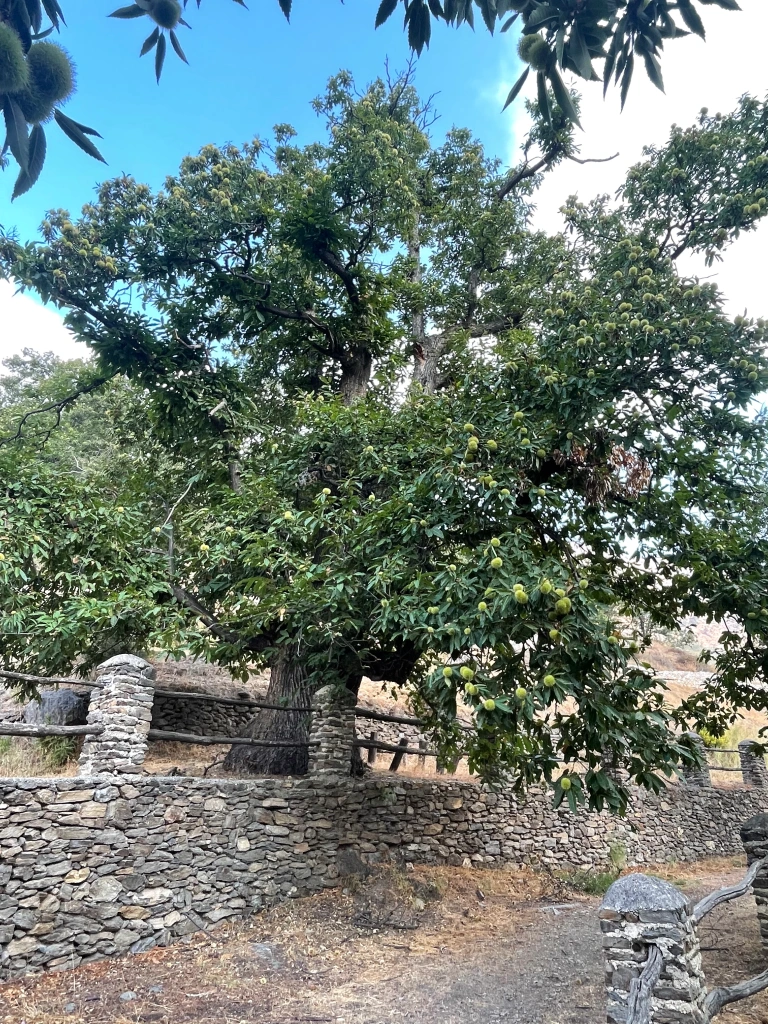
After that, just a long contour on the opposite side of the valley, always along the acequias. These valleys are famous for the chestnut trees, but quite a few of them had died, whether from old age, or ironically from lack of direct rainfall in such a well-watered area, no one knew. Below, a herd of a hundred goats was resting in an enclosure.

Proceeding along a dry acequia

Descending towards Lanjarón we passed quite a few mountain houses with splendid views to the south. Near one of these a couple of kittens ventured out as we passed by. They were probably in cat adolescence, not fully grown, but not so tiny. But the remarkable thing was that when the group paused in the shade a bit further down, someone noticed that the kittens were pursuing us. Completely unfazed by the size of the group they came tumbling down the mountain path, about 300m from the house. Someone produced slices of ham which they devoured quicker than a robber’s dog. We had some difficulty in shooing them away when we continued.

There is no doubt that kittens at this age are very entertaining. Recently I have only had the street cats which my neighbour feeds to contend with, leading me to describe cats as ‘soulless beasts’, which a friend found very amusing, but is based not only on the experience of these very suspicious and untrusting street cats, but also on a lifetime of keeping cats. But these ones were most amiable, exploring, tails in the air, not minding being picked up, but wriggling free; the best word I can find is sparky! That is for me ironic, as the first cat I ever had was called Sparky, so maybe this is an ancient neuron sparking alive again!

Well, the definition of a good walk with the Senderistas of Archidona is that it will be about 20km long and involve some thousand metres of ascent, and that at the end you will have bruised toes, some blisters on the heels, aches of various kinds in the legs, a light sunburn, eyes smarting from the bright light, and a limping gait. Most of all you will deserve a hot bath, and the following day you will only be able to hobble about. On these criteria, this one was a success!

Finally we were on the outskirts of Lanjarón and instead of the usual visit to a café for refreshment, we sat on a ledge and filled our bottles with cold water gushing out of a pipe into a stone trough. It tasted good, and any doubts about whether it was potable disappeared when a succession of locals came with five litre bottles to fill up.

At last some of the ladies decided to take off socks and shoes and bathe aching feet. This provoked a terrific critique from a stout elderly lady who had arrived to fill her bottle. The essence of this was that it was vulgar to wash ones feet at a source of drinking water, even though no contamination was taking place. It became endless and over-heated until Mario, our leader, told the lady concerned that her vituperation was being directed at his mother, and that it would have to stop. It did.

It is interesting how memories from walks in the past can suddenly well up. I remembered how once in the summer holidays in my first school in Lancashire, the deputy head and myself took a group to the Glen Shiel area in western Scotland. At the end of a hot and tiring day, one of the boys complained: “My feet are knackered, my legs are knackered, my back is knackered, my shoulders are knackered, my eyes are knackered ….”

My reply:”I wish your tongue was knackered!”

I have come to enjoy these outings. All the walks are pre-tested by the monitors. It is safety first, and a good first aid kit is carried. My socialisation has been gradual, but a step along the way, a staging post in unfoldment, a grand complement to a hermitic existence. And like the acequias, so beautifully designed to take advantage of geometry and gravity, life-giving.

chestnut tree

sturdy chestnut tree

Joys of Cleaning

Posted on September 18, 2021March 8, 2025 by ianraitt

Contemplating the emotions and sensations around our normal reluctance to get going on cleaning the house, brought up some memories of my time as a professional cleaner. Short as it was, there were lasting lessons.

The years of travail in mid-1970s Edinburgh partly revolved around the lack of a career plan, but as with current cleaning, needs must, so one had to find a job of some sorts. The Edinburgh Cleansing Department, maybe now inflated to Department of Environmental Health, wanted street sweepers, given mock dignity by the euphemism of Street Orderly. I had my cart with a dustbin, two brushes, one consisting of twigs bound to a pole, and a shovel. And each of us had a beat. The depot might have been in the Grassmarket, from which we would spread out to cover the central area of town. I remember working in the Royal Mile, and also at the West End, scanning for the dross and muck of city streets.

At the time, I was making tentative moves to improve a semi-ruined property rashly bought with an inheritance, and had approached an eminent architect who specialised in restoration of historic buildings. The eminent architect was passing by the grand Caledonian Hotel, as I was patrolling with my cart, clothed in official Cleansing Department uniform. Saw me, recognised me, eyes met. But ne’er a word of greeting. I mean – could have been a bit much to have expected him to stop and say:”Well, Ian. Keeping things in order! I knew you were interested in Conservation, but here you are keeping Edinburgh clean as well!” Then again I could have hollered at him: “Iain …” that was his name. “What brings you to these parts?”

Apart from the invisibility and tedium of a low status job, there were cold, brilliant November afternoons, skies above a sharp vivid blue, the wind as a knife. Scalding milky sugary tea at lunch break: hot mince pies, doughnuts.

In those days job seekers would scour the Edinburgh Evening Post. Worn out by the interminable demand Experience Required, I went along to Dario’s Pizzeria on Lothian Road, to apply for the post of Dishwasher. I do have experience. It was great, paid cash in hand, £1.00 an hour. I had my corner, a stool, an array of towels, and two sinks.

I was getting the hang of the dishwashing life, so maybe I could branch out and get an additional part-time dishwashing job? So off to interview in an Italian restaurant in Leith Walk. The owner said: “All the other dishwashers are women. You wouldn’t fit in. But I’ll take you on as Trainee Chef.”

Didn’t take up the interesting offer, because I was about to go back to University, but it illustrated that humble anonymous jobs might lead to something. The many students I taught over the years didn’t always appreciate the great discovery that every form of work is a form of service.

The dishwashing career ended when I became a night porter in a hotel (yes, more cleaning too!), while attending University during some of the waking hours, which would allow me to take up teacher training in Religious Education the following year.

Very happy in that dishwashing job. Had just started on a spiritual path that combined the teachings and the contemplation practice searched for since mid-adolescence. One of the books someone told me about at that time was The Practice of the Presence of God by Brother Lawrence. He was a lay brother and they gave him humble work tasks, including dishwashing. Despite lowlier status, he attracted listeners; he radiated something, and these conversations evolved into this now famous text.

At the interview where I gained my first teaching post, one of the school governors said:”Street Orderly? You really had to do that?” (shakes head)”Yes, Sir. I did”.

But it was dishwashing that started me on the up and up, and not only in outer career, but inner appreciation. I’ll never forget it.

The Joys of Cleaning the House

Posted on September 17, 2021March 8, 2025 by ianraitt

There must be some irony in this title, surely? It is an activity perfectly designed for procrastination. I’ll do it tomorrow, or sometime later this week. An activity also started when things are truly desperate; it is, as in chess, a forced move, when the King has no alternative but to move to a certain square to get out of check, for example when visitors are about to arrive. And the joys, if there be any, are rather in the result, rather than the activity itself, you may surely claim.

Certainly, a sense of virtue steals over one, when the deed is done, or rather the process has finished, another battle against the dust has been won, even if the war cannot ever be concluded. The virtue is linked to the defeat of inertia, as well as the sense of cleanliness, even if is fleeting. The house glows, a little.

One of the reasons for this, is that a kind of metaphysical levity has entered the home. (What?) Yes, it is because of the attention energy, you see. It is not just because you have “gone over” all the surfaces, but that you have given attention to the objects that clutter all homes, and this is being reflected back. Everyone likes attention, and so do the apparently banal blocks, items that are arranged, stored, around our houses, called furniture and other names. Carpets are especially pleased with attention, other than footprints. They get a thrill from being shaken.

So, for a short while, we can relax. We did our duty, possibly avoiding those judgements from visitors, and also we participated in the afterglow, consisting of a victory over our inertia, a victory in the on-going dust war, and a chance to bask in the reflection of the attention energies coming back gratefully from our objects.

But what of the process itself, isn’t it tedious, time consuming, the very reason why we put if off so readily? This is where our attitude comes in. If only we realised how much the house likes to be cleaned, we might do it more often! Yes, it is common sense that the longer you put off the task, the grubbier the place will become, nothing to do with attention energy, you say. Agreed, but you can come into an agreement to share your attention just a little more frequently.

Aids to this process are, of course, a Dyson V 11 Absolute Extra and a good pair of noise cancelling bluetooth headphones. Part of the stress of traditionally vacuuming was the noise: listen to me, how hard I am working to clean this house which you keep neglecting, it huffed. Now, the Dyson is so quiet that you can use this cordless wonder without headphones and not feel stressed, but the headphones transport you to a new recording of Chopin’s Scherzi played by Seong-Jin Cho (streaming from idagio.com). The Dyson provides a good feedback loop as well, as you can see what has actually accumulated in the collection chamber, from the innocent looking floor tiles that were actually hotching with dust, crumbs, hairs, skin fragments, all imaginable detritus, and the tiles themselves are crumbling into dust.

Now comes the bit that I actually enjoy: swabbing the decks! Really. Yes, because the mop aborbs any latent resistant particles, and the tiles really change colour pleasantly during their humid phase, and the speckless pristine floors gleam. Tell me this is not a good use of attention energy! It is a good counterweight to any dusty country, like Spain, that with tiles and movable rugs, you can get a sense of fresh surfaces, even for a day or so.

There are opposing cleaning tribes. Probably some readers will recall Quentin Crisp’s approach, which was that after five years there can be no point in dusting, as nothing will change. But he had a strict rule about picking up organic matter that fell on the floor. On the other extreme are cleaning obsessives, who might get up from a conversation and reach for the Bang as they have seen a spot that shouldn’t be there. And a word of warning: the vast array of cleaning materials are to be used cautiously, since there is evidence that inhaling all that stuff is not good for the lungs over time.

Once I shared a top floor flat in the Marchmont area of Edinburgh, typically with about another five students, heavy tenements all with bay windows to keep tabs on who is out and about and passing below. Of course, there must have been disputes about whose turn it was to clean the kitchen and bathroom and hall. The opposing flat on the top floor was occupied by a lady who lived on her own. Whenever I had occasion to knock on the door, one looked into an immaculately kept hall with a dark shiny antique table and vase filled with fresh flowers. Once I asked, well how do you keep the house looking so sparkling? Oh, I just do a little dusting, whenever I have a moment. It looked as if it was dusted every half hour. You see, the attention energy hit me in the face!

Balance is needed. Too much attention energy going out from our bodies leaves a deficit where it matters, the inner growth area. So, yes, we must keep the house in some order and cleanliness. This is why minimalism has become somewhat popular too. But that is another subject. How to reduce the clutter and bring order to the inner environment in the house (as well as the inner being).

Snow over Scotland

Posted on February 11, 2021March 14, 2025 by ianraitt

Every childhood winter was spent in a frenzy of longing for snow to fall. Granny said that it would snow if the clouds were tea-coloured. I would pester her: “Granny, is it going to snow?” But sometimes she would say with finality: “No, it is too cold for snow.” What law of nature, what observation, lay behind that statement of inherited generational wisdom?

I learned to watch the skies and had a regime of taking the air temperature four times a day. A maximum-minimum thermometer hung on the fence outside the back door, recording rises and plunges with its thin slivers of metal inside the glass tube. You magnetically drew these back to the current levels, observing the tide of mercury expanding and retreating. 34 degrees Fahrenheit, two degrees above freezing point, usually produced snow, whether the temperature was rising or falling. I would write entries in a ledger on the daily weather conditions, and note the barometric pressure too, pretending to take a scientific approach; and though nothing was ever done with the data, I became a snow observer, a snow steward, a snow celebrant.

Snow covered road near Aberfeldy, February 2021

The weather forecast on the radio at 5:55pm became the passionately awaited moment. On television, the Sunday afternoon , a BBC programme, “Weather for Farmers and Growers”, gave the five day Atlantic chart future. Moods, almost bipolar, would change depending on the probability of snow ahead. Snow was forecast, at least on the hills, when a strong blast of wind came from the north west or the north. But the most lasting and stable conditions for snow depended on a strong east wind, generated by high pressure over Scandinavia, and low pressure in the Bay of Biscay, bringing frigid air all the way from Siberia.

I had another motive for wanting it to snow: I had started skiing, and went to the Cairngorms in February half-term, and also at the weekends to Glenshee. While the commercial development of skiing was getting underway, the doyen of off-piste skiing in those days was Valdemar Axel Firsoff (V A Firsoff), whose book, published in 1949, had almost instant classic status: The Cairngorms of Scotland on Foot and Ski. He described his ski-touring explorations of the high Cairngorm plateaux and possible descents of remote corries on ski, using skins attached to the skis in order to climb up.

One of his sayings was: The Devil is not as black as he is painted. He used this to justify his habit of solo climbing and skiing; he was a loner. Received wisdom meant that this was quite risky, so ´the devil´ was the great danger of going it alone. As I was a bit of an evangelical Christian at the time, I found this idiom to be quite intriguing. I also found Firsoff’s accounts to be so inspiring that I started to study the map of the Cairngorms National Park, and became an armchair expert on what might be done. Later I would make some forays into the hills in winter, but not on skis it must be admitted.

Looking at the long list of books that Firsoff published, it is also intriguing that one of his interests was astronomy and cosmology. He was an amateur astronomer and may not have had formal training in these fields, but he was a prolific publisher of popular science books that speculated about the universe. This was quite unknown to me at the time I read his Cairngorm books, but it resonates now. I used to state a bit pompously at the age of ten that I was going to be an astrophysicist. His enthusiasm and dedication earned a mention from Patrick Moore at the time of his death in 1982. [http://adsabs.harvard.edu/full/1982JBAA…92..139M]

My appreciation of Mr Firsoff deepens. So, he was an amateur astronomer and a speculative cosmologist, who loved mountains and rocks. I had started a geology collection in the garden shed. Was he maybe of Norwegian descent? He did work as a translator of Scandinavian languages. However, he was born in the Ukraine. The long solitary walks I took during adolescence also tied in to those future forays into the Cairngorms. Mr Firsoff may have walked and skied alone, but he certainly took this reader with him. Meanwhile, from the small bedroom in Needless Road, Perth, I looked north past the apple tree and yearned for precipitation of a whiter variety.

Snow covers a building near Braemar – February 2021

Langtang in Winter. Conversations we had on the trek: the pot cannot call the kettle black.

Posted on February 9, 2021March 15, 2025 by ianraitt

A trek is not just a geographical displacement; it is always a change in consciousness. Here is where it started, in Dhulikhel, just outside the main urban area of Kathmandu, in the early morning haze.

Hazy early morning view of the Mahabharata mountain range from Dhulikhel

The discussion of this haze, as part of a massive bank of pollution from the North Indian plain and how it had invaded the air space all the way to the border with China, and how you had to climb to about 3800m to get completely out of the sea of particles, was part of the discovery.

Knowing that we would walk over the site of the destruction of Langtang village in the 2015 earthquake, we reminisced about another disaster in recent years, the October 2014 snowstorm on the Annapurna range. In the peak trekking season, when the monsoon is over and the weather is usually dry and sunny but not yet too cold, trekkers flock to the Annapurna circuit, with its high pass, the Thorung La (5415m). The snowstorm was caused by a tropical cyclone which formed in the Andaman Sea and progressed over the Bay of Bengal gaining in intensity. It moved in a north westerly direction towards Nepal. It was recognised and expected in India, but there does not seem to have been any early warning system in Nepal for trekkers in the way of the storm.

I used to check satellite photos of the Indian subcontinent published by the meteorological office in Britain. I distinctly remember observing the very pronounced depression (Cyclone Hudud) and seeing it track into India. It was clear that it would go on towards Nepal and only be drained of its energy on the sheer walls of the Himalayas, but at what cost?

Sitting in a comfortable room (at that moment I was working in Cajamarca, Peru) I could have sent a message to Nepal. I could see the storm making its unexpected journey to the mountains. I did recall that there can be very late storms in October or November. I remembered that the Arabian Sea or the Bay of Bengal can produce these spontaneous tempests at almost any time in the year, certainly outside the monsoon. Probably one assumed there could be a warning from the Nepali authorities.

Unlike an earthquake, you can predict the weather at least three days in advance with some certainty, but there was no awareness nor communication with the Annapurna area, and the trekkers became trapped in conditions which saw almost two metres of snow arrive suddenly at a time of year when this is not at all expected. At least 43 people died.

Madhu and Bishnu have a nephew, Anish, who was a porter on the Annapurna trek during the storm. Somehow he got over the Thorung La, arriving at Muktinath with his group very late at 9.00 pm. But one of the porters did not survive. The intensity of the storm was local. Canadian friends of Madhu and Bishnu were in Langtang at the time, where the only signs of the storm were snow flurries and wind.

Another area that has seen avalanches after unseasonal snow is the upper part of the Annapurna Base Camp trek. On an earlier trek here, we came across a former trekking guide sitting on a wall, crutches beside him, with a tin for donations. Both his legs had been amputated below the knee after he had been trapped in such an avalanche. The cause was an unseasonal November snowfall resulting from one of those sudden storms funnelling up from the Bay of Bengal. Madhu mentioned that in the last month there had again been fatalities on the ABC trek, again due to the unforeseen instantaneous avalanches from above the sheer enclosing cliffs on the trail.

Risk management is a concept used to control the effects of unfortunate events. In the context of these disasters, some measures can certainly be applied to mitigate earthquakes, and the sudden onslaught of bad weather. But a more insidious danger is breathing polluted air, especially for the developing brains of young children, and for the accumulated effect on adult lungs.

Brick kiln emissions near Bhaktapur, Kathmandu valley

We started the trek in Dhulikhel, where a series of hotels has been built on a ridge facing the long mountain chain of the Himalayas, to celebrate one of the greatest views in the world. But now, in the viewing season after the monsoon, the air is never as clear as it used to be, the local Kathmandu valley pollution being amplified by the North Indian pollution. The mountains often remain obscured. Nepal is at the mercy of its larger neighbour in this respect, and this is now being recognised and documented.

https://www.nepalitimes.com/here-now/how-transboundary-haze-affects-nepal/

At present the pot cannot call the kettle black, unless Kathmandu becomes irreproachable and stainless in the matter of its air purity.

Dhulikhel: delicate clouds float in gentle afternoon light, the air a bit clearer now
Prayer flag in clear air: Tsergo Ri

Langtang in Winter

Posted on February 8, 2021March 15, 2025 by ianraitt

Day 0: Wednesday 12 February 2020
There was a window of opportunity in February, before work obligations in the spring. Covid was just starting its march across the world. Could there be a quick trip to Nepal, as the recorded cases of coronavirus were so far tiny? A convenient short winter trek would be Langtang.

Memory is unreliable. Had I done this trek in January two or three times? I recalled twice ascending Kyanjin Ri (4774m), an outlying peak above the Kyanjin Gompa, the last settlement on the trail. The second of those ascents had been accompanied by chest pains, warning signs of altitude stress on the lungs. The ascent from Langtang Village to Kyanjin Ri is 1344m, which can be too much in a single day, especially as the overall ascent in the Langtang trek is rapid.

I had inflated to three the number of previous visits, a common ego problem: exaggeration! The third unconfirmed occasion was a trip for grade nine students which I had organised but not accompanied. The chest pains on Kyanjin Gompa were during another later school trip. So: this new trek would be the third one up the Langtang Valley.

The trek would be familiar, but could it reveal something? What new vistas would open up after a successful climb of Tsergo Ri (4984m), the peak that dominates the views on the upper part of the valley trek? The students on the earlier trek had been willing to try the peak, but it had been safer not to go up: in January it was snow-covered, not all had suitable boots, and the icy nature of the ascent and descent could be risky. Now, it would be feasible.

No journeys in Nepal can be made without commenting on the state of the roads. Every village wants a new motorable road. But often these are bulldozed in without thought of the likelihood of landslides in the monsoon. I remembered some massive landslides on this road, and the vertiginous mountain-hugging path the road would take. It caused some nervous moments when taking the students up to the start of the trek at Syabrubesi.

Road blocked by overloaded truck with broken axle: after waiting three hours – let’s walk!

Now this road was being improved with the aid of Chinese grants, as it connected with the border and could be used to enhance trade, so we made quite good progress on the widened stretches. But after lunch we came to a long queue of vehicles: a truck heavily laden with cement had got stuck in mud and no one could pass in either direction. After some three hours waiting, I said to Madhu and Bishnu, “Come on, let’s just walk to Dunche. We don’t need to get in to Syabrubesi. And the following day we can go over to U Kyang, the Tamang village.”

It was a gentle walk of about 10 km, and we even got a short lift on the school bus, though we had to get out in order to register at the entrance of the National Park, where rucksacks had to be unpacked. The soldiers were particularly interested in whether we were secreting drones, which are prohibited. The bus had the rules of transport written on a whiteboard at the front, with such recommendations as: Remember, you are on School Bus. Take your seat and do not talk loudly. And finally: The harder you work, the luckier you get. On the path we could see a hardy goat devouring aggressive looking nettles, its leathery tongue lashing the leaves, relishing every bite.

It was a cold, damp evening when we approached Dunche in the last light of day. This town is the starting point for the ascent to the sacred lakes of Gosaikunda, and sees a massive influx of pilgrims trekking up to the abode of Shiva during the festival season in August. But now it was relatively quiet. I think we were the only guests at one of the roadside hotels on the main stretch of the town.

Approaching Dunche village – hazy air showing winter pollution from north India and the Kathmandu valley

Gokyo to Everest Base Camp: returning to Salleri

Posted on October 18, 2019March 15, 2025 by ianraitt

Sunday January 13th, 2019.

Amazingly this is Day 18. Coming down is all part of the experience, and allows a retrospective contemplation, but while most trekkers stop at Lukla, and then take a plane ride back to Kathmandu, with more time on our hands we have elected to walk out to Salleri, the way we had come in. Today is quite a long day and we only reach a village beyond Phakding, and  close to Lukla, by dusk.

A4AB2C4F-5809-4FF2-A70E-F0372A04F4A6
Evening scene near Lukla

Somehow Madhu has found a homestay, rather than a trekking lodge, so it is very pleasant to stay in an actual house, which has a great deal of good quality wood on the first floor as partitioning walls, and the base of the house is in handsome stone blocks. However, this is a rebuilt house, as the area was affected by the recent earthquake.

While we wait with anticipation for the evening Dhal Bhat, I notice that in addition to a gas ring in the kitchen, there is a wood burning stove-cooker, but that the lady of the house is operating it with the door open, feeding logs into the glowing interior. I comment that it would use less wood and probably be hotter if they just closed the door, but there is attachment to old ways, maybe she feels she has more control over how fast the wood will burn by delaying the push of the log in further. Well, I have said my piece; whether it changes anything, as often, I won’t be here to see.

Monday 14th January, 2019: Lukla to Bupsa

Certainly, if you don’t fly out from Lukla, there is no alternative but to keep walking! And today we are reminded that the way in was very much up and down, and the reason for this is that the north-south watercourse of the Dudh Khosi is intersected at right angles by many deep valleys whose east-west tributaries flush down from the heights and cut deeply into the landscape, making the trail an equal challenge of ascent and descent in either direction. But now, at the end of the trek, anticipation of some rest is in conflict with the continuing effort, and familiarity certainly does not breed acceptance!

6039D3A7-77D3-4AA5-B3C4-26654BEE5FBF
Transverse valleys cut into the Dudh Khosi river

Many mule trains meet us. They are bred in India, and the going price is $1300. A hard life, being a mule. One section of the trail is very slippy with mud and droppings. A slip here and you could go over, so mules must be given right of way. They may be unassertive, but they are heavily loaded, and take the route their feet dictate, so could swing against you in unexpected ways.

We spend a very long time waiting for lunch, during which the lady of the lodge upbraids her teenage son, presumably for being idle and spiritless both at home and at school.  On the trail a mother asks if her daughter can walk with us, as even in this region an unaccompanied female might run a risk of assault apparently, though at the top of the pass before Bupsa, on familiar territory, she sprints off energetically on her own. The light fades and then we approach Bupsa in the dark, and I can’t help complaining a bit to Madhu, pointlessly, which he gracefully ignores, and when we reach the same lodge we stayed at on the way up, there is no one else there, so they have not put on the heating. Cold, so quick to the sleeping bag.

Tuesday 15th January, 2019    Bupsa to Nunthala

Madhu has had a shower this morning, whether hot or cold I don’t know, as today is a festival day when the people eat yams producing heat in the body, as well as taking this ritual purification by water. But at least it feels warmer now in the sun at this lower altitude.

Another very long day, and the trail is in shocking condition in places, clearly the result of the incessant mule trains on the go. The carefully constructed stone steps have broken up, and there are huge sections of dust and decay. And a new road is being bulldozed down near the bottom of the valley, and the idea is to take this to Sirte, below Lukla. It seems that the one urgent undeniable request of all the isolated hill communities is that they should have a road, so that these roads criss cross the ridges of Nepal, and are clearly visible from the skies, lacerating the green spaces. But in this case, it might have some logic due also to the very heavy expedition traffic, but heaven forbid that any road should go on further from Lukla.

The lodge in Nunthala is again unheated, and we are the only visitors. However, I’ve decided that this is the end of the trail, and that we can get a jeep to Salleri, avoiding a tough climb up. However, there is no booking system, so we have to wait until tomorrow to see how this will work out.

The next day there is a long and uncertain wait in the morning but finally a jeep will be going. I speak with other trekkers who have also decided that this is the end. The road is packed earth in mostly good condition. Once over the top of the hill, the landscape again looks familiar. This is now day 21, so we have done almost three weeks on the trek. Once in Phaplo, near Salleri, Madhu directs us to a small lodge on the main street whose owner he knows, and we are soon enjoying hot samosa and noodle soup.

7B666A51-E1EA-412A-84A7-0B9CA5111691
Wintry scene: looking back at the mountains of the Solukhumbu

Winter: inwardness, preparation, recuperation. Looking back at a mountain kingdom, a fastness, with that blur of mysterious precipitation, be it snow, hail or rain. Winter: a very good time for a trek in the Solukhumbu.


Gokyo to Everest Base Camp (part 2)

Posted on October 16, 2019March 15, 2025 by ianraitt
5508FB11-2D49-4811-A12B-5CC8CE27E61D
Temba on the trail returning from Lobuche

Lower altitude permitted some sleep last night. It is snowing, and all views have disappeared, only the sense of the gulf down to the river. Quiet, with that sense of mystery and stillness. After a steep rise, the path is contouring round. A yak follows us. There are footprints in the snow, but surely not made by a snow leopard? Madhu thinks Temba has made them with his trekking pole. It was fun though, the thought, while it lasted.

D3409141-581B-4670-A978-3BB71558A0E5
The fake snow leopard prints

A yak follows us. We come across a group of sheep, scampering on the edge of a cliff. Madhu says that they gather in such areas for defence, against a leopard, for example.

785DB299-6B0F-4D3C-931D-F8460ED0C01C

F714D710-6E84-4CFE-86DB-FBC0139E285F

Lunch is at Somare, and the wait feels very cold when you are not moving. On to Pheriche,  the lodges mostly empty and deserted. At night, there is no electric light as the dull day has not allowed the batteries to charge up, so candles illuminate the long corridor, clearly a fire hazard in the wooden building. A bleak place in this weather, like being stuck in a Scottish glen in winter. 

Tuesday 8th January 2019 Pheriche to Lobuche

The morning, however, is radiant again, all the more welcome after the mist, with the mountains jagged and striking, and a fairly gentle ascent to Dughla, gingerly crossing a frozen river before enjoying a hot drink in the sunshine.

F7C9FDDE-29F9-4237-9490-62112826AA94


86980BF8-6DEE-4668-AFA9-921C92C9DF5F

We speak to someone who had suffered from altitude sickness the day before, and is now waiting for the others in his group to come down from their attempt at Kala Pattar (5546m). He is Australian, his father is ethnic Egyptian, his mother ethnic Greek. There are quite a few groups of Australians here, as January is the summer holiday. But despite the implied warning about AMC, after resting I announce to Madhu that we can go on to Lobuche. Maybe it turns out to be not such a good idea, as we shall see later on, but I thought that Lobuche was in the plan for today. In fact, we have gone faster than planned, on the whole trek, but it seems without rushing, and surely we are already acclimatised?

But there is pure exhilaration on reaching the top of the pass with the sense of openness, light and joy, and being a very high place, in a circle of mountains, and far away from the human world. We are going to stay the night in the Pyramid, the Italian research station lodge. It is a bit warmer, as there are two layers of glass on the windows.

071DF2CE-66B9-4A2D-A596-5EDC6BA01CC1
Breaking through into the Everest area at last

Wednesday 9th January 2019 Lobuche to Base Camp

A slow climb to Gorakshep. It is misty but the mountains are visible.

39C00284-114F-44C3-9124-03E2CA0AA320
Gorakshep at the edge of the shrinking glacier

We soon see down below the lodges of Gorakshep, clustered together for mutual support in the high desert. And onwards to the base camp after lunch, quite a scramble as the rough path is often through boulders.  Up and down, and certainly still up! No activity at this time of year, and at least it has been cleaned up, though the spring onslaught is not far away.

2C942FDF-A363-4B68-9331-4EBBA79E8FDE
The icefall from Everest Base Camp

The glacier below has vast ice auditoriums, but all covered in grit and stones. You can see earlier marks where the glacier has been much higher on the hillside. The icefall is clear of debris, all white. We hear the explosive sounds of an avalanche while returning.

Sun warms the lodge a little. A breeze startles the wind chimes into melody.


Thursday 10th January, 2019. Kala Patthar

This is the day. Another cold night and not much sleep. It looks straightforward, but a slog. Very few people out on the hill.

A9B35C1A-E1E7-4F4F-B4D6-3C4E8C41D63E_1_201_a
Going up Kala Patthar

No energy, but at least no headache. Stopped a couple of hundred metres below the summit.

It was probably the correct thing to do, as it took an hour to recover in Gorakshep, with complete weakness but still no headache.  A bit dizzy on the return to the Pyramid in Lobuche that afternoon.

Friday 11th January, 2019  Lobuche to Pangboche

Another splendid morning, and the comforting thought of descent. At the top of the pass there is an elegiac atmosphere, as there many memorial cairns for deceased sherpas.

4A24EAC4-9523-4605-8BF1-42B59A96A5D1
Sherpa memorial cairns

After tea at Dughla, we take the high trail to Dengboche, a wide trail, with many variations.

AFF3ED6B-4056-46CB-A29B-6653C41AA746

You can see the village below finally, and there is a sense of the very modest amount of flat land having been consumed by the building of the lodges, a reminder of the question of how to balance the economy of tourism with the fragile environment. One trekker we met suggested that there were too many yaks for the landscape, but maintained due to the need for yak dung as fuel,  but now denuding the soil and pasture.

D4E224FC-FA5E-4674-BC00-BB77D8A61E58
Looking down at Dengboche

Saturday 12th January, 2019   Pangboche to Namche

There are dogs on the way, who sometimes will accompany you to the next village. They respond to friendly words, but are not used to overt affection. Himalayan Hounds … looking quite well-prepared for the cold.

633CA054-DAEA-40F4-98AF-DF2A896B6E95_1_201_a

We can see on the other side of the valley the way we had come from Phortse, in the snow, but now the snow has rapidly evanesced in the January sunshine.

2E36C93D-0C27-4BA5-B937-42F6C61AB6DD

The familiar amphitheater of Namche comes into view again.

4F285D95-E9F6-4A3E-B3CC-3B9838A3387C


Gokyo to Everest Base Camp (Part 1)

Posted on October 15, 2019March 15, 2025 by ianraitt

5th January 2019
A gentle sense of achievement flushes the veins, as in the bright air we start to descend: there will be scalding soup at Gokyo, and in gradually waning afternoon light, views will open up besides frozen brooks. Colder air, wisps of mist condensing, calm silence; only busy ducks will forage in the waters of a still unfrozen first Gokyo Lake, as the icy fluid sluices away underground, gravity-led, to the surging river below.

A4ACECE3-3A83-4C80-863A-C87752FF1C03
Leaving the unknown region

There’s a memory of Scottish winter afternoons, light fading at 4.00 pm, walking in the gloaming, cheeks glowing in cooling air, anticipating pleasure in the warmth that returns once inside. Now mist wells up in thickening waves and all perspective is lost as we negotiate a narrow staircase in the descent. Then the rays of the sun illuminate the peaks above the mist just before it drops below the mountain chain for the day.

In the lodge at Machhermo, the lady of the house has a baby that she fondles constantly, showing the importance of touch, and she uses sound and chants to captivate, soothe and reassure the swaddled entity.

Another difficult night as it is still hard to sleep, and the ten hour period from 8.00 pm to 6.00 am is rather like being in a cell,  and the sleeping bag can feel like a straight-jacket. In the morning it is impressive to see the yaks who live outside in the cold of night stirring gently in the morning air, breathing.

6th January
A beautiful walk down, with a glorious perspective, and the knowledge that we came up this way, so patiently.

29440FBE-AE8C-481D-8BB0-F36F56B07CB4
Clear morning air on the descent

Once again in the forest: rhododendron, pine, juniper, birch.

317092F3-CC9C-4C08-BD15-DA5022E88046
Entering the forest. Pheriche on the hill in the middle distance

Pheriche is a working village perched on flatter land whose edges are eroding. We arrive after a steep climb up from the river, to thickening clouds and the chance of snow the next day. Potatoes are huddled under earth mounds awaiting the spring planting. Nothing is open, but finally we find Thamserku View that will take us. You realise that if you are going to build a house here, you might as well build extra accommodation for trekkers. Now we are the only guests, grateful again for the stove.

A1E6849C-F03A-4045-8F21-CF48C36F471D
Tea around the stove

Toward the Unknown Region

Posted on January 28, 2019March 17, 2025 by ianraitt

This eloquent title belongs to a poem in Walt Whitman´s Leaves of Grass. It begins:

Darest thou now, O Soul,
Walk out with me toward the unknown region,
Where neither ground is for the feet, nor any path to follow?

The epithet ´unknown region´resonates, challenges. This is how we may feel at the end of the trail up the Ngazumba Glacier, three hours up from Gokyo village, as we look out at the wilderness and realize the difficulty of going any further, toward the unknown region.

img_5734

How jagged and proud the mountains stand, in the midst of dissolution, constantly crumbling. Here, cloud-shrouded, is another perspective on Everest, dark shape in the centre, the glacier in the foreground smothered in rubble and gravel.

img_5743

According to Wikipedia (https://en.wikipedia.org/wiki/Gokyo_Lakes):

Gokyo Lakes are oligotrophic lakes in Nepal‘s Sagarmatha National Park, located at an altitude of 4,700–5,000 m (15,400–16,400 ft) above sea level. These lakes are the world’s highest freshwater lake system comprising six main lakes, of which Thonak Lake is the largest.

dsc00328

They are also a focus of Hindu devotion especially during the festival of Janai Purnima, usually falling in the month of August, when about 7000 devotes visit Gokyo.

After a hard climb the day before, we reached the summit of Gokyo Ri, 5483m, which affords clear views of the Everest massif.

img_5721

A dust storm raced along the glacier. Can´t blame Delhi´s air this time.

img_5724

Then we´re on the way out, light fading as we move down towards Machermo, cheeks glowing in the cold, just as you remember them from cold winter childhood days.

dsc00381

And the unknown region? Walt has dared us, dared Soul. This poem was set to music by Vaughan Williams, his first choral work for massed choir. You can see a performance here:

While it may seem slow at first, it builds momentum to a fine climax in the last four minutes, as does the poem itself. If you like that, then try Vaughan Williams A Sea Symphony, on a much larger scale, also with words by Whitman.

Here is the poem. I think it is clear he is talking about the translation from the earth plane at the time of death. I may demur at his acclamation of Time and Space though – isn´t our final destiny above? –  but there is no denying his examination of our reluctance and fear and ultimately our exultation.

Toward the Unknown Region (from Leaves of Grass)

Darest thou now, O soul,
Walk with me toward the unknown region,
Where neither ground is for the feet, nor any path to follow?

No map there, nor guide,
Nor voice sounding, nor touch of human hand,
Nor face with blooming flesh, nor lips, nor eyes, are in that land.

I know it not O soul,
Nor dost thou, all is a blank before us,
All waits undream´d of in that region, that inaccessible land.

Till when the ties loosen,
All but the ties eternal, Time and Space,
Nor darkness, gravitation, sense, nor any bounds bounding us.

Then we burst forth, we float,
In Time and Space O soul, prepared for them
Equal, equipt at last, (O joy! O fruit of all!) them to fulfil O soul.

Altibajos …. or the ups and downs of the trek – and its exigencies

Posted on January 28, 2019March 15, 2025 by ianraitt

We have to accept ups and downs, so nicely captured in the Spanish word altibajos. But it is difficult not to resent losing the height one has gained. A particular example occurs up from Namche. After patiently climbing to the pass at Mong, the path descends all the way down to the river, yes the same Dudh Kosi … that now I see actually flows from the famous Gokyo Lakes where we are headed.

But first the trail is looking straight north-east, right up to the peak of Everest. And what is that village so perilously perched beneath the crags? Is it really secure or might  landslides open up on either side where the land falls steeply to the rivers below? It is Phortse, where will we stay on the return from Gokyo. Defiant, stoical people must live on that bleak ledge.

img_5675

But this is real walking, with some narrow corners, some exposed ledges.

img_5680

Do man´s visions last, Do man´s illusions? My illusion was that the trail would just continue nicely contouring up into the Gokyo valley, instead of plunging 400 metres down to the river. Here, approaching the village of Mong, the illusion was still intact. Take things as they come!

img_5681

But we can enact our daily homage to spontaneity, surely? Although we had planned to stay in Phortse Thanka, by the river, we found the lodge we anticipated staying in was closed. Nothing for it, but to continue up to Dhole then, a rise of some 500 metres. Any altitude risk?  … probably not. We passed through magical forests of pine and rhododendrons, skirting the frozen rivers, conscious of passing into a more hallowed land and rarer air, to the sacred lakes.

img_5686

And what about the ¨exigencies¨hinted at, and why the obscure vocabulary? Dear reader, I promise it is not to baffle nor to impress; these words simply pop up from the subconscious river of lexis. I check them for their suitability. Exigencies are the demands of the trek, what it requires, what is urgent and unavoidable.

It´s the cold that is unavoidable, now intensifying each night as we go above 4000m. Yes, yak dung is pressed into service in the stoves, and effective it is too, but there is nothing for it but to return to one´s frosty room at about 8.00 pm, and it´s a long night to 6.00 am. A long, sleepless night, since it is increasingly hard to conk out: one of the effects of altitude.

On top of this, in the small hours I begin to feel claustrophobic in the sleeping bag and fumble to release its constricting chords. Then reassess the irrationality, tighten up again. Repeat. All the time drifting in a half sleep, conscious, checking the watch. If one is lucky, one may have vivid, alarming, surreal dreams, but I have not been blessed so far. All symptoms a result of the thinner air and its effect on the vigilant brain.

Despite the cold, movement on the trail warms you, radiance of the sun splashes you benignly, and you have to take off an anorak and thus walk comfortably with three layers: thermal vest, shirt, fleece.

img_5689

Onward, upward, inward to the heart of the mountains and the lakes, the landscape becoming more extraordinary, wild. How satisfying to see the trail leaping ahead, with the Dudh Kosi river bed stretching into Gokyo, some water still flowing.

IMG_5694.JPG


Take things as they come

Posted on January 25, 2019March 15, 2025 by ianraitt

Should we embrace a teleological view of the trek, that it only has meaning based on its purpose to complete its objective and arrive at the final point, or should we follow that impressive advice of Robert Louis Stevenson, ¨to travel hopefully is a better thing than to arrive¨? Dear reader, you will probably feel that with his Zen advice on trekking, the writer must accept the latter dictum. Already the readers are bristling into armed camps of liberals and conservatives, the conservatives insisting on completing the trek as planned, and the liberals favouring Lao Tse´s flexibility in the face of perpetual change: take things as they come.

Having an objective to be reached in planned stages on the trek gives order, a sense of progression and control, defines proper effort and expenditure of energy, and gives blessed form to the immediate future in the turbulent seas of this uncertain world! But still, the mind will ¨What if …?¨  us, so travelling hopefully is tempting. Altitude might intervene, a snowstorm might confine us to immobility in a lodge, or even on a ledge, some injury might occur.

Early morning cold, brilliant sky, the valley narrowing, and a promise of the new heights and views once we reach Namche. Here we look towards the mountain sacred to the Sherpa people, and thus unclimbable, Khumbi Yul Lha, which towers above the villages of Khumjung and Khunde, above Namche. There is an example in the foreground of two of the many boulders engraved with mantras in Tibetan, chiseled letters then highlighted with paint.

img_5636

And on the trail, quite busy with trekkers, mules and yaks descending, half way up, a first glimpse of Everest through the pines.

img_5637

Namche, commercial capital, calling  trekkers for a two-night stay, with rest day, on the way up, and perhaps for a celebration on the way down in its mini-Thamel section (reminiscent of the famous tourist quarter in Kathmandu), now seems over-built in its elegant nest and horse shoe crescent shape, with some tall tea house residences, where potatoes used to grow in the short summer growing season. Higher up there are fairly newly planted pines to bring stability to the steep hillside. An underground stream gushes out, turning massive prayer wheels, providing a public washing place for clothes, our last opportunity for the laundry.

img_5640

dsc00202

The constant struggle between ascetic and sybarite is resolved in favour of good coffee and apple pie in one of the cafés open, even in this low season. Take things as they come!

The following day is the ´rest´day, as even though we climb up to the villages of Khumjung and Khunde, some 400m, we will descend to sleep again in Namche. There is a sense of peace in these quiet, deserted villages, not only as views on the way open up gloriously in the clear air to the Everest massif, but also because they are homes to two Buddhist monasteries, and in Khumjung the school inspired and built by the efforts of Sir Edmund Hillary and other donors. We walked around the deserted school compound of small-scale and well-built stone buildings, students being on the January break. The monastery at Khunde blends perfectly into the hillside, with a quiet and discrete power. This area is the higher spiritual plane of the area, with Namche, or to give it its full title, Namche Bazaar, the material world below!

img_5667

The landscape is serene, empty and sun-bleached, with a Zen garden feel, each rock a presence.

img_5671

With the cheerful certainty of the dogmatic, I led Madhu and Temba through interconnected and flowing yak enclosures, to seek the way down to Namche, despite their mild, polite protests that the path was much further over. My confident road to nowhere was just an aesthetic preference.

img_5669

But, to travel hopefully is a better thing than to arrive!

Still, it was quite quick to get back to the proper trail down to Namche, very steep; then we were rewarded with a perspective of the blessed, sheltered balcony that cradles the town.

img_5672

Now we are truly on the upland route, one week into the trek. Here with quiet, stoical and steady Sherpa Temba, as Everest looks down with its distinctive plume drawing us upward and inward.

img_5654

Here is that beautiful, thoughtful contemplation from Lao Tzu:

All Things Pass – Lao-Tzu

All things pass
A sunrise does not last all morning
All things pass
A cloudburst does not last all day
All things pass
Nor a sunset all night
All things pass
What always changes?

Earth…sky…thunder…
mountain…water…
wind…fire…lake…

These change
And if these do not last

Do man’s visions last?
Do man’s illusions?

Take things as they come

All things pass

Zen and the art of trekking

Posted on January 24, 2019March 15, 2025 by ianraitt

Sometimes the contrast between the real and painful effort made during the trek and the imaginative mental projection of finally crossing the highest pass, and the way we compensate in planning how to present this ´triumph´to others, makes one think that one purpose of trekking is to bleach out all pretence and vainglory, vanity and self-aggrandizement.

Live in the moment; do not anticipate; obey one´s guide; do not use imagination to falsely elaborate or boast.

Pilgrimages have always been inner journeys as well as outer treks. Perhaps this trek will also produce insight. It is always a departure from set routine, and in this case choosing to start the journey on Christmas Day, is a deliberate dislocation from the Western end of year and new year routines.

On the second night, we met Dave, a lone British trekker carrying only a 10kg rucksack, in the lodge at Bupsa. He was on his way out after having done the Three Passes route (all over 5000m). An impressively fit figure in his mid 50s, he admitted to having trained for three months to get ready for this challenge. After 30 days he was happy to conclude the trek.

I explained that I was uncharacteristically drained of energy at the start of the trek. Why was this? We agreed it was just altitude. Salleri is about 2200m and the first day involves going up to almost 3000m; this is a much steeper and higher start than the Annapurna trail. It had been a surprise having dizzy spells even walking downhill.

A note about the terrain of the walk up the valley: it is the great Dudh Khosi Nadi (milky river) gathering all its tributaries and flowing south from the heart of the Solu Khumbu, that is intersected at right angles by water courses, thus causing the path to rise up and over the passes, the Taksindu La, Kari La, and Chutak La, all about 3000m, then fall down, even as far as the valley floor in Surke below Lukla. This will continue, but with milder variations until a great rise from the valley floor to Namche takes us up into the higher region. Here the perspective is looking north, up the Dudh Khosi.

IMG_5608.JPG

The mule trains are coming up and down, causing us to pause: a mule can inadvertently push you off the path, so it´s best to stay on the inside. A little research about mules reveals that they have some superior qualities than their parents, male donkey and female horse: endurance and pliability. Even so, the shouts and whips of the mule herders are harsh. Meanwhile the beasts seize any moment to pause on the path and leech a little moss from the rocks.

img_5611

Day 3 was a long 20 kilometre day from Bupsa to Chheplung, where the lodge would´t put on any heating except an electric heater that was more light than heat, thus removing a basic comfort that you expect: the yak dung fueled stoves. But Day 4 was a gentler day to Monjo, and a lodge that would have had a full range of coffees available, if only the operator of the coffee machine had been there. But it had a characteristic dining room as sun lounge that became surprisingly warm while the rays of of the sun were on it. Now for the ascent to Namche, the commercial centre of the Solu Khumbu, where trekkers stay going up as well as going down. The river valley is narrower now, and thickly forested, the river a strangely beautiful hue of green and blue, foaming as befits its name, with ice-encrusted rocks.

Though I have recovered from the weakness, now all my leg muscles are screaming, particularly on descents, and at the end of the day I totter upstairs to the frigid bedroom, feeling this is what age-infirm means and I thought I´d postpone that for another day, perhaps until over the age of 80, and here it is!

Everest Region: to the Gokyo Lakes

Posted on January 24, 2019March 15, 2025 by ianraitt

Beginnings

Exactly ten years ago, during the January school break in Nepal, when I was working in Kathmandu University High School, we planned to do the Everest Base Camp trek. I was intrigued to discover that the trails would be snow free, for the most part, and provided you could stand the cold, they would certainly be empty compared with the congestion of the busy spring and autumn seasons. However, the flight to Lukla was cancelled on two consecutive days due to local conditions, probably low cloud, so we went to Langtang instead (probably an equally dangerous road route … certainly with landslides and vertiginous slopes). But it was good to mature and realize this idea, notwithstanding the time that passed.

Lukla airport has been called the most dangerous in the world, and while not wishing to underestimate its challenges for pilots, it´s worth mentioning that in the busy seasons there are 80 flights a day. Over the years there have been several mishaps while landing, often due to sudden poor visibility, but major loss of life has been limited to one fatal crash in 2008. The upgraded airport at Phaplu, near the district capital of Salleri, may enjoy clearer skies as it is slightly lower. We saw one of those small planes make a perfect landing there, and as at Lukla the runway is steeply angled upwards, slowing the plane on impact, which no doubt compensates for its restricted length; but it is also the flattest land available.

So, I admit that this history influenced me to take a jeep to Salleri, and start the trek from there. It took three days to get just beyond Lukla, not a long addition. Here we can see Lukla on the right, and planes come in from the left, coming up the valley and descending quite markedly. This also shows the direction of the trail, moving directly north into the heart of the Solu Khumbu, as the district is known.

IMG_5612.JPG

One of the attractions of this trek, from the purist and aesthetic point of view, is that there are no roads, at least in the Sagarmatha National Park, but they are encroaching on Lukla. There is a track from Salleri to Nunthala, the first stop on the trail. After the trek, as we returned there, a new branch of this had been added nearer the river. Apparently it will go on to below Lukla. Meanwhile there is a huge traffic in mules, as everything to stock the teahouses, as well as the huge traffic in Everest expeditions, must come in on foot.

As we approached Salleri in the jeep, suddenly the vista opened up and you could see in pristine air, the great wall of mountains ahead: what joy!

IMG_5588.JPG

It seems to be difficult to breathe clean air these days, if you live in a city of any size. Kathmandu seems to be under a permanent haze of pollution, only dispersed to some extent during the monsoon. The hill station of Dhulikhel, close to Kathmandu, where the hotels were built to benefit their customers with fine views of the Himalaya, is now also immersed in this smog, with very rare mountain views. Delhi has by far the worse air quality in the world, exacerbated in the winter months by a pool of static frigid air. Could it be, that since the wind drifts from west to east in the winter months, that this particulate horror has drifted towards Nepal? Here is the evidence of this insidious smog, in a photo looking southwards at the same time as the shot of the pure air to the north (above) was taken.

IMG_5565.JPG

So, we have to come right into the heart of the mountains to get clear enough air!

Khopra Ridge

Posted on November 21, 2018March 15, 2025 by ianraitt

Day 16 – Day 21: Tatopani to Nayapul

We reached Tatopani by bus from Jomsom. This might have been the riskiest road I have travelled on, being beset by landslides and also being so narrow that the buses have to blast out warnings to oncoming traffic to permit a mutual passing place through consensual pauses. Its state is only as good as the temporary repairs made after the last monsoon. Perhaps there is a plan to make it more stable and secure.

IMG_5299

We were hiking up from Tatopani in the Kali Gandaki valley, when we became aware of the lesser visited trail towards the Khopra Ridge. We accepted the intriguing possibility of exploring it. The lower reaches are through thick forest. These beautiful pausing places where trekkers and porters can rest had been lovingly constructed in perfect harmony with the silvan environment.

The ageless stone paths give reassurance. We are in a landscape of memory. Surely we came here before in our reading of some classic fairy tales?

IMG_5297
This must lead to a mysterious place or portal

The following day we break out on to the ridge, with the huge gulf of the Kali Gandaki valley on one side, and Annapurna South now perceptibly closer. The Khopra Community Lodge has occupied an obvious position.

IMG_5331
Dhaulagiri takes all the attention when looking we look west

A trail leads further up the ridge, though we are not taking it this time.

IMG_5332.JPG
Looking towards Annapurna South from Khopra Ridge

The following day we are walking through pine and rhododendron forest.

IMG_5349.JPG

The dawn walk to Muldhai point above the Dobato lodges the next day is mostly clear …

IMG_5379.JPG
Annapurna South and Machhapuchre at dawn

… for a while.

IMG_5385.JPG
Mist rapidly forms and pours up the valley

We made a long walk out that day, from Dobato Lodge to Ghandruk, and then to Nayapul the following day. Farewell for now, to the varied landscapes and cultures around Annapurna.

DSC00103.JPG
Manang from above


  • Previous
  • 1
  • 2
  • 3
  • Next
Ian, the Scot

Ian, the Scot

A Scot who lived in five continents, now using some free time to attempt some of the classic treks in Nepal, where he lived before. As well as contemplating why we like to move through majestic three dimensional geometry, there could be some reflections on life´s higher altitude.

Subscribe to Receive Updates

Check your inbox or spam folder to confirm your subscription.

Recent Posts

  • Nepal Notes: Demonic trumpets and vivid necklaces
  • Nepal Notes: day hike to Namobuddha
  • Nepal Notes: Animal Welfare
  • Nepal Notes: a wondrous sound
  • Nepal Notes: Christmas
©2026 Be Kind To Dragons